By Li Muzi, Vision Times
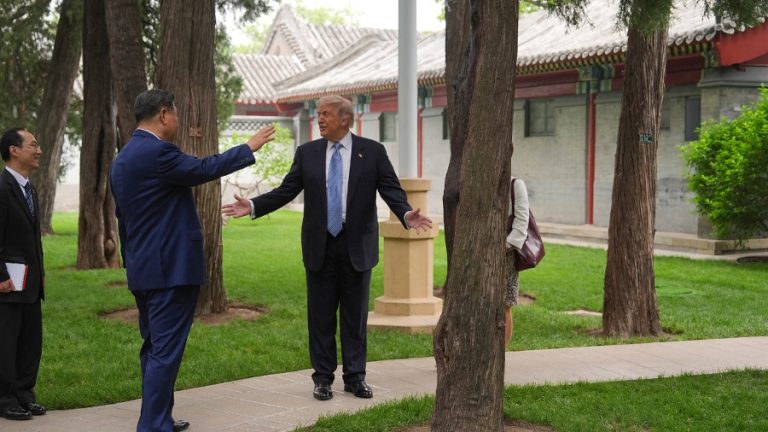
On March 23, Chinese Communist Party (CCP) leader Xi Jinping visited the Xiong’an New Area in Hebei Province, during which he declared that the central government’s decision to build the massive development project was “completely correct.” His remarks quickly drew criticism from commentators and observers who argue the ambitious project has struggled to attract residents and economic vitality.
According to Singapore’s Lianhe Zaobao, Xi traveled to the region alongside three members of the CCP Politburo Standing Committee. During a symposium held that afternoon, Xi emphasized that Xiong’an must firmly maintain its role as the primary location for relocating Beijing’s non-capital administrative functions.
RELATED: China’s Early-2026 Trade Boom Reveals ‘Structural Paradox’ in the Economy: Analysts
Xi stated that the CCP leadership’s decision to establish the new development zone had his backing to move forward and said that work on the project had been “progressing steadily.” However, critics say the development still faces significant challenges.
Questions over Xiong’an’s real appeal
Success
You are now signed up for our newsletter
Success
Check your email to complete sign up
An independent Beijing-based scholar who spoke to Radio Free Asia under the pseudonym Fu Tao said the visit may have been intended to reinforce the leadership’s commitment to the project.
He noted that the Chinese authorities have accelerated relocation efforts in recent years, with many universities, enterprises, and government institutions being encouraged or required to move operations to the new district. “The pace has indeed accelerated over the past two years,” Fu Tao said. “But Xiong’an’s popularity and public expectations remain quite low. Much like China’s broader economy, which is currently experiencing significant deflationary pressure, Xiong’an is facing similar challenges.”
Fu added that Xi’s visit may also have been intended as a political messaging exercise aimed at officials within the party. “It could serve as an example for cadres at the county and department levels to learn from when it comes to evaluating political achievements,” he said. “But the problem is that this example itself is difficult to present as a positive model.”
Another Beijing scholar who studies regional economic development, identified only as Mr. Xiao, offered a similar assessment. “If a city constantly needs policies to arrange for people to move there, it suggests that its intrinsic appeal is still insufficient,” he told Radio Free Asia. “Xiong’an’s biggest problem today is not how quickly it is being built, but whether people are willing to stay.”
A flagship project for Xi
The Xiong’an New Area was officially established on April 1, 2017, and was described by Chinese authorities as a “millennium plan” and a “national priority.” The project was designed to help decentralize Beijing, transferring certain administrative, educational, and corporate functions away from the crowded capital while promoting coordinated development across the Beijing–Tianjin–Hebei region.
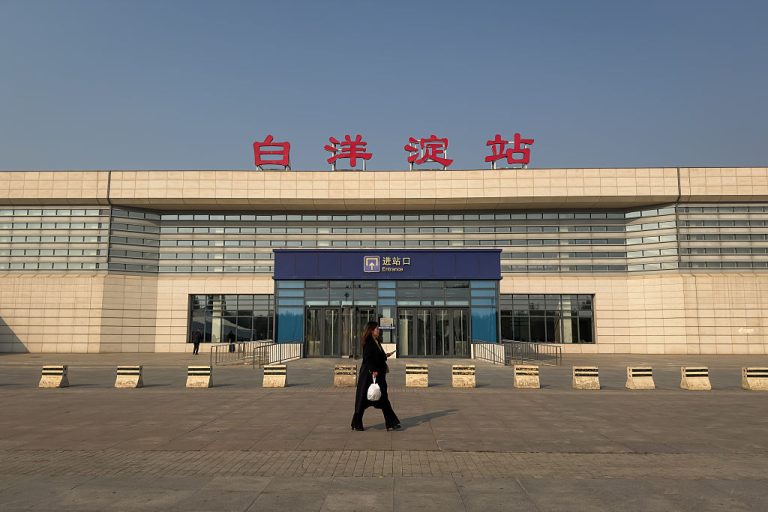
Several large state-owned enterprises, including China Satellite Network Group, China Huaneng Group, and Sinochem, have already relocated headquarters or major operations to Xiong’an. Multiple universities, research institutions, and hospitals are also being built or relocated there. But despite these developments, the city has struggled to overcome criticism that it lacks economic dynamism and population growth.
Commentator “Xin Gaodi” wrote in a recent analysis that while Xi praised the project during his visit, international media and independent observers often describe Xiong’an as a “ghost city.” Wide boulevards and clusters of high-rise buildings stand largely empty, the commentary noted, despite official claims that the area’s population has reached 1.4 million.
Visitors who have shared images online have sometimes described the atmosphere as resembling a “post-apocalyptic tourist site” or a “ghost city of the century.”
Structural challenges
Urban planning experts have pointed out that successful large-scale cities typically rely on several key factors: favorable natural geography, clearly defined core industries, well-researched global positioning, and functional integration with surrounding cities.
According to the analysis, Xiong’an faces challenges in each of these areas, making it difficult to achieve the dynamic growth envisioned by policymakers.
The commentary also notes that while Xiong’an was initially presented as a central government–directed strategic project, management responsibilities have gradually shifted toward Hebei provincial authorities, suggesting a reduced level of direct central oversight.
Observers say that in China’s political system, major initiatives endorsed by top leadership are rarely publicly reassessed, even if results fall short of expectations. Once a project is approved at the highest level, critics argue, it is often framed as a success regardless of mounting costs or mixed outcomes.
Netizens react
Xi’s remarks also triggered discussion on social media platform X, where some users questioned the optimistic assessment. One user wrote: “He emphasized that it was a decision of the Party Central Committee, not something he personally directed. That may suggest even he feels uneasy about the situation.” Another commented sarcastically: “You just have to read their statements in reverse. During the years when tens of thousands starved daily, everything was also said to be ‘completely correct.’”
Another user named Liu Min criticized the leadership’s economic management, writing: “Xi Jinping holds the positions of General Secretary, President, and Chairman of the Central Military Commission, yet he has never demonstrated the governing capability such roles require. Over the past decade, countless unfinished projects have appeared across the country. Xiong’an has become barren land, support for Evergrande turned into a joke, the Belt and Road initiative faces setbacks, and many state projects have stalled.”
“What Xi has brought to the Chinese people is endless hardship and suffering,” the post noted.