On March 24, 2026, the CCP’s Central Commission for Discipline Inspection, the Party’s internal enforcement body, and the National Supervisory Commission announced that Zhou Liang is under investigation for “serious violations of discipline and law.” This is the standard Party formula for corruption charges that almost always end in conviction.
Zhou, a Party Committee member and deputy director of the National Financial Regulatory Administration, was born in October 1971 in Yongzhou, Hunan province. He previously served as director of the discipline commission’s organizational department and deputy chairman of two predecessor agencies: the China Banking Regulatory Commission and the China Banking and Insurance Regulatory Commission.
Zhou served as Wang Qishan’s secretary for over twenty years
Zhou began working as Wang Qishan’s personal secretary in 1997. He followed Wang through five consecutive postings: the Guangdong provincial government, the State Council’s office for economic reform, the Hainan provincial Party committee, the Beijing municipal government, and the Party’s discipline inspection system. The two worked together for more than two decades.
Zhou’s rise tracked his patron’s power precisely. During Wang’s tenure as a Politburo Standing Committee member and head of the Central Commission for Discipline Inspection, Zhou climbed steadily through the commission’s ranks. He became deputy secretary-general in 2013, executive deputy director of the commission’s organizational department in April 2015, and full director by September of the same year. That final role made him the gatekeeper of all personnel decisions within the Party’s most feared enforcement body. Chinese state media described him as Wang Qishan’s “personnel chief,” the official who decided who staffed the purge machine.
In November 2017, Zhou moved to the banking regulatory commission as deputy chairman and Party Committee member. After a series of institutional mergers, he was appointed deputy director of the newly created National Financial Regulatory Administration in May 2023. He held that position until his arrest.
Success
You are now signed up for our newsletter
Success
Check your email to complete sign up
Zhou’s last known public appearance came in February 2026, when he chaired an awards ceremony for the national financial regulatory system. Chinese state outlet Zhengzhi Ju had previously noted that Zhou was the discipline commission official who worked alongside Wang Qishan the longest, and that he kept an unusually low profile.
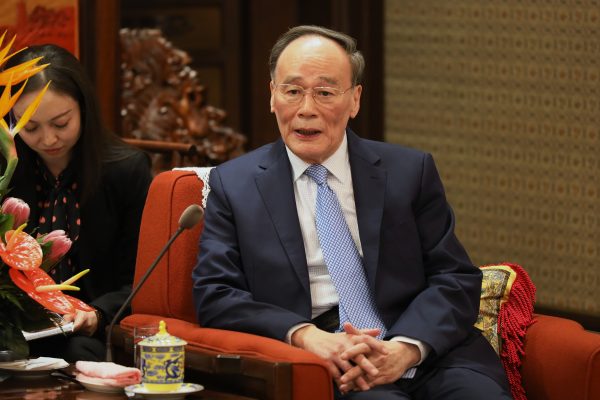
Wang Qishan ran Xi’s purge campaigns, then became a liability
Wang Qishan served as head of the Central Commission for Discipline Inspection during Xi Jinping’s first five-year term. He wielded the Party’s so-called “anti-corruption campaign” as a political weapon. The campaign’s targets fell overwhelmingly along factional lines: officials from competing power blocs were investigated, tried, and imprisoned, while Xi’s allies were largely untouched. Wang’s fearsome reputation was built on this selective enforcement.
By Xi’s second term, the relationship between the two men had visibly deteriorated. Wang, once known for his stern and commanding public manner, increasingly appeared cautious and subdued at official events. In September 2018, he was shunted to the ceremonial post of vice president, a role carrying no real power. He retired formally in 2023.
Xi Jinping took down all four of Wang Qishan’s closest aides
Since Wang was moved to the vice presidency, his former associates have been picked off one after another. Each case targeted a different node in Wang’s network, cutting his ties to the Party’s discipline apparatus, the central banking system, commercial banking, and financial regulation.
Dong Hong: Wang’s political enforcer. On Jan. 28, 2022, Dong Hong, a former deputy leader of the Party’s Central Inspection Teams (roving investigators dispatched to probe provincial and ministerial officials), was sentenced to a suspended death penalty on bribery charges. Prosecutors said he accepted more than 463 million yuan, roughly $63 million. Dong served as Wang’s personal secretary for six years beginning in 2000, when Wang led the State Council’s Office for Economic System Reform. He accompanied Wang everywhere and served as a key enforcer during Wang’s purge campaigns. His conviction was widely seen as the first strike against Wang’s network.
Tian Huiyu: Wang’s man in commercial banking. On Feb. 5, 2024, Tian Huiyu, the former Party secretary and president of China Merchants Bank, one of China’s largest commercial lenders, received a suspended death sentence. Tian entered China Construction Bank in 1987 and became Wang Qishan’s personal secretary when Wang ran that institution. He also helped establish China International Capital Corporation (CICC), a major investment bank. His case exposed the depth of Wang’s influence across China’s commercial banking sector.
Fan Yifei: Wang’s central banking link. On Oct. 10, 2024, Fan Yifei, a former deputy governor of the People’s Bank of China (the country’s central bank), was sentenced to a suspended death penalty. Fan served as Wang’s chief financial officer during Wang’s tenure at China Construction Bank. His conviction severed Wang’s remaining connections to the central banking system.
Zhou Liang: Wang’s last remaining ally. Zhou’s arrest on March 24, 2026 completes the pattern. Xi Jinping has now removed every one of Wang Qishan’s four most senior former aides from the political system.

Xi dismantled Wang’s network systematically
On March 24, an X (formerly Twitter) commentator posting under the handle “Finding心归何处” argued that Zhou Liang’s arrest carries heavy symbolic weight. Zhou followed Wang from the late 1990s through Guangdong, Hainan, Beijing, and the discipline inspection system. As the commission’s organizational department director, he was the official Wang trusted most to manage personnel. His arrest removes Wang Qishan’s last political buffer. Xi Jinping has left no remaining allies of Wang’s anywhere in the system.
The commentator laid out the sequence. Dong Hong’s fall was the opening move. Fan Yifei’s sentencing cut Wang off from the central banking apparatus. Tian Huiyu’s case exposed how deeply Wang’s patronage network was embedded in commercial lending. Zhou Liang’s arrest completes the circuit.
Online commenters responded bluntly. One asked: “Is this a redistribution of CCP power? Has Xi decided the purge tool he once used has become a liability?” Another wrote: “Being a Chinese official is now an extremely high-risk occupation. Getting onto the train depends on your connections. Getting off safely is what matters.” The observation captures the reality facing officials who rose through factional patronage: the Party’s selective “anti-corruption” campaigns function as political liquidation, and yesterday’s enforcer becomes tomorrow’s target.
Xi broke a personal promise to Wang Qishan
Cai Shenkun, a U.S.-based political commentator, posted on X on March 24 that Wang Qishan regarded Zhou Liang almost as a son and deeply valued his abilities. Cai wrote that Wang had deliberately kept Zhou away from financial dealings throughout their decades-long partnership, specifically to shield him from the kind of corruption charges that could be turned into political weapons later.
Even when Wang was at the height of his power, Zhou sensed the danger ahead. He repeatedly asked to be transferred to a provincial posting. Wang refused to let him go. When Wang stepped down from the Politburo Standing Committee, he personally raised Zhou’s future with Xi Jinping. Xi agreed to arrange a suitable position. Wang took Xi at his word.
The promise proved worthless. As Party authorities arrested a growing number of officials from Hunan province, many of whom Zhou had helped place in their positions, Zhou himself became a target. Xi discarded the commitment.

Wang Qishan triggered the arrest by breaking Xi’s rules
Cai’s account points to a specific trigger. During the 2026 Spring Festival holiday, Wang reportedly sent an intermediary to meet with Zhou. This violated Xi’s explicit demand that Wang sever all contact with his former associates.
The transgression came at a particularly dangerous moment. After Xi arrested Zhang Youxia, the former vice chairman of the Party’s Central Military Commission (the body that commands China’s armed forces), Xi had alienated virtually the entire “red second generation” (children of revolutionary-era CCP leaders), the military old guard, and the broader Party elder class. Xi now fears that the few remaining national-level leaders who could threaten him might coordinate against him. His primary concerns, according to Cai, are Wang Qishan and Zeng Qinghong, a former vice president known as the Party’s most skilled behind-the-scenes political operator.
Online reactions point to Xi Jinping’s escalating paranoia
Online responses to Cai’s analysis were pointed. One commenter wrote: “Arresting an elder’s secretary and closest aides at this moment is a warning to the elder himself.”
The same commenter noted that the Party had shut down Mao Zedong’s mausoleum in Tiananmen Square a full year ahead of schedule, ostensibly for the once-a-decade renovation. “Some analysts think Xi believes the mausoleum disrupts Beijing’s feng shui. Could he use this renovation to relocate it?”
The commenter added: “There is no question that Party and state power still rests in Xi’s hands. His decision to take down Zhang Youxia before the Fifth Plenum was about one thing: refusing to become the next Hua Guofeng.” Hua was Mao Zedong’s handpicked successor who was swiftly sidelined by rivals after Mao’s death. The comparison captures the psychology of a dictator simultaneously terrified of betrayal and incapable of sharing power.
Another commenter asked whether Xi’s health has seriously deteriorated, and whether he is clearing every potential threat before a successor takes over. Others called Zhou’s arrest part of a broader purge of Hunan-linked officials across the Party apparatus.
By Li Deyan