A Chinese court has sentenced Tan Ruisong, former chairman of the state-owned Aviation Industry Corporation of China (AVIC), to death with a two-year reprieve for corruption and insider trading offenses, according to official reports. Authorities said Tan accepted more than 600 million yuan (about USD $83 million) in bribes and engaged in repeated securities trading based on confidential information, describing the case as “particularly serious.”
The ruling comes amid an ongoing crackdown in China’s military-industrial sector, where a number of senior executives and defense scientists have been investigated or removed from their posts in recent years.
A shocking verdict
According to Chinese state media, the Dalian Intermediate People’s Court in Liaoning Province convicted Tan of embezzlement, bribery, insider trading, and leaking insider information. The court handed down a death sentence with a two-year reprieve, which under Chinese law typically commutes to life imprisonment after the reprieve period if no further crimes are committed. Authorities also ordered the confiscation of all of Tan’s personal assets.
Prosecutors said Tan abused his positions in China’s aviation industry over several decades to accumulate illicit wealth and manipulate financial markets.
Court documents state that between July 2003 and 2010, while serving as vice general manager of China Aviation Industry Corporation II and later vice general manager of AVIC, Tan illegally appropriated public funds totaling 89.93 million yuan.
Success
You are now signed up for our newsletter
Success
Check your email to complete sign up
In addition, from 1998 to 2024, Tan used various senior posts to help companies and individuals obtain business opportunities, including corporate mergers and project contracts, in exchange for bribes totaling more than 613 million yuan.
The court also found that from March 2012 to March 2023, Tan repeatedly conducted securities trading using confidential information obtained through his position. Authorities said he also leaked insider information on multiple occasions and “explicitly or implicitly instructed others to conduct securities trading related to insider information.” The official announcement emphasized that the circumstances of the crimes were “particularly serious.”
Long career in aviation
Public records show that Tan Ruisong was born in February 1962 in You County, Hunan Province, and spent most of his career in China’s aviation and defense industry. He held several senior leadership roles over the years, including vice general manager of China Aviation Industry Corporation II from 2004 to 2008 and vice general manager of AVIC from 2008 to 2012. In March 2012, he was promoted to general manager of AVIC, later becoming chairman of the group in May 2018.
Tan remained one of the most influential figures in China’s state-run aerospace sector until March 1, 2023, when he was removed from his posts as AVIC chairman and party secretary.
Authorities formally placed him under investigation on Aug. 30, 2024, on suspicion of “serious violations of discipline and law.” In February 2025, China’s top anti-corruption watchdog expelled him from the Chinese Communist Party and transferred his case to prosecutors.
In its disciplinary statement, the Central Commission for Discipline Inspection accused Tan of “feeding off the military industry”, a phrase commonly used in official corruption cases involving defense-related enterprises.
Military-industrial sector under probe
AVIC is one of China’s largest defense conglomerates and a key state-owned enterprise directly managed by the Chinese Communist Party’s central authorities. The company oversees a vast network of subsidiaries involved in military aircraft, helicopters, airborne systems, aviation research, supply chains, and defense exports, as well as financial services and engineering projects.
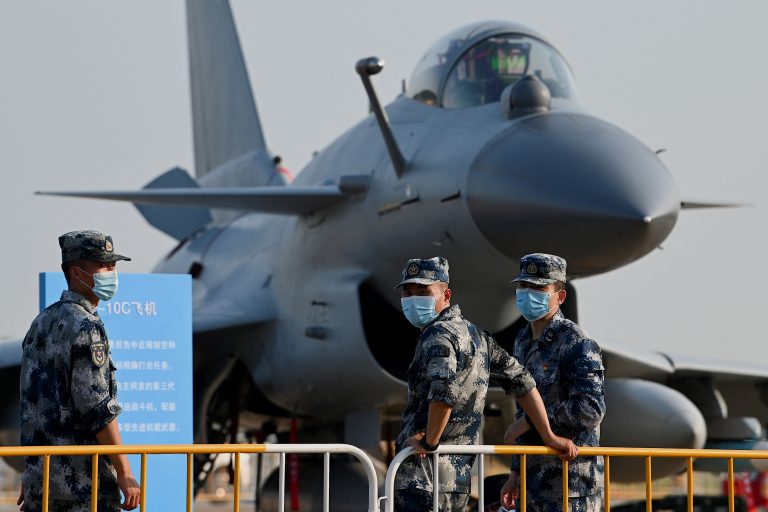
Two of AVIC’s major subsidiaries, Shenyang Aircraft Corporation and Chengdu Aircraft Industry Group, are responsible for producing many of China’s frontline fighter jets. Among the aircraft manufactured by these companies are the J-20 stealth fighter, which Chinese state media often describes as the country’s most advanced fifth-generation combat aircraft, and the J-16 heavy multirole fighter used by the People’s Liberation Army Air Force.
Tan’s conviction comes as Beijing continues a sweeping campaign targeting corruption within China’s military and defense-industrial systems. Over the past three years, multiple senior executives and technical experts connected to China’s military-industrial complex have been removed from their posts or placed under investigation.
AVIC itself has been heavily affected. Since 2025, several high-ranking executives linked to the group, including general manager Hao Zhaoping, vice general manager Yang Wei, and former chairman Zhou Xinmin, have reportedly been dismissed or investigated.
Observers say the continuing wave of probes suggests Chinese authorities are attempting to address corruption within sectors closely tied to national defense and strategic industries. At the same time, the removal of numerous senior figures has also fueled speculation about broader political and institutional tensions within China’s defense establishment.