The sudden death of Chinese aviation engine expert Yan Hong has triggered a wave of speculation and unease among netizens after official statements offered little explanation beyond a brief note that she died “after medical treatment failed.” Her passing comes amid a string of recent deaths involving senior figures in China’s defense and military-industrial sectors, raising broader questions among observers.
According to an obituary released on March 26 by the School of Power and Energy at Northwestern Polytechnical University, Yan Hong died on March 24 at Jiangsu Provincial People’s Hospital at the age of 57. The notice stated simply that she passed away “due to illness after unsuccessful treatment,” without providing any further details.
Yan, a prominent researcher in supersonic and hypersonic flow control, had long been active in China’s aerospace field. She served as executive vice chair of the university’s overseas scholars association and was an Associate Fellow of the American Institute of Aeronautics and Astronautics (AIAA). She was also a specially appointed expert under Shaanxi Province’s “Hundred Talents Program.”
Her academic career included doctoral studies at Northwestern Polytechnical University, postdoctoral research at Tsinghua University, and research positions in the United States, including at Rutgers University and Wright State University. She returned to China in 2010, later serving as deputy dean of the School of Power and Energy and director of a provincial key laboratory focused on aero-engine internal flow dynamics.
Yan’s work focused on hypersonic aerodynamics, plasma flow control, and computational fluid dynamics, and she led multiple national-level research projects. But given her relatively young age and active status in the field, her sudden death, and the lack of detail surrounding it, has drawn scrutiny online.
A cluster of deaths
Success
You are now signed up for our newsletter
Success
Check your email to complete sign up
Commentator Li Muyang wrote on social media: “Was it really illness, or was it like Fang Daining and Yang Wei, something else?” Recent online discussions have referenced the reported death of Fang Daining, a key scientist in China’s hypersonic weapons program. According to circulating obituary images cited by media reports, Fang died on Feb. 27, 2026, also with no clear cause listed.
Some early online accounts suggested he died suddenly while on a business trip abroad, though details remain unclear. Li Muyang further claimed that rumors had circulated suggesting Fang died under unusual circumstances, stating he may have been “killed while swimming,” drawing comparisons to the controversial death of former Chinese Premier Li Keqiang, whose official cause of death in 2023 was listed as a heart attack during swimming.
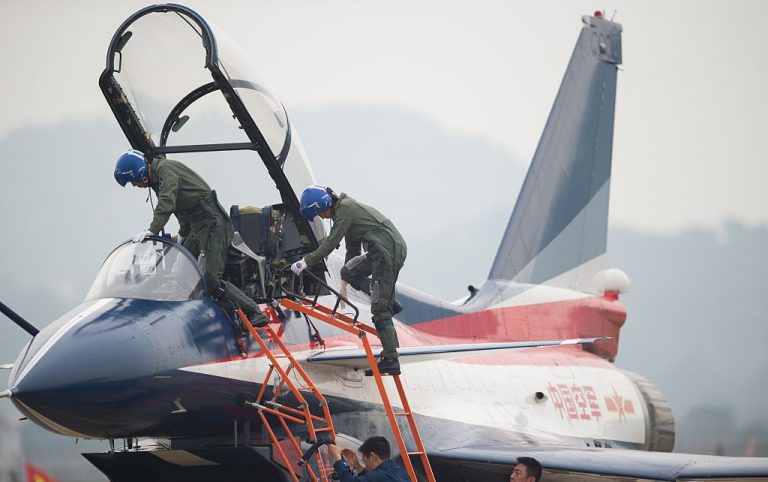
Claims cited in commentary allege that Li’s death involved foul play, though such allegations have not been substantiated. Separately, overseas activist Sheng Xue wrote that, according to an unnamed source, Chinese authorities had pressured Yang Wei, chief designer of the J-20 fighter jet, to “end his own life,” allegedly due to corruption-related concerns. These claims also remain unverified.
Purges gaining steam
Yan Hong’s passing follows the deaths of several senior figures in China’s defense and technology sectors within a matter of days:
- On March 25, Li Youping, a Chinese Academy of Engineering academician and a pioneer in nuclear weapons electronics, died in Beijing at age 91.
- On March 24, Wei Zhengyao, a military information technology expert, also passed away in Beijing at age 90.
- On March 23, Wu Dexin, a semiconductor scientist and academician of the Chinese Academy of Sciences, died at age 90.
- On March 20, Sun Yu, a communications technology expert involved in early nuclear and missile systems, died at age 89.
Official obituaries for all four similarly attributed their deaths to illness without elaboration.
Netizens react
The concentration of deaths among high-level scientists, combined with limited official explanations, has fueled online speculation and public concern. In recent months, several other prominent figures, including public personalities and corporate executives, have also reportedly died suddenly, contributing to wider discussion in China about unexplained deaths across different age groups.
Some online commentators have linked these incidents to broader health concerns, while others view them through a political lens, particularly given ongoing investigations and restructuring within China’s military-industrial complex.
At present, no official connection has been established between these deaths. However, the timing and clustering of such cases continue to draw attention, particularly as China’s defense sector undergoes intensified scrutiny.
Editorial note: This article is based on publicly circulating reports and commentary from independent analysts. The claims described have not been independently verified by Vision Times, and relevant authorities have not publicly confirmed the allegations.