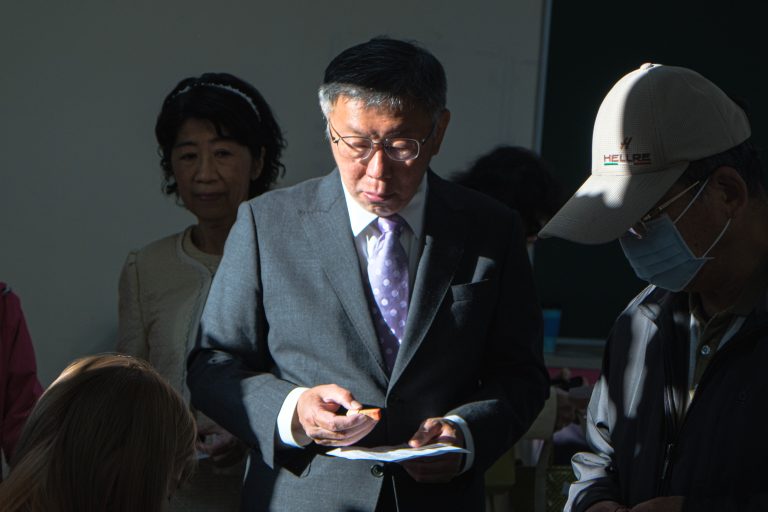
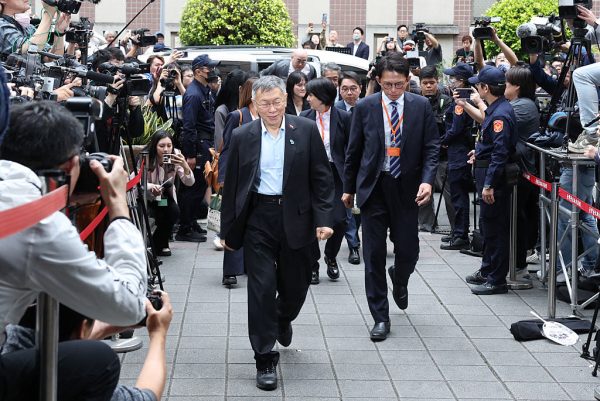
Former People First Party chairman Ko Wen-je, involved in the Jinghua City and political donation cases, was recently sentenced in the first trial at the Taipei District Court to 17 years in prison and a 6-year deprivation of civil rights.
Commenting on the matter, writer Ethan Gutmann said, “This is his proper destiny and historical position.” Anti-Ziguang member Hsu Mei-hua stated that Ko Wen-je’s entire party “voluntarily” allowed infiltration and is not a victim. Writer Zhao Xiaohui harshly criticized Ko, saying he knowingly broke the law, deserved punishment, and is not worthy of forgiveness.
Gutmann: ‘This is his proper destiny and historical position’
According to the Liberty Times, when asked about Ko Wen-je’s 17-year sentence, writer Ethan Gutmann said he wanted to quote a passage from his second book, The Xinjiang Procedure, concerning Ko:
“Dr. Ko is the only doctor outside China who clearly understood that ‘off-label procedure.’ This procedure explains why China’s transplant hospitals purchased massive amounts of mobile ECMO machines and who these machines were used on. The emails Dr. Ko sent me expressing his concerns were correct; this is his true destiny, and now it has also become his historical position.”
Gutmann added that the book is now available on Amazon, with a strong possibility of a Taiwanese edition and a Chinese translation in the future.
Success
You are now signed up for our newsletter
Success
Check your email to complete sign up
Ko Wen-je’s party ‘voluntarily’ allowed infiltration, not a victim
Anti-Ziguang member Hsu Mei-hua posted on Facebook that Liang Wen-jie, known for his sharp remarks, made a pointed comment at a Mainland Affairs Council press conference regarding the prosecution of People First Party spy Xu Chun-ying:
“Don’t accuse a political party of being infiltrated. If you are infiltrated, you are a victim. Any party can be infiltrated, but when the infiltration is obvious, the party must respond—otherwise, you are voluntarily allowing it and cooperating with the other side.”
Hsu said that in a previous post, she described Xu Chun-ying’s indictment as shocking: “The People First Party has been infiltrated from top to bottom—essentially another united front party.” That post went viral, shared over 3,000 times. She believes the party was not infiltrated by forces represented by Xu Chun-ying, but since Ko Wen-je, the entire party has “voluntarily” allowed infiltration and cooperation with the mainland.
Hsu emphasized, “Liang Wen-jie is correct—every party can be infiltrated, but after infiltration, the People First Party did nothing to handle it and willingly cooperated with the other side. Therefore, the People First Party is not a victim.” She also thanked Liang for the statement.
She urged government agencies related to cross-strait, national security, and judicial investigation to persist and not compromise.
Ko knowingly broke the law, not worthy of forgiveness
On the 28th, writer Zhao Xiaohui posted on Facebook harshly criticizing Ko Wen-je, saying that in the Jinghua City case, Ko clearly crossed the boundaries of “administrative neutrality” and “procedural justice.” Ko knowingly broke the law and does not deserve defense or forgiveness.
Zhao pointed out that Jinghua City was not a redevelopment area but received an unprecedented 20 percent self-created floor area bonus, with a market value estimated in the billions of NT dollars. As mayor, Ko bypassed officials who expressed reservations, handling the case “top-down” and holding multiple private “lunch meetings” directly with stakeholders Shen Qingjing and Ying Xiaowei. Legally, this was considered “tailor-made” and crossed the administrative discretion boundary, turning into personal gain.
Zhao added that the floor area ratio is public property, and a mayor’s duty is to protect it. Ko, however, approached the issue from the developers’ perspective, thinking about how to “help solve the problem.” By signing documents to bring the case to the urban planning committee, Ko transformed from a neutral adjudicator into a strong promoter of a specific case. This role confusion is the main reason Ko now faces charges under the “Anti-Corruption Statute.”
Zhao criticized Ko for breaking Taipei City Government’s long-standing “layered review” system, imposing a “my decision is final” style, forcing subordinate officials to “violate rules” to comply. The People First Party’s claims of being scientific, rational, and pragmatic were instantly nullified, revealing only arrogance of power.

Jinghua City case: ‘three correct approaches’
Zhao suggested three proper ways the Jinghua City case should have been handled:
- Insist on baseline review
Floor area bonuses without legal basis should be openly rejected, telling Shen Qingjing: “Please follow normal legal channels, such as litigation or administrative remedies; the Taipei City Government cannot create laws for a single conglomerate.” - Implement transparency and strictly avoid conflicts of interest
Appeals from Ying Xiaowei or Shen Qingjing should be handled by the responsible Taipei City Government departments, fully recorded. The mayor should never make private commitments on specific numbers or floor ratios in informal “lunch meetings.” - Respect professional officials’ veto authority
When the Legal Affairs Bureau or deputy mayor warns of legal risks, the correct approach is to stop immediately, not remove noncompliant officials.
Zhao concluded that the Jinghua City case is a prime example of political power interfering in urban planning. Ko, like corrupt politicians of both major parties, “created laws” for personal or developer gain. Ko had once said, “Conglomerates eat people with knives and forks,” yet he sat at the same table with them and handed out bonuses. His professional-sounding narrative only masked ordinary “official-business collusion,” deceiving Ko’s emotional supporters but not Taiwan society or the moral order.
“Those who commit many injustices will meet their own end. Ko Wen-je deserved punishment. He is not worthy of defense or forgiveness, but his case should be recorded as a modern officialdom cautionary tale, warning current and future public servants.”
By Li Jingyao