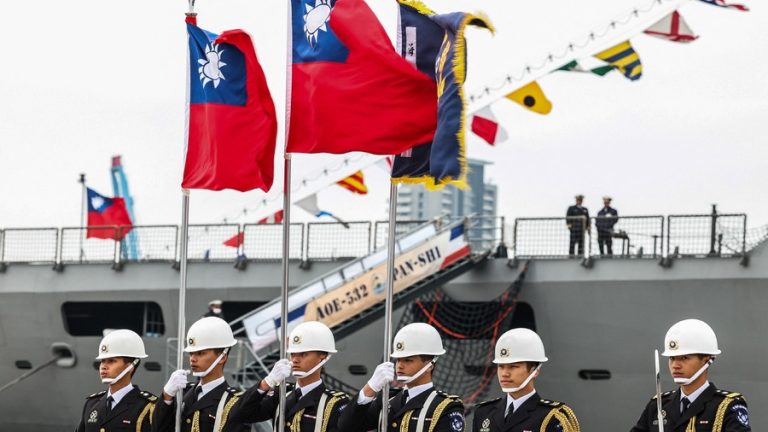
Recently, Taiwan has received multiple high-profile international delegations, including a bipartisan U.S. Senate delegation, the European Parliament, the UK-Taiwan Parliamentary Group, and the Global Taiwan Institute (GTI). Scholars say this highlights the international community’s recognition of Taiwan. Located at the core of the first island chain, Taiwan holds an irreplaceable position in geopolitics, security, and global trade.
According to the Central News Agency, on March 31, Taiwanese President Lai Ching-te received the UK Parliament’s “UK-Taiwan Parliamentary Group” delegation. On the same day, he also met with the U.S. delegation from the Global Taiwan Institute (GTI). During the meeting with GTI, Lai said that the Chinese Communist Party is attempting to change the status quo in the Taiwan Strait through military intimidation.
Taiwan will continue to strengthen its defense capabilities, build a “Taiwan Shield” to protect democracy and freedom, and work with the U.S. and other democratic partners to maintain regional stability.
When meeting the UK-Taiwan Parliamentary Group, Lai noted that the international situation is changing rapidly. Peace and stability in the Taiwan Strait are crucial to regional security and closely linked to the resilience of global supply chains and worldwide prosperity. He thanked the UK government and Parliament for repeatedly publicly opposing unilateral changes to the Taiwan Strait status quo and emphasized that Indo-Pacific and transatlantic security are inseparable.
He also expressed gratitude for the UK’s past deployment of naval vessels in the Indo-Pacific to conduct freedom of navigation operations, highlighting concrete actions to jointly safeguard peace and stability in the Taiwan Strait and the region.
Success
You are now signed up for our newsletter
Success
Check your email to complete sign up
Lai added that in 2023, Taiwan and the UK signed the Enhanced Trade Partnership (ETP), the first bilateral institutionalized trade framework between Taiwan and a European country. He hopes that Taiwan will deepen economic exchanges and promote industrial cooperation with the UK, and that the UK will continue to support Taiwan’s accession to the CPTPP (Comprehensive and Progressive Agreement for Trans-Pacific Partnership), jointly fostering a new era of prosperity and development in Indo-Pacific trade.
On March 30, a bipartisan U.S. Senate delegation arrived in Taiwan. In addition to meeting President Lai, they met with Legislative Yuan Speaker Han Kuo-yu and representatives from various parties.
According to Formosa TV, the U.S. bipartisan delegation consisted of four senators, including members of the Foreign Relations Committee, Democratic lead Senator Shaun, Democratic Senator Rosan, Republican Senator Kuang Xiheng—an expert on China strategy with strong interest in Taiwan arms deals who had previously lived briefly in Taiwan—and co-chair of the Senate Taiwan Caucus, Tiris. Their main goal in visiting Taiwan is to push for the rapid passage of the special national defense legislation.
The eight-year, NT$1.25 trillion special defense procurement legislation proposed by Taiwan’s Executive Yuan has long been stalled in the Legislative Yuan. Opposition parties have proposed different versions of the defense budget: the People’s Party’s version is NT$400 billion, while the Kuomintang, led by Zheng Liwen, proposes NT$380 billion plus additional items. The Legislative Yuan’s joint review of foreign affairs, defense, and finance committees has only reached consensus on two clauses, with the rest reserved for negotiation. Analysts say the U.S. delegation’s intentions are clear, and the outcome depends on how the opposition responds.

Scholars: International community recognizes Taiwan’s importance
Regarding the recent visits by major U.S., European, and UK delegations, scholars say it underscores Taiwan’s significance.
According to Radio Taiwan International, Wu Sezhi, director of the China Issues Research Center, said, “From Taiwan’s perspective, the consecutive visits by these delegations show the international community’s attention to Taiwan.” Key discussion topics include security, global supply chains, high-tech development, and the maturity of democracy, human rights, and the rule of law.
From a geopolitical perspective, Wu noted, “Taiwan sits at the core of the first island chain. Since the end of World War II, its position in geopolitics, security, and global trade has been irreplaceable. When it comes to the Taiwan Strait, all democratic countries emphasize maintaining peace and stability and oppose unilateral changes to the status quo, showing the high international concern for Taiwan’s security.”
Wu believes Taiwan should further develop three subjective advantages. First, democratic politics: Taiwan is a model of democratic values among Chinese-speaking countries and should continue to demonstrate the contrast between democracy and authoritarianism. Second, security: Cross-strait issues now extend beyond Taiwan and China, becoming a “global cross-strait” matter. International attention on Taiwan has increased in recent years, as seen with visiting delegations, the notion that “Taiwan’s security equals Japan’s security,” and the Philippines’ focus on Taiwan Strait stability.
Therefore, Taiwan should continue enhancing its defense and contributing to regional stability. Third, supply chain stability: The Taiwan Strait is a critical global trade route. Taiwan’s high-tech achievements in recent years highlight how its security and stability affect the geopolitical economy. Continuously promoting Taiwan’s story and leveraging its strategic role in the first island chain will be key challenges and opportunities for the future.
Wu also noted that multiple international delegations not only met with President Lai but also visited the Legislative Yuan, Academia Sinica, and relevant enterprises, showing that international friends seek to deepen exchanges and cooperation with Taiwan at all levels.
By Li Jingyao