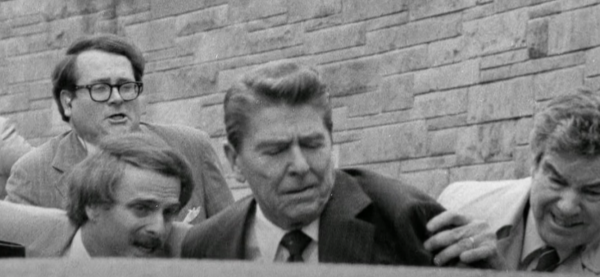
On a cold afternoon in Washington on March 30, 1981, Ronald Reagan stepped out of the Hilton Hotel and into gunfire. Six shots in three seconds. One bullet struck the presidential limousine, deflected, and entered his chest, stopping just short of his heart.
He survived. What followed was not caution.
When Nancy Reagan reached his bedside, he joked, “Honey, I forgot to duck.” On the way into surgery, he looked at the doctors and said, “I hope you’re all Republicans.” The surgeon replied, “Mr. President, today we are all Republicans.”
The lines spread quickly. In the United States, they reinforced the image of a president untouched by fear. Across the Cold War divide, they carried a different signal. In Beijing, they were read as evidence of something harder to manage.
Accounts long circulated among China specialists and former insiders describe how Deng Xiaoping and senior party elder Chen Yun discussed Reagan in the early 1980s. The phrasing varies, and none of it appears in official archives. But the judgment attributed to them is consistent: Reagan was not like Nixon or Carter. He was not operating within the familiar boundaries.
Success
You are now signed up for our newsletter
Success
Check your email to complete sign up
What set him apart was not only his posture toward the Soviet Union. It was the premise beneath it. Reagan did not treat communist systems as permanent realities to be managed. He treated them as structures that could fail.
After the assassination attempt, Reagan wrote in his private diary that he believed his life had been spared for a purpose. That belief did not stay private for long. It surfaced in speeches, in tone, and in the steady escalation of language that would culminate in the phrase “Evil Empire.”

Beijing appears to have responded.
Following Reagan’s 1982 address at Westminster, where he predicted that Marxism-Leninism would end up on “the ash heap of history,” the Chinese Communist Party’s General Office reportedly circulated internal reference materials to senior officials. The details remain opaque. What is clear, however, is the timing.
In 1983, the party launched the Campaign Against Spiritual Pollution, an effort to curb the spread of Western ideas and tighten ideological discipline. At the time, many observers saw it as a domestic correction, a pushback against the looseness of early reform. Another reading has persisted alongside it: that the campaign was also a reaction to mounting external pressure, particularly from the United States.
Voice of America broadcasts expanded. American rhetoric hardened. The language used inside the Chinese system began to reflect a growing concern about “peaceful evolution,” the idea that communist rule could be weakened from within, not through invasion, but through ideas.
When Reagan later introduced the Strategic Defense Initiative and sharpened his public attacks on the Soviet system, internal warnings in China, according to these accounts, shifted accordingly. The target of Reagan’s language might have been Moscow. The implications were not limited to it.
Miles Yu, now director of the China Center at the Hudson Institute and a former China policy adviser to Secretary of State Mike Pompeo, has written that Reagan’s approach rested on a distinction that earlier policymakers often blurred. Communist parties and the societies they governed were not the same. That distinction allowed opposition to a regime without collapsing it into hostility toward an entire people.
Cheng Xiaonong, a sociologist trained at Princeton and a former policy adviser to Zhao Ziyang, has focused on a different element. The pressure applied to the Soviet system was not only rhetorical. It was economic. Programs such as the Strategic Defense Initiative, combined with restrictions on advanced technology exports, forced a level of competition that a command economy struggled to sustain.
Ming Juzheng, emeritus professor at National Taiwan University, has taken the argument in another direction. What mattered most, in his view, was not the weapons program or the economic strain, but the language. Reagan named the system. He did not hedge. Over time, that clarity carried consequences inside the system itself.
What appears to unsettle Beijing today is not the defense buildup of the 1980s. It is the way of thinking behind it.
It is the idea that the Chinese Communist Party and the Chinese people are not interchangeable. The refusal to accept the party’s claim to rule as self-justifying. The willingness to organize policy around strength rather than expectation of gradual change.
For a period, that framework receded. Engagement dominated American policy thinking through the 1990s and into the early 21st century. In recent years, parts of that earlier approach have begun to reappear.
The bullet that stopped an inch from Reagan’s heart did not end his presidency. It fixed an image. A man under fire who did not adjust his tone, did not retreat, did not recast his purpose.
Decades later, that image still carries weight. Not as memory, but as a problem left unresolved.
Editor’s Note: This article draws on publicly attributed analysis by Miles Yu, Cheng Xiaonong, and Ming Juzheng, as well as party-internal accounts cited by China observers. Claims about CCP internal documents and leadership deliberations have not been independently verified through official archival records.