In late March 2026, word emerged that Ba Shusong, the chief economist of the China Banking Association and a senior advisor at the Peking University HSBC Financial Research Institute, had lost contact with the outside world. On March 25, the mainland Chinese outlet Economic Observer reported that Ba was suspected of involvement in an illegal fundraising case and had been taken away by investigators around March 12. Authorities had restricted Ba from leaving China at least six months before his detention.
On March 27, CCP-affiliated outlet Caixin reported that a man named Guo Yunzhao had been taken away at the same time. Guo was formally a “doctoral student” Ba had mentored at the China Institute for Reform and Development in Hainan. In practice, Guo is several years older than Ba. Sources say the two men, Ba now 57 and Guo turning 60 this year, developed a tight bond that extended well beyond academic mentorship. Guo became a central figure in Ba’s financial network.
Around 2015, Guo left positions at publicly listed companies and state-owned central enterprises to launch his own private equity fund. His firm, Tuoze Huili Enterprise Management (Hainan) Co., Ltd., focused on primary and early secondary market investments. Guo also held board seats at Woori Bank (China), Ruifu Investment Management, China Guangfa Bank, and China Insurance Investment, along with senior roles at multiple listed companies.
According to sources quoted by Caixin, when Guo left the CCP establishment to go into private business, friends and former classmates rallied behind him. Much of his initial capital came from securities firms, and at his peak, he managed tens of billions of yuan. The fund appeared to perform well early on, but in recent years, as Chinese markets deteriorated, Guo reportedly lost substantial sums.
Ba Shusong’s role in the arrangement was to help Guo raise capital for investment projects. Ba was reportedly active in fundraising efforts within his inner circle. Whether Ba held equity stakes in Guo’s fund remains unknown. Ba’s downfall may be the direct result of Guo’s fund collapsing and dragging him into the investigation.
Success
You are now signed up for our newsletter
Success
Check your email to complete sign up
Ba built a financial empire on academic networks and millions of social media followers
Ba Shusong leveraged the “teacher-student relationship,” a potent source of loyalty and obligation in Chinese professional culture, to assemble an extensive web of financial connections. He became a major social media personality with tens of millions of followers across platforms and ran numerous WeChat groups, each capped at 500 members, where he regularly posted commentary and financial analysis.
Multiple industry insiders also pointed to the Shenzhen Asset Management Society, a nominally private think tank focused on asset management research. The society’s official description is packed with CCP jargon about “building consensus,” “promoting cooperation across the value chain,” and “serving as a bridge between market and government.” Its supervising authority is the Shenzhen Federation of Social Science Associations, and it is registered under the Shenzhen Civil Affairs Bureau.
According to sources, Ba Shusong was the person who secured the society’s operating license. The approval was issued by the Shenzhen branch of the People’s Bank of China, where Ba’s wife, Xing Yujing, held a leadership position at the time. Industry insiders say it was widely understood that Ba was the society’s de facto controller.
The society collected steep annual membership dues, reportedly bringing in 50 to 60 million yuan per year. Where the money went and what investment projects it funded were never disclosed. Ba also established multiple WeChat groups for the society, charging an entry fee of several thousand yuan per member. Dedicated staff posted financial news updates in the groups, and Ba himself was a frequent participant.
Days after Ba’s disappearance, his wife Xing Yujing also went “missing.” Xing is reportedly an economics PhD who studied at the same university as Ba.
The real target may be Wang Qishan’s financial network in Hong Kong
On the surface, Ba Shusong’s titles are formidable. He served as a professor at Peking University’s HSBC Business School, executive dean and later senior advisor of the HSBC Financial Research Institute, chief economist of the China Banking Association, managing director and chief China economist at Hong Kong Exchanges and Clearing (HKEX), and held positions at several economic research foundations and policy bodies.
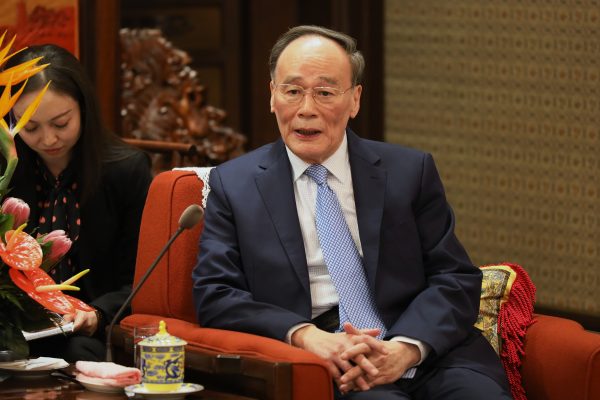
On March 25, 2026, U.S.-based independent commentator Cai Shenkun posted on the X platform: “Ba Shusong’s detention is closely tied to the purge of financial officials. Ba was highly valued by Wang Qishan and handled large sums of money on Wang’s behalf.”
U.S.-based commentator Guo Jun stated on the program “Elite Forum” that Ba’s case must be understood in the context of the CCP authorities’ ongoing investigation into the financial influence of Wang Qishan, the former CCP vice president who served as Xi Jinping’s original “anti-corruption” enforcer before the two men’s relationship soured. Wang has long frequented exclusive clubs in Hong Kong and wields considerable influence in the city’s business circles. Many Chinese businesspeople traveled to Hong Kong specifically to seek audiences with Wang, a practice known in Chinese as “paying respects at the dock,” meaning currying favor with a powerful patron.
Ba Shusong was far more than an economist at HKEX. He was a fixture of the Chinese-capital financial policy world, connected on one end to Beijing’s regulatory and decision-making apparatus, and on the other to Hong Kong’s markets and international investors. He took part in policy research while wielding real influence in the marketplace. He understood both power and capital. In stable times, such a person functions as a bridge. During a political crackdown, he becomes the most exposed node in the network.
Ba was still publicly active as recently as October 2025 and left HKEX at the end of that year. When news of his disappearance and arrest broke in March 2026, the timing aligned with a wave of arrests in Hong Kong and Beijing’s ongoing financial purge. In the CCP system, cases are never isolated. When the authorities move against one person, they are pulling an entire thread.
Hong Kong’s securities regulator launched a parallel crackdown on the same day
On March 12, 2026, the same date Ba Shusong was reportedly detained, the Hong Kong Securities and Futures Commission announced a joint investigation with the Independent Commission Against Corruption (ICAC) into insider trading and bribery involving senior executives at financial firms.
According to Hong Kong media, investigators targeted senior executives at two securities firms and one fund management company, arresting six men and two women. Seven of the eight were corporate executives; one was described as a middleman.
Regulators suspected that securities firm executives had accepted bribes exceeding HK$4 million (roughly US$487,000) from a fund management company. In exchange, they allegedly leaked confidential information about upcoming share placement plans at multiple listed companies before the announcements were made. This allowed the fund company to short-sell the relevant stocks in advance. The fund company reportedly profited HK$315 million (roughly US$38.38 million) from these trades.
The March 12 arrests operated on three levels. On the surface, the case involves insider trading and short-selling for profit. Beneath that, it exposes fractures in the cross-border capital chains linking Chinese-capital securities firms to Hong Kong markets. At the deepest level, the crackdown targets figures like Ba Shusong, people who sit at the junction of policy and markets. When authorities start moving at that third level, the operation has changed in kind. Beijing is no longer trying to clean up the market. It is building a financial system it can control.

Xi Jinping is turning Hong Kong into a controlled offshore financial platform
Hong Kong’s IPO market had been recovering, and this trend has alarmed CCP general secretary Xi Jinping. The concern is that large numbers of Chinese-capital enterprises will register offshore, spin off their most valuable business units, and list shares in Hong Kong through structures that let capital leave China.
For years, major Chinese companies, including China Mobile, CNOOC, and hundreds of private firms, have set up shell companies in the Cayman Islands or British Virgin Islands, injected mainland assets into them, and listed in Hong Kong and the United States as “red chip” entities. The primary advantage of this offshore architecture is flexibility: it gives companies and their investors far more room to move capital across borders.
The CCP has now issued regulations requiring companies to keep their registration domicile and controlling interest within mainland China. Mainland regulators are trying to force enterprises registered overseas to restructure before listing in Hong Kong, effectively requiring them to re-register on the mainland. If companies are compelled to dismantle their red chip structures and reconstitute as domestic entities, similar to the existing H-share model, the flexibility of their equity design would shrink dramatically. Foreign private equity firms have little appetite for buying into such constrained share placements.
The potential regulatory shift has provoked sharp pushback from international investment banks, legal advisors, and overseas investors, who see it as a threat to the profitability of Hong Kong-listed deals.
Two seemingly contradictory dynamics are now playing out at once. Hong Kong is scrambling to attract capital, push IPOs, and grow its wealth management business. At the same time, Beijing’s regulatory grip keeps tightening, reaching into the policy establishment itself. Hong Kong is being converted from a free financial market into a controlled offshore financial platform.
The March 12 arrests in Hong Kong, combined with the detention of someone at Ba Shusong’s level, make the trajectory clear. Beijing is not adjusting the market. It is redistributing financial power while locking down the outflow of CCP-connected assets.