July 20, 2014, marked the 45th anniversary of humanity’s first moon landing. As the first American astronaut to set foot on the lunar surface, Neil Armstrong, famously said: “That’s one small step for a man, one giant leap for mankind.”
Forty-five years ago, China was still in the throes of the Cultural Revolution, isolated from the world and imbued with a sense of exaggerated self-importance. The epoch-making Apollo moon landing went entirely unreported in Chinese media; at the time, many Chinese naïvely believed that the “Red Sun” was leading all of humanity.
Interestingly, even today, some people question the authenticity of the Apollo missions, claiming they were a carefully orchestrated American hoax. Many scholars have debunked these claims from a professional perspective. Yet, in my view, the Italian scholar Umberto Eco offered the clearest and most logical rebuttal. Eco argued:
“From an epistemological perspective, we cannot be absolutely certain that the Americans really went to the Moon. Let us, for a moment, adopt extreme skepticism: it is conceivable that a small group of conspirators fabricated an extraordinary fake news story. We—all the television viewers—simply believed the photos showing a person on the Moon.
The only reason that convinces me Americans truly landed on the Moon is that the Russians did not dispute it. They had both the capability and the motivation to expose the deception, yet they did not. I trusted them, and thus I firmly believe that Americans really landed on the Moon.”
Success
You are now signed up for our newsletter
Success
Check your email to complete sign up
Returning from the moon: alive, but changed forever
Several reports have recounted the struggles and adjustments faced by the lunar astronauts after returning to Earth. Overnight, they became global heroes and household names, immortalized in history books. Yet for many, their lives, thoughts, and even personalities underwent profound changes.
After the first wave of media interviews and public speaking engagements, Neil Armstrong quickly grew weary. He became intensely private, unwilling to live perpetually under the halo—or shadow—of his lunar achievement. Others, however, could never stop seeing him as the first man on the Moon. Armstrong even retreated to the countryside to live a semi-reclusive life, leaving no phone number in public directories.
Buzz Aldrin, the second man on the Moon, struggled even more. He suffered from depression, spent time in a psychiatric hospital, battled alcohol use, and went through divorce and remarriage.
Several astronauts found that their lunar journey altered their beliefs. Some claimed to have encountered extraterrestrials, others believed they had seen 4.5-billion-year-old crystals on the Moon, and some felt an unprecedented closeness to God. As a result, some became devout religious followers, founded spiritual organizations, or pursued studies of the supernatural.
Such transformations are hardly surprising. After all, a moon landing is an experience unprecedented in human history. The psychological impact on those who experienced it firsthand is beyond ordinary comprehension.
In my view, the most remarkable aspect of a lunar journey is that it allows a person to leave human life alive.
Humans are inherently social creatures, needing the company of others. Life among people is what we call the human world. In all languages, death is often euphemistically described as leaving this world. Even when isolated—such as in a solitary cell or on a deserted island—the extreme emptiness is tempered by the fact that one remains on Earth, connected in some way to the human experience.
A moon mission is different. Astronauts leave the human crowd, leave Earth itself, and depart the atmosphere that surrounds it. They truly leave the human world behind, and can fully perceive and be conscious of that fact. It is an extraordinary, almost mystical experience.
Astronaut Ed Mitchell recounted, “Through 24,000 miles of sky, I saw our planet.” Charlie Duke described seeing Earth from the Moon as a radiant, jewel-like globe. One can imagine the profound awe they must have felt. We who have not been to the Moon can try to envision it, yet no imagination, however vivid, matches the intensity of the firsthand experience—especially knowing it was humanity’s first. The psychological and emotional impact is immense.
How we perceive the world inevitably shapes our worldview. A moon mission gives astronauts an entirely unprecedented perspective of Earth and the cosmos, inevitably altering their understanding of life, humanity, and existence.
As American philosopher Thomas Nagel observed, many people sometimes feel that life is absurd, while some experience this sense intensely and continuously.
This feeling of absurdity arises because, on one hand, we must take life seriously—constantly occupied with tasks and responsibilities—yet, on the other hand, we can step back and reflect, observing our lives and humanity from a distance. When we distance ourselves sufficiently, we may feel that everything is insignificant, fleeting, and meaningless.
Yet, despite this sense of meaninglessness, we must continue living. Like Sisyphus in Western myth, endlessly pushing a boulder up a hill only for it to roll down, or Wu Gang in Chinese legend, repeatedly chopping the laurel tree in the Moon Palace only for it to heal itself, we persist in acts that seem futile. This tension between awareness and necessity is the essence of the absurd.
The feeling of the absurd: A visitor from beyond
In real life, the sense of absurdity is like an uninvited guest: it does not come often, but when it does, it can arrive unexpectedly. So, what situations are most likely to trigger this feeling?
As mentioned, absurdity arises from the perception that life lacks meaning. Meaning exists in relationships—our life’s significance is found in our connection to others, even to people millions of years in the future. If one steps not only outside oneself but also outside all humanity, outside the collective experience of human life, a profound sense of meaninglessness emerges. No matter how monumental our achievements—our fame, our historical legacy, our contributions to humanity—if the Earth will eventually perish and humanity will disappear, what ultimate meaning do these accomplishments hold? What is truly significant in life?
This is the essence of the old saying about “seeing through the dust of the mundane.” Our worldview is shaped, to a large extent, by how we observe the world. To see through the mundane, the most effective method is to distance oneself from it. When we place ourselves outside the human world and observe it from afar, the feeling that life lacks meaning becomes unavoidable.
A moon mission is precisely such an experience of stepping outside the human world. Observing Earth from the vastness of space, from the lunar surface, and reflecting on humanity, astronauts cannot help but perceive all human affairs—the rights and wrongs, successes and failures, rise and fall, honors and grievances, love and hatred—that normally stir their emotions and drive their actions, as profoundly insignificant and disconnected from their own existence. Everything seems trivial, empty, and ultimately meaningless.
We who have never been to the Moon can imagine this only in abstract terms, but for the astronauts themselves, the experience must have been overwhelmingly intense and deeply transformative. Returning to Earth with such an experience, they are no longer the same people they were before.
When lunar astronauts return to the bustling human world, confronted with everyday concerns, fame, fortune, and interpersonal conflicts, they often find their engagement with human affairs diminished. Even if not entirely disinterested, they are more frequently detached and disenchanted. This profound disconnection may manifest as depression. Yet, it is a type of depression unlike ordinary forms—it is rooted not in personal or social failures, but in the sheer existential impact of having glimpsed humanity from outside itself.
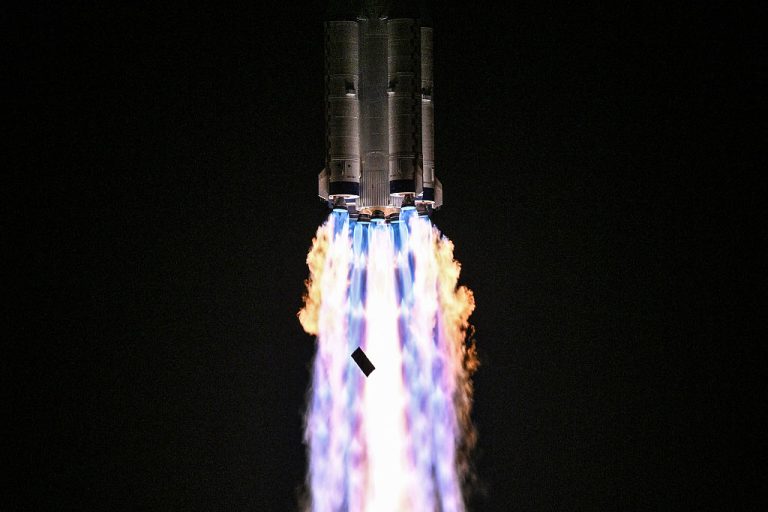
NASA’s Artemis II lunar mission, consisting of the Space Launch System (SLS) rocket and the Orion crewed spacecraft, lifted off on April 1, 2026, from the Kennedy Space Center at Cape Canaveral, Florida. (Image: Miguel J. Rodriguez Carrillo / AFP via Getty Images, ID: 2258921729 / Getty Images)
Nasa launches Artemis II, astronauts set for first lunar flyby in over 50 years
On Wednesday, April 1, 2026, NASA launched its Artemis II mission, sending four astronauts into space as part of the first manned return to the Moon in more than five decades.
The crew includes American astronauts Reid Wiseman, Victor Glover, and Christina Koch, alongside Canadian astronaut Jeremy Hansen. The mission is scheduled to last approximately 10 days, during which the spacecraft will fly around the Moon before returning to Earth.
“Reid, Victor, Christina, and Jeremy, on this historic mission, you carry the spirit of the Artemis team, the courage of the American people and global partners, and the hopes and dreams of a new generation,” said Charlie Blackwell-Thompson, Artemis II launch director, during the launch approval.
The primary goal of Artemis II is to validate the capabilities of NASA’s new Space Launch System (SLS) rocket, the Orion spacecraft, and supporting systems, ensuring they can safely transport astronauts into deep space and sustain operations—paving the way for future lunar surface missions. NASA plans to attempt a crewed Moon landing in 2028 and eventually establish a lunar base.
The last time humans set foot on the Moon was in 1972.
Artemis II also marks a potential milestone for human spaceflight. Depending on the Moon’s position relative to Earth, the mission’s lunar flyby could bring astronauts farther from Earth than any humans have ever traveled before.
In advance of the launch, former U.S. President Donald Trump celebrated the mission:
“Tonight, at 6:24 PM Eastern Time, the United States will return to the Moon for the first time in over 50 years! Artemis II, one of the most powerful rockets ever built, will carry our brave astronauts farther into deep space than any humans before. We are achieving victory—in space, on Earth, and everywhere in between—economically, militarily, and now, even beyond the stars,” Trump posted on Truth Social.
(The views expressed in this article are solely those of the author.)
By Hu Ping