Most Chinese citizens never decided to join the Chinese Communist Party. The decision was made for them.
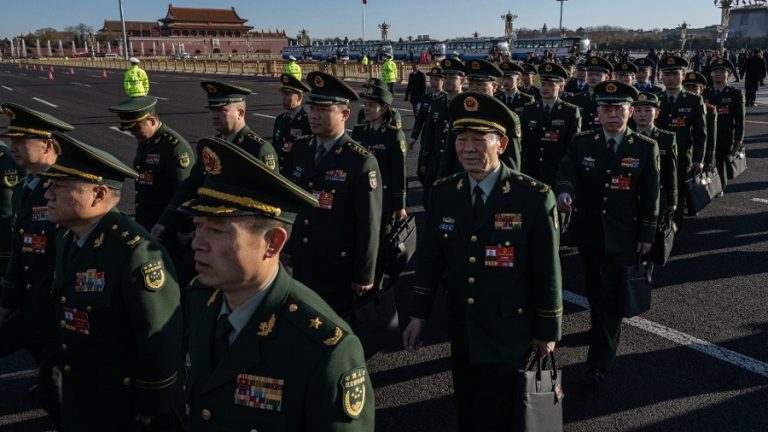
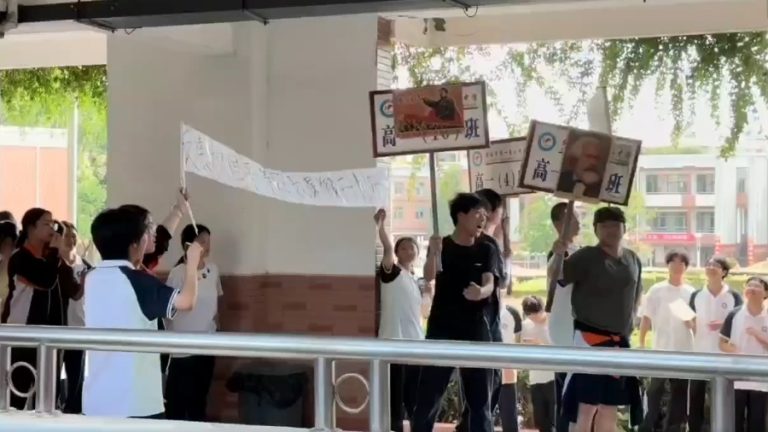
In China’s schools, children as young as six are enrolled in the Young Pioneers, the Party’s youth organization, as a routine part of the educational curriculum. Teenagers are expected to progress into the Communist Youth League. Adults in government jobs or state-linked workplaces face strong institutional pressure to join the Party itself. At each stage, membership requires swearing a public oath to dedicate one’s life to communism and never betray the Party.
Quitting on record is an act the Party provides no safe mechanism for. People who attempt to renounce their membership through official channels risk professional consequences, harassment, or worse.
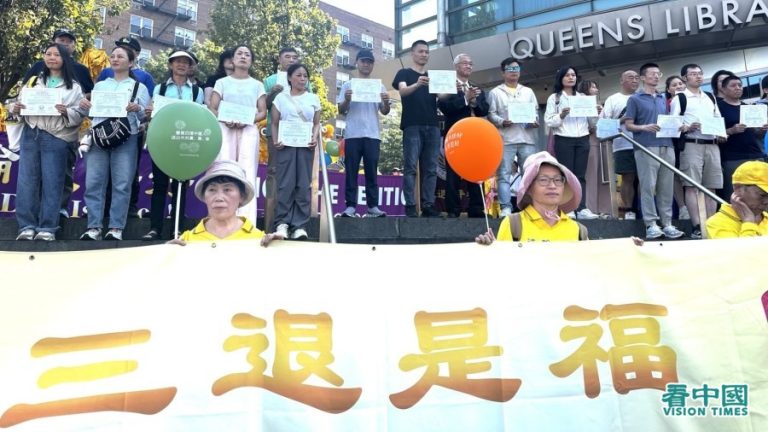
That gap, between millions enrolled without genuine consent and the absence of any legitimate exit, is what the Global Service Center for Quitting the CCP was created to fill. The U.S.-based nonprofit operates a secure online portal where Chinese citizens can submit formal withdrawal declarations, using a pseudonym if necessary. Those who cannot reach the portal due to China’s internet firewall may write their statement by hand and post it publicly. These declarations count, though they are not entered into the tracked database.
The act of renouncing all three organizations is called “Santui” in Chinese, meaning “three withdrawals,” or sometimes simply “Tuidang,” meaning “quitting the Party.” Since the movement began in late 2004, more than 450 million such declarations have been filed. In January and February 2026 alone, the total grew by more than 2.15 million.
Success
You are now signed up for our newsletter
Success
Check your email to complete sign up
What pushed people to sign
The declarations filed in early 2026 are not written in the language of ideology. They read like personal reckonings.
Wu Rutang, a supplier from Hebei province, spent years trying to collect payment from the local government for tree saplings he had provided. When he finally got an answer, an official told him the money was gone, spent on building a martyrs’ cemetery. He filed his withdrawal declaration the same day.
Ren Zhonghao, a young lawyer based in Changsha, Hunan, described the moment his faith collapsed: the summer of 2015, when Chinese authorities detained more than 300 lawyers and legal activists in a single coordinated sweep, an event known as the “709 Crackdown” after the date it began. “I lost all remaining hope,” he wrote.
Cao Ji’an, an 89-year-old Beijing resident, offered a simpler verdict after a lifetime of observation: “The CCP is corrupt and cruel. Heaven will not spare it.”
Across hundreds of declarations, a common theme emerges around the question of consent. Liu Wanting, a young woman from Chongqing, wrote that she joined the Communist Youth League because she believed refusing would cost her job opportunities. Liu Kuiying from Hebei said enrollment was simply required at her middle school. Li Xiuping wrote that she had doubted the Party’s version of history for years but saw no way out. The Nine Commentaries on the Communist Party, a 2004 series of essays by The Epoch Times that documented the Party’s history of mass violence and deception, appears repeatedly in declarations as the text that finally gave people a framework for what they had long sensed.
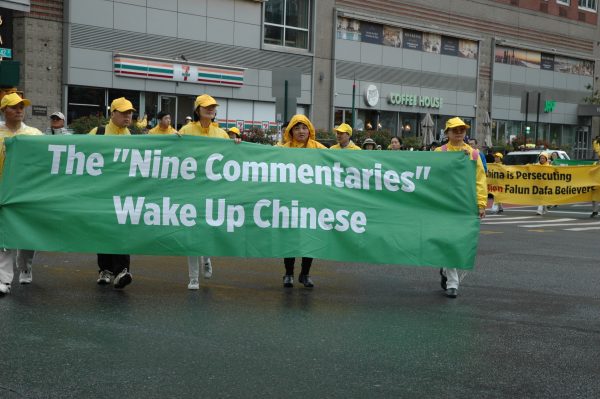
The people signing are not who you might expect
On Jan. 24, ten civil servants signed a joint renunciation statement. In China, civil servants operate under close political monitoring; open dissent is a career-ending, sometimes life-altering act. Their statement described the withdrawal as “a silent protest against institutional bullying” and a refusal to spend the rest of their working lives as “compliant tools” of a system they regarded as morally bankrupt.
Three veterans, who identified themselves as Jin Sanqiang, Ding Erfeng, and Jiang Dadao, signed together after reading the Nine Commentaries. Their statement reached back through decades of Party-inflicted suffering: the forced collectivization of the 1950s, the political purges of that era, the man-made famine of the Great Leap Forward that killed tens of millions. “The Party lured farmers into the cities to extract their labor,” they wrote, “then branded them as ‘low-end population’ and drove them back to ruined villages to fend for themselves.”
Xu Zhiheng, an art student studying in the United Kingdom, kept his declaration brief: “The essence of art is truth. The essence of the Communist Party is lies.”
Revelations about the Party’s forced organ harvesting from prisoners of conscience, a practice extensively documented by independent investigators and denied by Beijing, have prompted declarations from people who cite it as their breaking point. Reports about actor Yu Mengling, whose public controversy exposed the Party’s use of entertainment celebrities to manufacture political loyalty, appear in other submissions.
One man’s reckoning
Among the recent declarations, one from a Hunan man named Hu Qian stands out for the clarity of its self-accounting.
He describes learning as a small child to tie the red neckerchief of the Young Pioneers and singing “Without the Communist Party, There Would Be No New China,” an anthem taught to every Chinese schoolchild. He did not know then, he writes, that the red of that flag represented the blood of tens of millions killed under Party rule. He joined the Communist Youth League as a teenager, genuinely believing he could serve the people. “Then I grew older. And I realized that those ‘people’ never included me.”
His declaration moves through what he witnessed over a lifetime: state violence deployed to suppress inconvenient truths, propaganda used to control thought, class struggle weaponized to destroy families, economic rewards offered in exchange for political compliance. Each item is concrete. Each is drawn from his own experience.
“Withdrawing is not retreat,” he concludes. “It is the starting point of freedom. People are not born to serve the Party. I, Hu Qian, choose truth. I choose justice. I choose the future.”
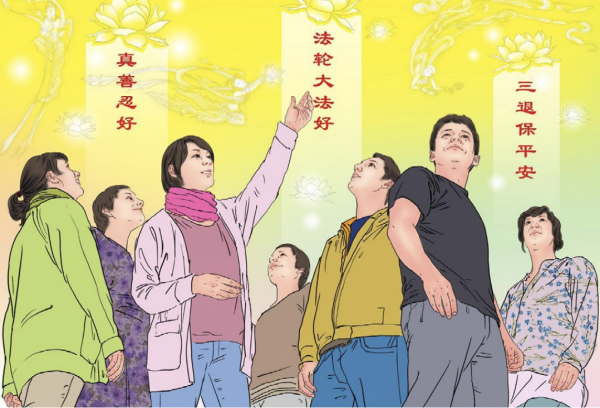
A global movement, not just a Chinese one
The Tuidang movement has always had an international dimension, but 2026 has made it harder to ignore.
In London, thousands demonstrated against the Chinese Communist Party’s plans to build a new embassy complex near the Tower of London. In Berlin, activists used projectors to display anti-CCP messages on public building facades overnight. Rallies took place in New York and Los Angeles in the first weeks of the year. International attention to the human rights situations in Hong Kong and Xinjiang continued to grow.
A separate initiative open to people outside China, the “End CCP” petition, has collected more than 5.17 million signatures since its launch in 2020. Signatories hold the Party responsible for the COVID-19 pandemic, arguing that suppression of early warnings turned a containable outbreak into a global catastrophe, and call for international accountability for what they describe as decades of brutality visited on the Chinese people and, increasingly, on the world.
The Global Service Center noted in its 2026 New Year statement that overseas Chinese participation has risen sharply. What began as a movement to help people inside China formalize a private conviction has become a global argument about what the Communist Party is, what it has done, and what accountability might look like.
Editor’s Note: This article is based on figures and personal statements published by the Global Service Center for Quitting the Chinese Communist Party (Tuidang Center) and related sources. These claims have not been independently verified.