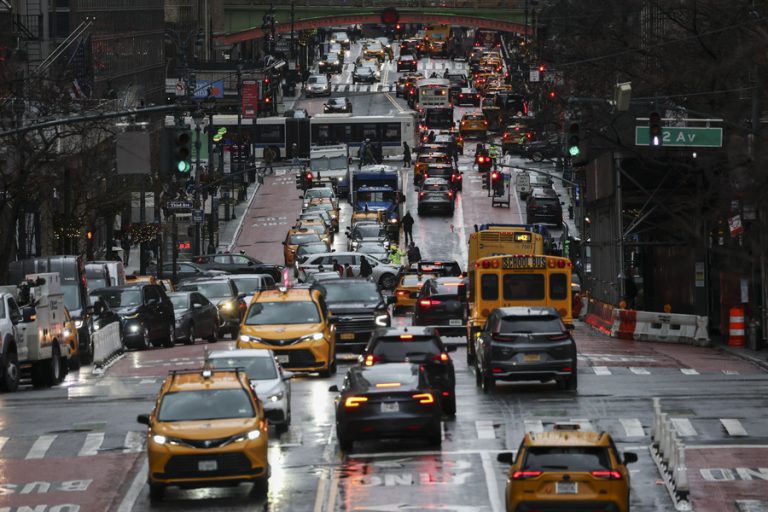
Car insurance in New York has reached a breaking point, with costs climbing to levels that now rank among the highest in the country. Researchers and policymakers increasingly agree that the problem runs deeper than normal market fluctuations.
A transportation research center affiliated with the City University of New York has now stepped into the debate, urging state lawmakers to pursue targeted reforms aimed at restoring affordability.
In a formal letter to Senate Majority Leader Andrea Stewart-Cousins and Assembly Speaker Carl Heastie, the University Transportation Research Center (UTRC) laid out what it described as the structural drivers behind the surge in premiums.
The numbers are stark. Full coverage now averages around $4,000 a year, nearly double the national figure. Even minimum coverage policies cost significantly more than in most other states. In 2025 alone, premiums rose about 13.5 percent, one of the sharpest increases nationwide.
The impact stretches well beyond individual drivers. Small businesses, taxi operators, for-hire vehicles, limousines, bus companies, and public transit agencies are all absorbing the rising costs.
Success
You are now signed up for our newsletter
Success
Check your email to complete sign up
Fraud and litigation driving a ‘hidden tax’
The UTRC argues that these increases cannot be explained by ordinary market dynamics. Instead, it points to a set of systemic distortions that have gradually pushed costs higher.
Matthew W. Daus, the center’s chair of transportation technology, and Camille Kamga, its director and a professor at the City College of New York, identify organized fraud as a central factor. That includes staged accidents, exaggerated or fabricated claims, and extensive abuse of the state’s no-fault insurance system.
They also point to medically unnecessary treatments and legal practices that amplify claim severity, particularly in litigation-heavy cases.
The result, they argue, functions as a “hidden fraud tax” built into every policy. Their estimate: roughly $200 per policy each year, passed directly on to consumers.
UTRC’s findings draw on years of research into the commercial auto insurance market, particularly in sectors such as taxis, for-hire vehicles, and limousines. The center, which participates in the U.S. Department of Transportation’s University Transportation Centers program, has previously identified regulatory inefficiencies, liability structures, and market constraints as key cost drivers.
Some of that research has already shaped policy. New York City’s Local Law 90 of 2025 capped personal injury protection requirements imposed by the Taxi and Limousine Commission at no more than 200 percent of the state minimum, currently $50,000 per person, offering limited relief to the industry.

Hochul’s reform plan gains traction
Governor Kathy Hochul has advanced a reform package that closely mirrors many of UTRC’s recommendations, signaling growing alignment between academic research and state policy.
Her proposals focus heavily on fraud enforcement. They include new legal consequences for staged accidents, a narrower definition of “serious injury” under the no-fault system, and adjustments to comparative negligence rules so that compensation more closely reflects a claimant’s share of fault.
The plan would also limit non-economic damages in certain circumstances, such as when a driver is primarily responsible for an accident, lacks insurance, or is engaged in criminal activity.
Hochul has framed the reforms as a targeted effort to curb abuse while preserving core protections for legitimate victims. The proposals have drawn support from a wide range of groups, including religious leaders, labor unions, and transportation providers.
At the same time, negotiations remain ongoing, with lawmakers weighing how to balance affordability, consumer protection, and market stability.
The reform package also looks beyond enforcement. It encourages wider use of telematics and usage-based insurance, allowing premiums to better reflect actual driving behavior. It calls for stronger data sharing between insurers and regulators, tighter oversight of billing and claims practices, and reinforcement of the state’s excess profits law to ensure savings reach policyholders.
Potential savings for public transit and consumers
The financial stakes extend into the public sector.
Analysis by the Metropolitan Transportation Authority suggests the proposed reforms could reduce its insurance costs by nearly $48 million annually, freeing up resources for transit improvements.
Hochul has emphasized that the issue reaches far beyond private drivers. It affects transit riders, emergency services, and the broader economy. She has also pointed to cases in which public transit agencies face large settlements despite bearing little or no fault.
UTRC’s analysis draws heavily on reforms implemented elsewhere.
In Florida, recent liability and insurance changes have already begun to lower premiums. Major insurers have announced reductions for 2026, with nearly 80 percent of policyholders expected to benefit. Consumers have also received close to $1 billion in refunds or credits, supported by reduced litigation and excess profit mechanisms.
Texas and other states have adopted modified comparative negligence rules that limit or bar recovery for parties primarily at fault. According to UTRC, these frameworks have helped reduce both the frequency and severity of claims while preserving protections for genuinely injured individuals.
The center also recommends expanding safe driving incentives, requiring technology-based discounts, and strengthening the use of data analytics to detect fraud more effectively.
What happens if nothing changes
UTRC warns that without intervention, the current trajectory will continue.
Premiums are likely to keep rising, placing additional strain on household budgets, small businesses, and essential transportation sectors. Fraud and inefficiencies alone are estimated to add hundreds of dollars to the average policy each year.
The center argues that targeted reforms, including stronger enforcement, streamlined claims oversight, wider adoption of telematics, and adjustments to liability rules, could deliver measurable relief without weakening consumer protections.
Strengthening the state’s excess profits law would also ensure that cost savings are returned to policyholders, rather than absorbed by insurers, an approach already used in states such as Florida.
A broader national pattern, with local pressures
New York’s situation reflects broader national trends but is intensified by local conditions, including high population density, elevated medical and legal costs, the structure of the no-fault system, and a long history of litigation.
Insurers report thousands of suspected fraud cases each year, with staged accidents among the most common.
Supporters of reform, including business groups, transportation agencies, and some community leaders, argue that rising costs are hitting working families, immigrants, and minority communities particularly hard.
Opponents, including some plaintiff attorneys, warn that tightening legal thresholds could limit legitimate claims and weaken protections for injured parties.
UTRC has positioned itself as a nonpartisan academic resource in the debate, offering data, analysis, and technical support to lawmakers as they consider next steps.
With budget negotiations underway, the question is no longer whether the system is under strain, but how far policymakers are willing to go to fix it.