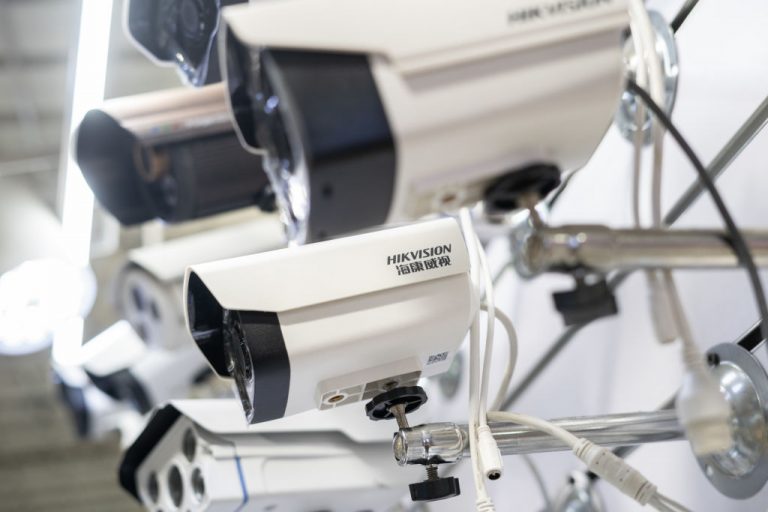
Recently, reports have emerged claiming that, due to suspicions of internal U.S. and Israeli spies, more than 300 people—including senior executives, R&D leadership, and technical staff at Hikvision, which provides surveillance systems to Venezuela and Iran—have been taken away.
Hangzhou head-quartered Hikvision is partially owned by the Chinese state and it manufactures video surveillance and AIoT solutions.
Online commentary has also suggested that Xi Jinping may have developed a sense of anxiety toward the vast network of surveillance cameras spread across China, potentially facing backlash in a scenario described as “being attacked with one’s own weapon.”
Reports of a sweeping crackdown at Hikvision: executives and R&D department implicated
On Feb. 28, 2026, a joint U.S.–Israeli force launched an airstrike on Iran, reportedly killing Iran’s Supreme Leader Ali Khamenei, followed by a series of precise strikes eliminating several high-ranking Iranian officials.
On March 2, an article in the Financial Times stated that Israeli intelligence agencies had successfully infiltrated Iran’s road surveillance camera systems in advance, allowing them to track Khamenei’s daily travel routes, activity schedules, and accompanying personnel over an extended period. After compiling and analyzing vast amounts of data, Israel—working in coordination with the U.S. Central Intelligence Agency’s precision targeting technology—ultimately carried out the lethal strike on Iran.
Success
You are now signed up for our newsletter
Success
Check your email to complete sign up
On April 6, 2026, Chinese pro-democracy activist Sheng Xue, who resides in Canada, posted on the X platform, revealing startling information allegedly provided to her by an insider in China known as “Mr. X.”
Mr. X stated that more than 300 people from Hikvision—including the company’s top executives, senior R&D leaders, and technical staff—have been taken away by Chinese authorities. The alleged reason is linked to incidents in which the U.S. military reportedly captured Venezuelan leader Nicolás Maduro and Iranian officials were killed in strikes. Surveillance systems in both Venezuela and Iran were said to have been supplied by Hikvision.
According to Mr. X, vulnerabilities in Hikvision’s surveillance systems were exploited by the United States and Israel, leading to the elimination of Iranian officials. He claimed that all Hikvision surveillance systems in China are now being replaced. Furthermore, Hikvision’s Xi’an R&D department was reportedly cleared out overnight. It is also said that arrests are taking place in Hikvision’s R&D centers in Shanghai and Zhejiang, with more than 300 people detained in total. The Xi’an R&D center alone, which originally had over a thousand employees, was reportedly emptied overnight.
Mr. X pointed out that the issue lies in how easily Hikvision’s backend systems can be accessed by foreign entities to obtain information. As a result, he claimed that governments around the world are now removing Hikvision surveillance systems, with some even returning products. Even in cities like Beijing, Shanghai, and Guangzhou, Hikvision products are reportedly being considered for suspension, while many street-level surveillance cameras across China have yet to be addressed.
Sheng Xue’s source, Mr. X also described the stance of the Chinese authorities: Key figures in Hikvision’s R&D leadership and core technical staff have all been taken away under suspicion of internal espionage. He added that China’s entire security sector—including major companies like Hikvision and Dahua—is now being investigated for spies.
Mr. X remarked that the situation is ironic. He said that China’s top leader, Xi Jinping, has become extremely wary and feels he can no longer trust anyone. He stated: “Look at the people he trusted most—Qin Gang, Li Shangfu, and Liu Zhenli—who have all been accused of being U.S. spies. Now there are even internal claims suggesting that Ma Xingrui may also have questionable loyalty.”
Ms. Sheng Xue responded: “I have always believed that Xi Jinping’s governing methods would eventually bring down the Communist Party from within.”
At present, Vision Times has not been able to independently verify the authenticity of these claims.
Netizens on the X platform expressed comments such as:
“The CCP concentrated surveillance technology from a few corporate giants, letting Hikvision dominate alone. As a result, once problems occur, the entire security system collapses. Centralized control is the CCP’s instinct, and centralized collapse is the inevitable cost—they are reaping what they sow.”
One user shared personal experience to confirm:
“China’s surveillance quality is extremely poor. I used to think all surveillance systems in the world were Chinese, so I specifically bought four high-end cameras from AliExpress. The results were terrible. First, the video angles were very narrow, they often malfunctioned, and during setup I had to go back and forth with the domestic supplier on WeChat for a long time. The software is very poorly designed. I no longer use them and have replaced the system with an American one.”
Another user pointed out:
“The surveillance operations in Iran and Venezuela were not done by Hikvision, but by Tiandy Technologies, a company based in Tianjin! Also, Hikvision has been cutting R&D staff across all locations, keeping only the headquarters’ R&D, and this has been going on since last year.”
Some even mocked China’s top leader Xi Jinping, saying:
“I never understood Emperor Chongzhen before, but after studying Xi Jinping, I finally do.”

Analysis: Xi Jinping trapped in a panic caused by the surveillance cameras
Netizens say Chinese leader Xi Jinping is deeply concerned, as China’s hundreds of millions of surveillance cameras could pose a threat to his safety—especially after the Iranian leadership was killed by US-Israel using traffic camera surveillance.
On March 4, 2026, an X platform blogger “Zhu Yunhe” posted:
“Under CCP rule in China, what is Xi Jinping supposed to do with 700 million surveillance cameras? This number surpasses any other country in the world. On average, roughly three cameras are watching every seven Chinese people. For Xi, this is also a huge security risk. The fact that Mossad was able to use spies and traffic cameras to end Khamenei’s life already serves as a cautionary example.”
X platform users commented:
“The devil grows taller, but the way grows taller still—it’s only natural.”
“Using your own spear to attack your own shield—brilliant!”
“Hikvision and Dahua’s high-definition facial recognition cameras have become tools for the dictator’s own downfall.”
Some users even suggested:
“The CCP probably plans to dismantle surveillance cameras nationwide.”
These comments reflect Xi Jinping’s alleged panic and his dilemma of being trapped by the very system of cameras he installed.
A widely circulated post sarcastically wrote:
“President Xi is terrified! Financial Times reports that during Israel’s operation against Khamenei, they hacked Tehran’s city surveillance cameras to track the movements of Iranian officials’ security and private drivers! China has the most cameras in the world, especially in Beijing. CCP officials are exposed from every angle, and Xi Jinping is being watched by the very cameras he installed! This is truly ‘lifting a rock only to drop it on your own foot’—hurry up and take down the cameras!”
In March 2026, Taiwanese scholar Professor Li Zhongxian of the Department of Electrical Engineering at National Cheng Kung University posted on Facebook:
“In digital-authoritarian China, because the Iranian dictator group was exposed and eliminated through digital surveillance, the media has noticed that Xi Jinping, for his own safety, has begun removing street surveillance cameras that were originally installed to monitor the public.”
He explained:
“Suppose one day the surveillance system is infiltrated, data leaks, or location information is exploited in reverse. Systems originally used to monitor the people can then be used to monitor the core of power. Databases initially meant to watch society can become a precise map for attackers. Information technology is not loyal; it only obeys architecture and vulnerabilities. Any tool you use to monitor others can also be used to monitor you.”
Li Zhongxian analyzed Xi Jinping’s panic:
“If one day the power core begins to feel uneasy about the surveillance system it established—whether limiting it, adjusting it, or redistributing control—that is not a joke; it is a signal of anxiety. It means they realize: technology is not one-way, control is not absolute, and digital centralization itself is a risk.”
“Xi Jinping built a digital-authoritarian power system, but digital authoritarianism has a fundamental contradiction: it requires high centralization, but high centralization equals high risk.”
In short, this sentence highlights the backlash of Xi Jinping forcibly installing high-density cameras across mainland China.
According to the Baidu Encyclopedia, Hangzhou Hikvision Digital Technology Co., Ltd. (Hikvision) was established on November 30, 2001. Hikvision focuses on smart IoT, big data services, and intelligent business, providing integrated hardware and software solutions, cloud-edge intelligent IoT products and services, and big data platforms that combine information and intelligence. The company also develops innovative areas such as smart homes, mobile robotics and machine vision, automotive electronics, intelligent storage, and smart fire protection. Its products and solutions are applied in more than 180 countries and regions.
Information collected by Sheng Xue shows that, according to 2025 industry ratings (such as JVSG), Hikvision holds approximately 25.7% of the global surveillance market, far exceeding the second-ranked Swedish company Axis at 12.9%.
In 2024, Hikvision’s R&D investment totaled 11.864 billion RMB.