On April 3, 2026, a document labeled “Police Situation Report” spread rapidly on X. The bulletin describes a catastrophic attack at the Dahanji Village open-air market in Hancunhe Township, Fangshan District, Beijing, on March 29, 2026. Reactions among Chinese-speaking users split immediately. Some said “something huge has happened in Beijing.” Others flooded the replies with denials, profanity, and personal attacks on anyone sharing the document.
The Chinese Communist Party has issued no official statement. But the regime’s own actions in the days that followed tell a story. Cai Qi, the Politburo Standing Committee member who runs the CCP’s day-to-day operations as head of the Party Secretariat, convened an emergency security meeting two days after the alleged attack. Cai, widely seen as Xi Jinping’s closest political enforcer, used language that read like a leadership in crisis. A recently leaked internal document from Zhongke Tianji, a CCP-linked technology contractor, also revealed the regime’s exact playbook for discrediting leaked information of this kind using AI-powered troll farms.
What the leaked Beijing police bulletin describes
The document describes two sequential attacks at the Dahanji Village open-air market in Beijing’s Fangshan District on Sunday, March 29, 2026.
Mass poisoning with sodium nitrite: At approximately 7:30 a.m., a 53-year-old man surnamed Qu, from Jinzhou in the northeastern province of Liaoning, entered the market. Posing as a customer, he moved through more than 50 open-air food stalls and, while vendors were distracted, dropped large quantities of sodium nitrite, a toxic industrial salt, into their cooking pots. The bulletin states that 1,170 people were poisoned. At the time of its writing, 975 had died despite emergency treatment. Another 195 remained in critical care.
Front-end loader ramming: Between 11:00 a.m. and noon, Qu drove a front-end loader through the market entrance and repeatedly rammed crowds and market stalls, killing 18 people and injuring 33, nine of them critically.
Success
You are now signed up for our newsletter
Success
Check your email to complete sign up
Motive: According to a preliminary investigation cited in the document, Qu had been entangled in an economic dispute with a factory and a rental company. He was described as a long-term petitioner, one of the millions of Chinese citizens who try to seek redress from higher-level authorities after local CCP officials refuse to address their grievances. The regime treats persistent petitioners as a security threat. Qu had been taken into custody.
Online reactions to the leaked bulletin were extreme on both sides. Some believed it. Others attacked anyone who shared it with a fury far beyond ordinary skepticism: “anyone who spreads rumors deserves their whole family dead,” “I wouldn’t believe this garbage if I weren’t living in Beijing myself.” The intensity was disproportionate, even by the combative standards of Chinese internet discourse.
Xi Jinping’s enforcer held an emergency security meeting two days later
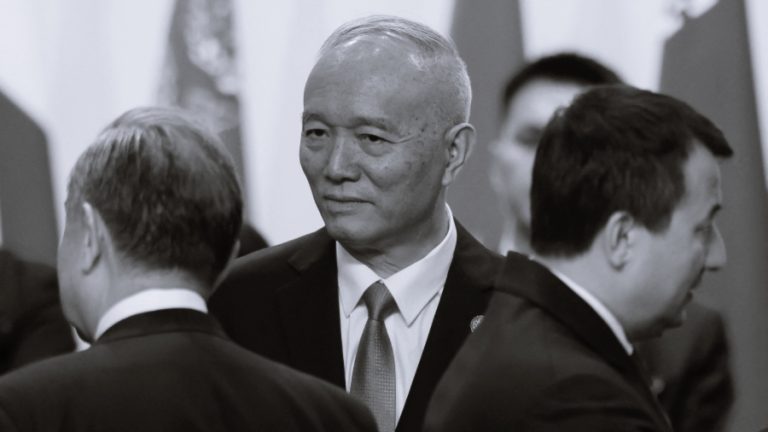
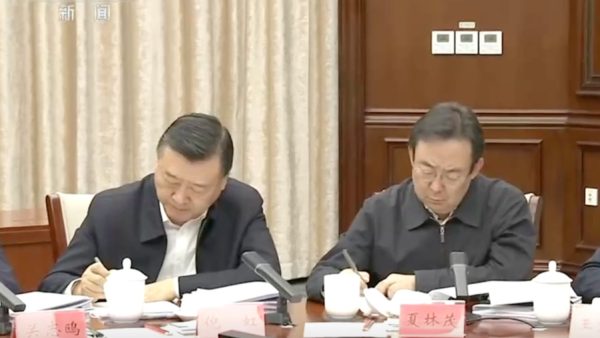
CCP state media reported that on March 31, 2026, two days after the date on the leaked police bulletin, the seventh plenary session of the 20th Capital Planning and Construction Committee convened in Beijing. Cai Qi chaired the meeting and delivered the keynote address.
CCTV footage showed a visibly tense atmosphere in the room.
Cai’s speech was loaded with security language: “Thoroughly implement the comprehensive national security concept, strengthen integrated protective measures, build a resilient city, and effectively prevent and defuse all types of security risks to safeguard the capital’s safety and stability.”
The leaked bulletin is dated March 29. Two days later, the most powerful CCP official responsible for Beijing’s political management convened a special meeting saturated with references to “safety,” “risk prevention,” and “defusing security risks.” For a regime that governs by carefully controlling its public messaging calendar, this kind of emergency gathering reflects deep anxiety within Xi Jinping’s inner circle.
One detail drew attention among China-watchers. Xia Linmao, Beijing’s executive vice mayor, who had recently been rumored to be under CCP investigation, appeared in the broadcast footage and received a noticeable amount of camera time. In the CCP’s visual grammar, prominent screen time for an official typically signals that they remain in good standing. Yet Xia looked visibly haggard, his expression that of a man who knows his political survival is not guaranteed. Appearing on state television and being safe are two different things in the CCP system.
The tense atmosphere, the security-saturated language, and the grim look on Cai Qi’s face throughout the meeting all reinforce what the leaked bulletin claims: something catastrophic happened in Beijing, and the regime is trying to bury it.
A leaked CCP contractor document shows how the regime suppresses leaks like this one
The accounts flooding X with accusations of “rumor-mongering” and personal attacks may not be real people at all. A leaked internal document from Zhongke Tianji, a CCP-affiliated technology contractor involved in the regime’s online influence operations, lays out the strategy explicitly.
The Zhongke Tianji document states the company’s mission plainly: “post rational-sounding comments behind anti-China accounts (using a combination of human operators and algorithms) to guide the fragmentation and division of anti-China groups.”
“Rational-sounding” is the CCP’s internal euphemism for coordinated suppression. In practice, it means flooding comment sections with scripted messages designed to make anyone sharing sensitive information look like a liar or a fool.
Research by Taiwan’s Doublethink Lab, a Taipei-based organization that tracks CCP information operations, has documented the infrastructure behind these campaigns. Zhongke Tianji runs a centralized command-and-control platform called the “Global Multi-Platform Account Cultivation System.” Each node can manage more than 50 mobile devices simultaneously, running coordinated account farms that push scripted responses across social media platforms while mimicking organic user behavior.
The comments attacking the leaked Beijing police bulletin fit the pattern. They varied slightly in wording but hammered the same message across dozens of accounts: “rumors,” “idiots,” “liars.” That kind of uniformity does not emerge from spontaneous public opinion. It emerges from a control room.
And the volume of the attack matters. When CCP influence operations throw this much firepower at a single post, it is because whatever that post contains has hit close to something the regime cannot afford to let spread.
By Jianyi