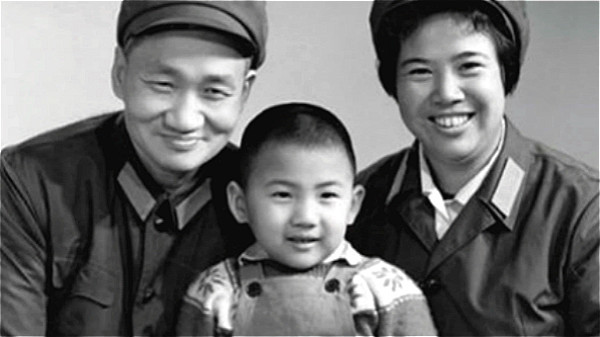
A grandfather who never came
Mao Zedong was 77 when he learned he had a grandson. He named the boy Xinyu. Then, for six years, until his death in September 1976, he never went to see him. No visit, no photograph, no recorded meeting.
This absence has circulated periodically on the Chinese internet for years, each time drawing fresh scrutiny to Mao Xinyu’s origins. The journalist Zhou Haibin, writing in the publication Tongzhou Gongjin, asked the question directly: why did Mao Zedong spend the final six years of his life ignoring the only grandson who bore his name?
The boy’s mother, Shao Hua, was the wife of Mao’s surviving son Mao Anqing. She was also the woman Mao’s fourth wife, Jiang Qing, the radical cultural enforcer who would later lead the “Gang of Four,” hated above almost anyone else in the household.
Jiang Qing’s hostility toward Shao Hua was not private. In June 1966, at the height of the Cultural Revolution, Jiang Qing appeared at Peking University and attacked Shao Hua before a crowd of more than ten thousand students and faculty. Shao Hua was sitting in the audience. Jiang Qing screamed that Shao Hua was “not a real daughter-in-law.” She called Shao Hua’s mother, the veteran revolutionary Zhang Wenqiu, “a political swindler,” and connected Shao Hua to what the Cultural Revolution called the “black line” in literature and art, a broad accusatory category used to destroy careers and lives.
“I have never acknowledged her as Mao Zedong’s daughter-in-law,” Jiang Qing declared.
Success
You are now signed up for our newsletter
Success
Check your email to complete sign up
Li Xuefeng, who served at the time as first secretary of the Beijing municipal Party committee, later recalled the scene: Jiang Qing’s words were immediately transcribed and distributed as pamphlets carrying the authority of “remarks by a central leader.” They spread across the country. That night, Shao Hua and Zhang Wenqiu fled their home and went into hiding across Beijing to avoid the Red Guards Jiang Qing’s denunciation had effectively sicced on them.
The biographer Ross Terrill, in his biography of Jiang Qing, recorded that she needed to be physically restrained during the harangue. Chen Boda, another senior Cultural Revolution operative, touched her shoulder to signal she should stop. The crowd of more than ten thousand sat in silence. Terrill wrote that observers nearby could hear Chen whisper to Jiang Qing: “I think it should end now.” Jiang Qing glared at him and paused.
Given this context, Shao Hua’s refusal to bring her son into Zhongnanhai, the fortified compound in central Beijing where Mao and the Party leadership lived, was a mother’s judgment about what Jiang Qing might do if given access to the boy. As the journalist and former magazine editor Liu Ming, a middle-school classmate of Shao Hua’s, later told overseas Chinese media: Shao Hua believed Jiang Qing was capable of anything.
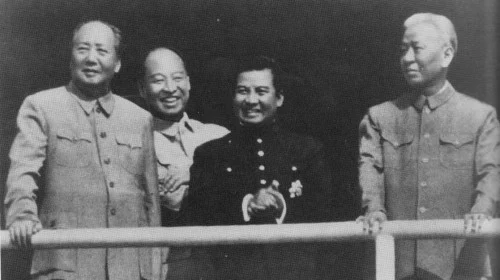
The health excuse does not hold
One standard explanation offered by Party-aligned commentators is that Mao was simply too ill in his final years to receive visitors, even close family. The writer Zhong Bo investigated this claim and found it weak.
Mao Xinyu was born in January 1970. Mao’s health did not deteriorate sharply until after the Lin Biao affair in September 1971, when his longtime military commander and designated successor attempted to flee to the Soviet Union and died in a plane crash in Mongolia under disputed circumstances. Before that point, Mao was publicly active. On May 20, 1970, he stood on the rostrum of Tiananmen Gate for two hours to deliver a statement. On May 1, 1971, he walked the length of the Tiananmen parapet multiple times at an evening celebration. His grandson was already a toddler.
Even after his condition worsened, Mao retained the capacity for carefully managed meetings. In the months before his death, he received Pakistani prime minister Zulfikar Ali Bhutto. If he could manage a formal diplomatic audience in his final decline, he could have endured a brief meeting with a child.
The theory that Mao simply did not know he had a grandson is equally unconvincing. Mao’s authority within the Party was such that no subordinate would have dared withhold the news from him.
The absence is documented in the Party’s own publications. A volume titled Warm-Hearted Mao Zedong, compiled by the Central Party Literature Research Institute and published by Liaoning People’s Publishing House in 2005, contains photographs of Mao with Shao Hua, but none of Mao with Mao Xinyu.
Mao Xinyu himself has published two books about his grandfather: Grandfather Mao Zedong and Grandfather Encouraged My Growth. Both books contain many photographs of Mao Zedong and many photographs of Mao Xinyu. None shows the two of them together. Official Party sources claim Mao did meet his grandson, but even they concede that no photographic record of the meeting exists.

The question of the boy’s true father
There is a harsher explanation, circulated in detail by sources close to the family: that Mao Zedong knew, or suspected, that Mao Xinyu was not biologically his grandson.
Shao Hua had been romantically involved before her marriage to Mao Anqing. Her boyfriend at the time was Xu Wenbo, the eldest son of Xu Haidong, one of the Communist Party’s senior military commanders. Zhang Wenqiu, Shao Hua’s mother, orchestrated the separation and arranged her daughter’s marriage to Mao Anqing, who had returned from medical treatment in the Soviet Union and had well-documented cognitive difficulties. Shao Hua and Mao Anqing married in 1960. Their son was not born until 1970, ten years later.
People who knew both families have noted that Mao Xinyu’s physical build does not resemble the Mao family pattern. Members of the Mao family carried weight in a loose, soft way around the face. Mao Xinyu’s face has two compact, forward-projecting pads of flesh in the cheeks; those who knew Xu Haidong’s family say the configuration is distinctly the Xu family’s.
Zhong Bo’s conclusion, offered cautiously, is that Mao Zedong may have had reason to believe the boy bore no blood connection to him, and that this belief shaped his decision to stay away.
Family members who keep their distance
The estrangement has extended to the next generation. Reports from overseas Chinese media indicate that Mao Xinyu’s two “aunts,” Li Min and Li Na, Mao Zedong’s daughters by different mothers, as well as his nominal cousin Mao Yuanxin, Mao’s nephew who served as the founder’s personal liaison and wielded enormous power in the final years of the Cultural Revolution, have all declined to join Mao Xinyu in commemorating Mao Zedong at his mausoleum.
The Party has no incentive to examine any of this carefully. Mao Xinyu holds a general’s rank in the Chinese military and functions as a living symbol of the Mao legacy. The official position is that nothing unusual occurred. In the complete official record of Mao Zedong’s family life, one image is missing: a grandfather holding his grandson. No explanation has ever been offered.