On Tuesday, April 14, the situation in the Middle East escalated sharply. U.S. Central Command commander Admiral Brad Cooper openly stated on social media: “The U.S. military has fully blockaded Iranian ports to maintain America’s maritime dominance in the Middle East.”
He further emphasized a key point: “About 90 percent of Iran’s economy relies on maritime international trade, and less than 36 hours after the blockade was implemented, this lifeline has already been completely cut off.” This statement was not a warning, but a “suffocation-style strike” that had already been carried out.
The operation officially began at 10 a.m. U.S. Eastern Time on Monday. All vessels entering or leaving Iranian ports were included in the blockade zone. U.S. Central Command stressed that the operation “applies equally to all countries’ ships,” covering all Iranian ports in the Persian Gulf and the Gulf of Oman. At the same time, however, the U.S. deliberately left a “gap,” not blocking ships from passing through the Strait of Hormuz to non-Iranian ports—showing control while avoiding accusations of completely shutting down international shipping lanes.
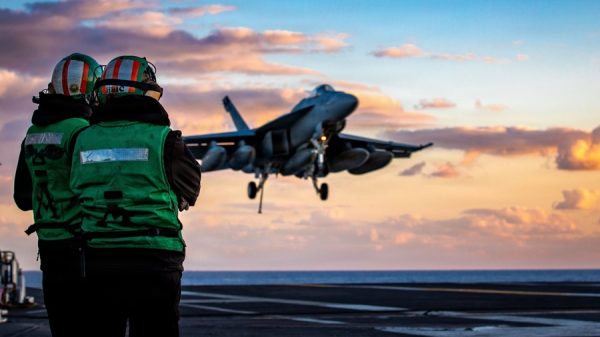
Even more deterrent was the simultaneous military deployment. An F-35B Lightning II fighter jet was stationed on the deck of the amphibious assault ship USS Tripoli, ready for immediate takeoff and mission execution. The ship, carrying about 3,500 sailors and Marines, is currently operating in the Arabian Sea as part of the blockade mission, becoming a key anchor point in the maritime cordon.
Meanwhile, multiple guided-missile destroyers have also joined the operation. These vessels typically carry over 300 highly trained sailors and possess strong offensive and defensive capabilities, meaning this is not just an “inspection line,” but a forward position capable of escalating into military conflict at any moment.
Success
You are now signed up for our newsletter
Success
Check your email to complete sign up
According to ship tracking data and military sources, the U.S. Navy has deployed at least 18 vessels in the Middle East region. This scale itself is a signal: the blockade is not a short-term posture, but a systemic operation prepared for sustained confrontation.
New round of negotiations
In addition, the U.S. and Iran are pushing forward a new round of negotiations, while Iran is considering a “short-term slowdown” strategy—temporarily reducing or even suspending oil shipments through the Strait of Hormuz to avoid directly crossing U.S. military red lines at the early stage of the blockade. This move may appear to be a de-escalation, but its impact goes far beyond the Middle East itself.
For China in particular, this is effectively a “throat-gripping” position. Observers note that when this critical Middle Eastern energy artery becomes entangled in multiple layers of geopolitical competition, the party pushed to the front line of pressure is the Chinese Communist Party (CCP).
Iranian crude oil’s major destination is China. In 2025, industry data suggests that the CCP’s daily imports of Iranian oil have reached about 1.38 million barrels, accounting for the vast majority of Iran’s exports. In other words, China is no longer just an “important customer” for Iran, but almost the only lifeline sustaining its fiscal system. In its most difficult period, demand from the East prevented Tehran from collapsing completely.
Economist Nouriel Roubini, often called the “Dr. Doom” of economics, recently noted that for China, once maritime routes are blocked, energy supply, transportation costs, and even the entire industrial system will be affected in a chain reaction. Such a level of blockade would not only increase regional tensions but also introduce new uncertainty into U.S.-China relations.
From his perspective, this maritime contest is unlikely to end quickly. Even under increasing pressure, Iran is unlikely to concede rapidly, and the deadlock could last two to three months or even longer. He also noted that this situation may disrupt plans for a U.S.-China high-level meeting scheduled for May.
More importantly, the blockade itself sends a clear signal of confrontation. Roubini stated that under such conditions, advancing high-level dialogue lacks constructive logic—pressuring on one hand while seeking breakthroughs in negotiations on the other is inherently contradictory.

China’s perspective
From China’s perspective, the situation appears particularly constrained. On one hand, it has accumulated hundreds of billions of dollars in investments in the Middle East and cannot remain detached; on the other hand, its energy security is highly dependent on the region. If the situation spirals out of control, risks will emerge simultaneously in supply chains, pricing, and overseas asset security.
Chen Shu, a Greater China partner at the Asia Group, also pointed out that China has vast interests in the Persian Gulf, involving not only energy resources but also personnel and investment security. Under the current circumstances, Beijing is essentially facing an extremely difficult task: simultaneously de-escalating tensions while maintaining relationships with Gulf states to ensure cooperation does not break down.
At the same time, on April 14, China’s latest economic data showed serious issues. Customs data revealed that March exports grew only 2.5 percent year-on-year, far below the market expectation of 8.6 percent. This is not merely a slowdown—it reflects a clear weakening of external trade momentum at a critical moment.
Energy data shows a similar impact. In March, China’s natural gas imports fell 10.7 percent year-on-year to a three-and-a-half-year low, while crude oil imports dropped 2.8 percent. In logistics terms, disruptions in the Strait of Hormuz have increased shipping costs, while efficiency and safety have both been affected.
Furthermore, the geopolitical contest over Iran is not simply a U.S.-Iran confrontation. The deeper it is examined, the more complex it becomes, showing an overlapping structure of “internal fractures + external intervention.”
First, Iran is not a monolithic bloc. There are growing differences between the administrative government and the Islamic Revolutionary Guard Corps. However, what complicates the situation further is external involvement.
Iran benefiting from direct support from China
Academic Yuan Hongbing, based in Australia, stated in an interview that the Revolutionary Guard’s continued hardline stance despite sustained strikes is largely due to direct support from China. According to him, this support includes not only material assistance but also deep involvement in technology and systems.
For example, Iran’s underground tunnel networks—considered central to its defense system—are alleged to have involved external technical participation. In addition, via maritime and land routes, covert transfers continue to supply key equipment and components, allowing Iran’s military system to retain a degree of resilience even under blockade.
More importantly, Iran’s internal power structure may itself be reshaped by external factors. Yuan noted reports suggesting that external funding is being selectively directed to the Revolutionary Guard system, strengthening its position within domestic power dynamics. This creates a situation where even if the administrative government seeks de-escalation, hardliners can still dominate external policy.
Against this backdrop, another significant claim emerged. According to CNN, citing multiple U.S. intelligence sources, China is reportedly preparing to deliver a new generation of air defense systems to Iran via third countries to conceal their origin. This indirect transfer suggests not just support, but deliberate evasion and strategic hedging.
After these reports surfaced, Donald Trump responded strongly, stating that if confirmed, the U.S. would consider imposing tariffs of up to 50 percent on Chinese goods as punishment. He framed this as a necessary response to “weapons proliferation and regional instability,” shifting the issue from security into economic confrontation.
The Chinese side quickly denied the allegations. A spokesperson for the Chinese Embassy in Washington, Liu Pengyu, stated that China “has never provided weapons to any party in the conflict” and called the claims “groundless accusations and political manipulation.”
However, what makes the issue sensitive is not only what is being said, but historical precedent. China’s long-standing cooperation with Iran in military technology, energy, and economic sectors makes it difficult for observers to dismiss such claims outright, creating tension between official denials and existing perceptions.
Claims hint at a broader shift
At a deeper level, if such claims were true, they would indicate a broader shift: the Middle East conflict is being embedded into a larger geopolitical competition, where technology, supply chains, and strategic influence are being redistributed. As overt confrontation and covert maneuvering overlap, the situation becomes increasingly unpredictable.
As these hidden dynamics surface, the nature of the entire situation is changing. The Middle East confrontation is being integrated into a broader great-power competition. From Russia and Iran to Venezuela, multiple fronts appear to be burning simultaneously. But at a higher level, they all revolve around one core objective: constraining China.
However, constraining is one thing—direct confrontation is another. In the short term, no major power is willing to push the situation into direct collision. As a result, a subtle pattern emerges: escalation on one side, restraint toward Beijing on the other.
The clearest example is U.S. strategy. While many expected a full-scale escalation in tariffs, technology restrictions, and export controls, the reality has been more measured, with some easing at key points—especially ahead of a possible U.S.-China high-level meeting in May.
Why? Put simply, Washington has more urgent priorities. It needs Beijing not to destabilize key issues and, in some cases, to help bring Tehran and Moscow back to the negotiating table. Meanwhile, China also holds leverage—rare earths, supply chains, and market access—all of which matter to the U.S., alongside Wall Street’s long-term dependence on Chinese markets.
The current situation can be understood as a “pressure and stabilization” dynamic. But beneath the surface, a more direct impact is emerging: the Strait of Hormuz, the world’s most critical energy chokepoint, has become a central arena of competition. If it is effectively blocked, it would not only affect Iran but the entire global energy system.
More interestingly, Iran has begun experimenting with alternative transaction mechanisms, including cryptocurrency and so-called “oil yuan” settlement systems. This represents a challenge to the existing financial order. If expanded, China would likely be a key participant.
Looking further ahead, if “using chokepoints as leverage” becomes a normalized strategy, similar logic could appear elsewhere—for example, in the Taiwan region, potentially affecting semiconductor supply chains. This is no longer purely speculative; it is a pattern being tested in real time.
Thus, the U.S. approach is becoming clearer: rather than confronting China directly, it is targeting surrounding pressure points first. Iran is being squeezed, Venezuela’s energy sector is being reintegrated into U.S. systems, and Russia is being drawn into prolonged attrition. Step by step, these peripheral nodes are being weakened.
China’s strategy, meanwhile, is also clear: avoid direct confrontation while continuing to provide indirect support through energy exchanges, technology transfer, and third-party channels. The advantage is flexibility, but the risk is also obvious—if proven, the costs could be significant.