Multiple reports circulating on Chinese social media in recent days describe an unusual wave of temple closures across multiple regions, accompanied in some cases by a visible security presence, sometimes armed guards. While official explanations remain limited across China’s tightly-controlled media landscape, the developments have drawn widespread attention and speculation.
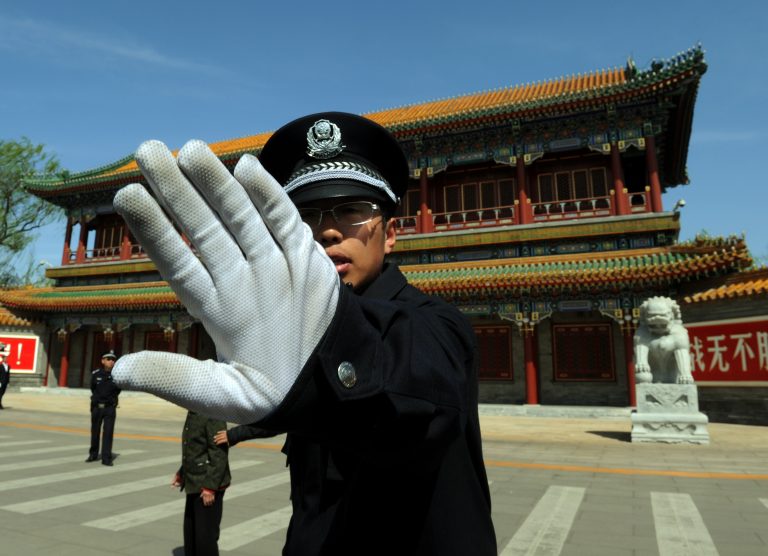
According to online posts and user-shared footage, several well-known scenic and religious sites, including Mount Wutai, Mount Putuo, Mount Tai, and locations in Luoyang, have reportedly seen increased deployment of armed police. Some accounts describe officers stationed at entrances, blocking access to certain areas, and maintaining a visible security posture.
Images and descriptions shared online depict masked personnel and vehicles stationed near entrances to temples and tourist zones. These reports have led some observers to characterize the situation as unusually tense, though independent verification of all claims remains limited.
Fervent public backlash
The developments have prompted strong reactions from social media users. Some questioned the necessity of such measures, while others expressed concern over the broader implications. One commenter wrote: “Are masked individuals pointing guns at ordinary people? This is unheard of.” Another added: “They look like they are trying to intimidate the public. It makes these places impossible to visit.”
A separate post reflected a more systemic concern: “When a government begins to take over faith itself and turn it into a source of revenue to sustain its operations, this is not just control; it may reflect deeper financial pressures.”
Success
You are now signed up for our newsletter
Success
Check your email to complete sign up
In addition to the reported security presence, multiple sources indicate that a number of temples across China have recently announced temporary closures for “rectification” or renovation.
A string of temple closures
Temples in different regions, including sites in Shanxi, Zhejiang, Beijing, and Henan, have issued notices suspending public access. Among them are prominent religious venues such as the Wuye Temple at Mount Wutai, Lingyin Temple in Hangzhou, Yonghe Temple in Beijing, and the Shaolin Temple in Dengfeng.
Some of these sites have also announced measures targeting commercial activity. For example, reports indicate that temporary retail structures and commercial operations within temple grounds are being removed, with deadlines set for complete clearance.
Other locations, such as Yanshan Temple in Shanxi, have suspended visitor access since early February.
Claims of coordinated action
Online discussions have suggested that these closures may be part of a broader administrative campaign. According to publicly cited figures circulating on Chinese platforms, more than 500 Buddhist and Taoist temples have reportedly undergone closure or “rectification” measures as of April 2026.
These figures are attributed in some reports to a multi-agency initiative involving government departments responsible for propaganda, civil affairs, public security, and religious administration. However, detailed official confirmation of the full scope and objectives of such a campaign remains limited.
Some commentators have linked the developments to broader institutional or financial considerations, though these claims remain unverified. One widely-circulated narrative suggests that increased oversight of religious institutions could be tied to tighter fiscal conditions, with religious sites facing stricter regulation and reduced autonomy. Others have speculated about changes in how religious organizations are managed or integrated into broader administrative systems.
At the same time, recent high-profile cases have also drawn attention. In 2025, Shi Yongxin, the former abbot of the Shaolin Temple, was officially investigated on allegations including financial misconduct and violations of religious discipline. While authorities framed the case in legal terms, some analysts have interpreted it as part of a wider tightening of oversight over religious institutions.
Ongoing developments
Despite the volume of online discussion, many details surrounding the reported closures and security measures remain unclear. It is not yet known whether these actions are temporary, localized, or part of a coordinated national policy shift.
Observers note that China has, in recent years, increased regulation of religious activity, particularly in areas involving large public gatherings, finances, and institutional management. However, the scale and visibility of the current reports have prompted renewed scrutiny.
Editorial note: This article is based on publicly circulating reports and commentary from independent analysts. The claims described have not been independently verified by Vision Times, and relevant authorities have not publicly confirmed the allegations.