Deng Xiaoping, who served as the Chinese Communist Party’s de facto top leader from the late 1970s through the early 1990s, is officially celebrated in the People’s Republic as the architect of reform and opening-up. The myth is carefully maintained. Beneath it lies a different story: a man who reached and held supreme power through decades of disciplined silence, tactical submission, and, when the moment required it, organized mass killing. Three episodes from across his career, drawn from Chinese-language memoirs, declassified Soviet archives, and scholarly biographies, provide a different view from the official narrative.
A convenient injury: how Deng avoided the purge that consumed his rivals
The Lushan Conference of the summer of 1959 was among the most consequential internal confrontations in the Party’s history. Senior military and civilian leaders had gathered on Mount Lushan, a hill resort in Jiangxi province, ostensibly to review economic policy. The actual stakes were far higher: what to do about the catastrophic famine already unfolding as a result of Mao Zedong’s Great Leap Forward, the forced collectivization and industrialization campaign launched in 1958 that would ultimately kill tens of millions of people.
Peng Dehuai, the defense minister and one of the most decorated commanders of the revolution, made the fateful decision to address a private letter to Mao criticizing the campaign. Mao chose to treat the letter as a political attack and read it aloud to the full conference. Peng was stripped of his posts, denounced as an “anti-Party element,” and placed under surveillance. His allies were swept up in the ensuing purge. The political atmosphere at Lushan poisoned the Party’s internal culture for years.
Deng attended none of it. His personal secretary, Li Ping, recorded in a memoir titled “Years at Deng Xiaoping’s Side” that Deng had slipped while playing ping-pong before the conference, injured his leg, and remained in Beijing to recover. The biographers Alexander Pantsov and Steven Levine, drawing on Soviet-era archives for their 2015 study “Deng Xiaoping: A Revolutionary Life,” corroborate that Deng cited a physical injury as his reason for absence. The injury spared him any requirement to publicly align himself with either Mao’s rage or Peng’s criticism. Senior Party veterans reportedly commented privately afterward that the accident had shaped the next two decades of Deng’s political trajectory.
The political historian Robert Kaplan put it plainly: “Deng’s luck often came from his low profile, not from his decisions.” After Lushan ended and Peng fell, Deng retained his positions in the Party’s central apparatus and general staff system while others who had been present were forced to make public declarations of loyalty or face consequences.

Success
You are now signed up for our newsletter
Success
Check your email to complete sign up
The affair the censors deleted: Deng’s one known personal scandal
Deng left almost no private life visible in the historical record. A man who spent his career controlling what others knew about him exercised the same discipline over his own biography. There is, however, one surviving account of a personal indiscretion, notable precisely because of how thoroughly it was subsequently suppressed.
Li Zhisui, who served as Mao Zedong’s personal physician over several decades, included in his 1994 English-language memoir “The Private Life of Chairman Mao” a passage about Deng’s hospital stay during the Lushan period. According to Li, Deng developed a romantic entanglement with a young nurse while recuperating from his leg injury. His wife, Zhuo Lin, discovered the relationship and confronted the situation forcefully enough that the nurse was removed. The episode circulated among Red Guards during the Cultural Revolution as proof of high-ranking Party cadre hypocrisy, the kind of conduct that official ideology condemned while Party elites practiced freely. When a Chinese-language edition of Li’s memoir was considered, the passage was cut, reportedly for political reasons.
The episode reflects how Deng’s private life was handled within the system. Almost nothing from his personal relationships or emotional inner life appears in any authorized account. His public persona was built entirely on rationality, composure, and self-control. The removal of the passage from later editions, and the lack of public discussion around it, points to how consistently his image was managed within the Party system.
‘The more you say, the more mistakes you make:’ Deng’s silence as political weapon
Among the generation of military and Party leaders who rose with the Communist revolution, three men were particularly known for saying almost nothing in public: Liu Bocheng, a senior military commander; Lin Biao, Mao’s chosen successor until his mysterious death in a plane crash in 1971; and Deng. The silences were different in kind.
Liu’s reticence, according to his biographer Wang Zhijin, writing in a 2003 volume on Liu’s life, was temperamental; colleagues from the early years described him as a man who thought constantly and spoke only when he had something exact to say. Lin’s withdrawal from social interaction reflected both chronic physical illness, he suffered debilitating headaches, and a deep introversion that Mao reportedly described as “few words, but military genius.” Neither man’s silence was primarily strategic.
Deng’s was. Multiple people who worked closely with him described it as something he had trained himself to do. Li Ping, his secretary, wrote that Deng rarely spoke unless he judged it necessary. The Harvard historian Ezra Vogel, in his 2011 biography “Deng Xiaoping and the Transformation of China,” argued that Deng’s reticence was a direct product of political catastrophe absorbed over decades: he had learned, through repeated experience, that expressing a view before the outcome was clear was a way to end up on the wrong side. Deng himself told his daughter Deng Rong that his governing rule in political life was simple: the more you say, the more mistakes you make.
Three major political destructions shaped that rule. In 1966, Mao’s Cultural Revolution targeted Deng as the “second-largest capitalist-roader in the Party,” a phrase from Maoist ideology denoting someone accused of opposing collectivization and ideological purity. Deng was removed from all positions, sent to work in a tractor factory in Jiangxi province, and placed under surveillance. He was rehabilitated in 1973, returned as deputy prime minister, and then knocked down again in 1976 when Mao’s inner circle accused him of orchestrating the public mourning demonstrations at Tiananmen Square following the death of Prime Minister Zhou Enlai. He regained his positions for the third time in 1977. Each cycle reinforced the same lesson: keep quiet, wait for the situation to clarify, and avoid statements that could later be used against him.

Three falls and three returns: how Deng outmaneuvered everyone who underestimated him
By 1977, Deng was writing letters designed to look like submission. On April 10 of that year, he wrote to Hua Guofeng, who had assumed the Party chairmanship after Mao’s death, and to Ye Jianying, a senior military elder who had helped engineer the arrest of the “Gang of Four,” the radical faction led by Mao’s widow that had dominated Chinese politics in Mao’s final years. Deng’s letter thanked the Party leadership for clarifying that he had no connection to the 1976 Tiananmen demonstrations, and offered to serve Hua into the twenty-first century. The language was deferential to the point of self-effacement.
Hua read the letter as sincere. He was operating in the difficult conditions of a post-Mao power vacuum, under pressure from senior military elders including Ye to bring Deng back into formal positions. At a Politburo meeting, Hua declared that Deng should “come out and work in a clear and dignified way.” Hua believed he was managing a subordinate. Deng spent the next four years quietly dismantling Hua’s political base.
At the Party’s Third Plenum of the Eleventh Central Committee in December 1978, a meeting the Party’s official history credits with launching China’s reform era, Deng secured the ideological and political conditions for his consolidation of power. By 1981, Hua had resigned the Party chairmanship. By 1987, Deng had forced out the reformist Party general secretary Hu Yaobang, whose death in April 1989 would become the starting point of the student demonstrations at Tiananmen. By 1989, the pragmatic Party general secretary Zhao Ziyang, who had opposed martial law during the protests, was stripped of all posts and placed under house arrest, where he would remain until his death in 2005.
Vogel described this sequence as “Deng’s continuous personnel adjustments carried out in the name of a senior adviser.” The description reflects how Deng operated without holding the formal top titles for much of this period, exercising authority through control of the military and personnel decisions, while figures like Hua, Hu, and Zhao occupied visible positions.
Rehabilitating Mao without rehabilitating the victims: the ‘seventy-thirty’ verdict
At the Sixth Plenary Session of the Party’s Eleventh Central Committee in June 1981, the Party formally adopted a resolution on “certain historical questions since the founding of the People’s Republic.” The document established the official assessment that Mao’s career should be evaluated as seventy percent achievements and thirty percent errors. Deng had personally overseen the drafting process, as documented in the third volume of his selected works.
His reasoning was stated explicitly. In a March 1979 speech to a central work conference, Deng argued that a complete repudiation of Mao would undermine the historical legitimacy of the Party itself, and with it any basis for public trust in the organization. The argument was framed as a matter of Party survival and social stability. It was also a calculation about Deng’s own position. His entire political career had been built within the Maoist system. A thorough accounting of what that system did would implicate him.
The same logic governed his approach to the Anti-Rightist Campaign of 1957, in which Mao had used a brief period of permitted dissent to identify critics and then purge them. An estimated 550,000 people were labeled “rightists,” stripped of their jobs, and often sent to labor camps. Many died. Under a 1980 Party directive numbered Document 75, Deng instructed a Politburo meeting that the campaign had been necessary in principle, even if carried out too broadly. Rightists could have their labels removed, he said, but the primary targets, including Zhang Bojun, who had led the China Democratic League, one of the nominal non-Communist parties that existed at the Party’s sufferance, and Luo Longji, another prominent liberal intellectual, would retain their designations. A complete reversal, Deng argued, would produce confusion within the Party that it could not afford.
The same approach appears across comparable decisions: limited correction while preserving the underlying system.
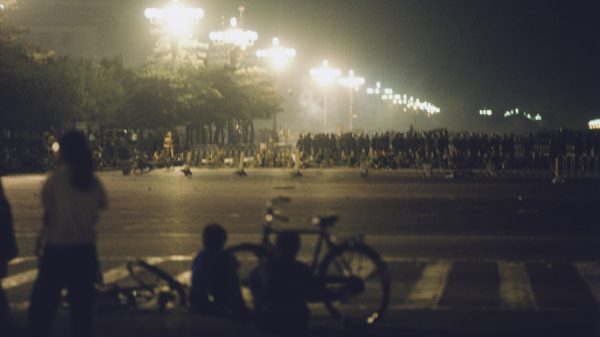
The Tiananmen massacre: how Deng made the final decision and defended it for the rest of his life
On April 25, 1989, as student demonstrations at Tiananmen Square had been building for over a week following Hu Yaobang’s death, Deng convened a meeting at his home. In attendance were members of the Politburo Standing Committee, the Party’s highest collective leadership body, along with Yang Shangkun, then serving as state president and a close Deng ally who controlled key military units, and Bo Yibo, a veteran Party elder who had helped Deng consolidate power after Mao’s death. Deng declared the demonstrations a form of “turmoil,” invoked his formula that stability takes precedence over everything else, and demanded that decisive measures be taken to end them. His words, preserved in Party records and quoted by multiple participants, were unambiguous.
On May 17, Deng convened a larger meeting and issued clearer instructions: Beijing needed to be resolved quickly; the military needed to move. This account is corroborated in the memoir of Zhao, who opposed martial law and recorded his recollections in secret before his death, and in the diary of Li Peng, who as prime minister at the time signed the martial law order on May 19 and whose diary was later partially published.
Martial law was declared on May 19. On the nights of June 3 and 4, People’s Liberation Army units moved into central Beijing. The Tiananmen Mothers, a group founded by a woman whose son was killed that night and which has maintained the most systematic accounting of the events, have documented more than 200 confirmed deaths. Amnesty International’s contemporaneous reports placed the figure considerably higher.
Deng later defended the decision publicly. In his 1992 speeches during a tour of southern China, aimed at relaunching economic reform after years of post-Tiananmen political retrenchment, he described the June 4 crackdown as correct. The alternative, he argued, would have been the kind of political disintegration that had destroyed the Soviet Union. He had made his position explicit even before the crackdown, in May 1989, when he told assembled leaders: “None of the current Party and state leaders have the authority to handle this crisis. Only I can do it.”
A life of political calculation, ended without accountability
From Lushan in 1959 to Tiananmen in 1989, the pattern lies in method rather than ideology. Deng avoided early exposure, adjusted his position when necessary, and acted decisively once conditions were set.
He absorbed the Cultural Revolution’s humiliations without visible bitterness and used them as evidence that he had been wronged, not as motivation to reform the system that had wronged him. He rehabilitated Mao’s reputation to protect his own. He tolerated the partial rehabilitation of Mao’s victims while preserving the political logic that had made them victims in the first place. And when a new generation came to Tiananmen Square asking, with the kind of hopefulness that authoritarian systems periodically generate by their own contradictions, for accountability and political participation, he was sent in the army.
His daughter’s memoir and his authorized biography record a man who was personally warm to those closest to him. History records what he did with power. His official eulogy, delivered by the Party apparatus he built and defended, called him the architect of reform and opening-up. The families of the dead at Tiananmen are still waiting to bury that verdict.
By He Zi