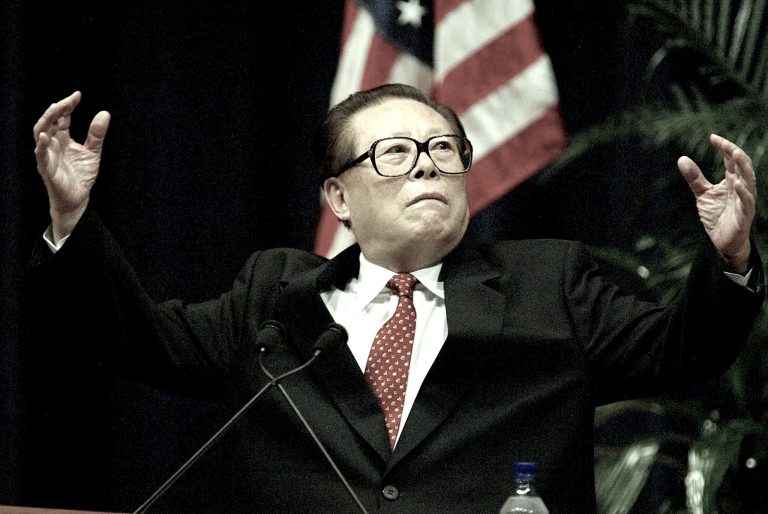
Jiang Zemin climbed to the top of the Chinese Communist Party by endorsing the June 4, 1989 Tiananmen Square massacre, and the weight of that choice never left him. In his own mind, he had blood on his hands and enemies in every corner, and so he spent the better part of three decades doing something a committed atheist, by official Party doctrine, had no business doing: he searched frantically for spiritual protection.
He visited temples and Taoist shrines across China. He cultivated the friendship of Zhao Puchu, the longtime president of the Buddhist Association of China, a government-controlled body that manages the Party’s relationship with Buddhism and has no independence from state authority, and on Zhao’s advice commissioned five colossal Buddha statues to be erected at points corresponding to the five cardinal directions, north, south, east, west, and center, in an effort to protect Party rule. Beijing’s political circles knew that Jiang marked the first morning of every Lunar New Year by rising before dawn and traveling with his wife, Wang Yeping, to Hongluo Temple, a monastery in the capital’s northern suburbs with more than 1,600 years of history, to offer incense before anyone else arrived.
Jiang’s obsession with feng shui, the traditional Chinese practice of arranging one’s physical environment in alignment with cosmological forces to attract good fortune and deflect bad, ran even deeper. While the Party publicly insisted its members were materialist atheists, Jiang spent public funds on three projects around Beijing designed to manipulate the capital’s geomantic energy in his favor: he had the Baiyangdian wetland basin reflooded, raised the height of the flagpole in Tiananmen Square, and relocated an earthen mound inside the Temple of Heaven complex. The goal of each intervention was the same: to extend his hold on power and postpone any reckoning.
Then Deng Xiaoping, the Party strongman whose patronage had put Jiang in power, died in 1997, and Jiang finally stood alone at the top. To mark the moment, he made a secret trip to Mount Jiuhua, one of China’s four sacred Buddhist mountains, located in Anhui Province and home to dozens of historic monasteries. He wanted a senior monk to read his political fate, to tell him how long his rule would last and how the Communist Party would ultimately end.
The monk refused to answer. Only after repeated pressing did he lift his eyes and say seven words: “Goat-year people will bring down the Party.” Jiang nearly fainted.
Success
You are now signed up for our newsletter
Success
Check your email to complete sign up
Jiang ordered tighter surveillance of the former party chief he feared most
“Goat-year people.” Jiang’s mind went at once to Zhao Ziyang, the former general secretary of the Communist Party who had publicly opposed the Tiananmen crackdown, refused to endorse martial law, and was subsequently stripped of all his posts and placed under house arrest in Beijing. Zhao had been born in 1919, the Year of the Earth Goat in the traditional Chinese zodiac calendar. He was already elderly and under close surveillance. The monk’s words sent Jiang into a fresh panic.
On the drive back from Mount Jiuhua, Jiang began planning a tighter cage. By the time he reached Beijing, the orders had been issued. Zhao was forbidden from leaving the capital; he could play golf, but only on Beijing courses. Workers installed a concealed electrified wire perimeter around Zhao’s residence at No. 6 Fuqiang Hutong in central Beijing. The guard detachment outside was reinforced. Zhao’s telephone lines were placed under covert surveillance.
These were the reflexes of a man who believed a monk’s words could chart the future, and who feared that future.
In the end, Zhao died under house arrest in January 2005, never restored to public life, without having brought the Party down. This has been interpreted as indicating that the monk’s prophecy may have referred to someone else.
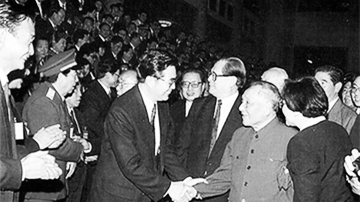
The Soviet collapse gave the prophecy historical credibility
The monk’s words struck Jiang so hard partly because they resonated with an older Chinese cosmological tradition that had already attached a pattern of disaster to the Communist Party’s history.
Zhao, born in 1919, had in fact come close to ending the Party’s rule during the 1989 crisis. He had sided openly with the protesters, refused to endorse martial law, and was removed only because the Party patriarch Deng Xiaoping overruled him. Had Deng not intervened, the outcome at Tiananmen might have been very different.
More striking still, the Soviet Communist Party and virtually every communist government in Eastern Europe had collapsed largely through the actions of two men: Mikhail Gorbachev and Boris Yeltsin, both born in 1931, the Year of the Metal Goat. The parallel was hard to dismiss.
Looking further through the Communist Party’s current leadership ranks, the pattern multiplied. Among figures born in 1955, the Year of the Wood Goat: Li Keqiang, who would later serve as China’s prime minister; Wang Huning, the Party’s chief ideologist and a member of the Politburo Standing Committee, the Party’s top leadership body of seven men who hold ultimate authority over all Chinese governance; Wang Yang, who chairs the Party’s political advisory body; and Cao Jianming, who served as China’s chief prosecutor. Cai Qi, who by the time this article was written had risen to serve as the Politburo Standing Committee member overseeing day-to-day Party operations as head of the Party Secretariat, was also born in a goat year.
The monk’s remark can also be read as referring to a broader generation rather than a single individual.
Traditional Chinese cosmology marks 2026 and 2027 as a sixty-year cycle of fire and calamity
The prophecy drew additional force from a much older Chinese concept: the “Red Horse and Crimson Goat Calamity,” known in classical Chinese as chima hongyangjie. The traditional Chinese calendar assigns each year two characters drawn from separate cycles: one from the ten “heavenly stems,” which carry elemental properties, and one from the twelve “earthly branches,” which correspond to the animals of the zodiac. The stems “bing” and “ding” both carry the elemental property of fire and are associated with the color red. The branch “wu” corresponds to the horse; the branch “wei” corresponds to the goat. When a bing-wu year (Red Fire Horse) is immediately followed by a ding-wei year (Crimson Fire Goat), classical Chinese cosmology treats the pairing as a period of extreme and destructive fire energy, the kind that burns through social order and political stability. This two-year sequence recurs once every sixty years.
The pattern has apparent historical support. The Taiping Heavenly Kingdom, the massive mid-nineteenth century rebellion that killed an estimated twenty to thirty million people and nearly destroyed the Qing imperial dynasty, erupted in full force around 1856 and raged through the bing-wu and ding-wei years that followed. The Cultural Revolution, the decade of political terror that Mao Zedong, China’s communist founder, launched in 1966, began in a bing-wu year and is counted among the catastrophes the tradition predicted.
By the traditional Chinese calendar, 2026 is a bing-wu year. 2027 is ding-wei. The Red Horse and Crimson Goat Calamity arrives now.
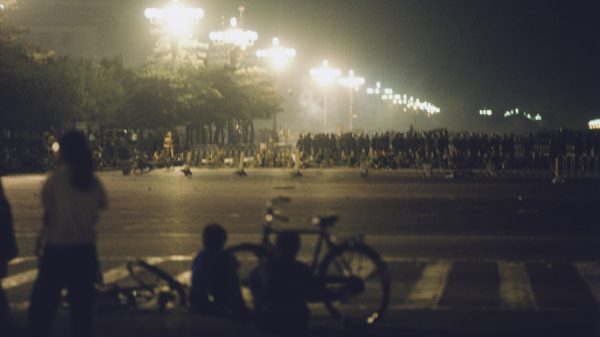
The massacre that brought Jiang to power occurred in a cosmologically charged year
The year 1989 in the traditional Chinese calendar is ji-si, a year whose elemental character is fire of a different kind: the fire of the serpent. The branch “si” corresponds to the snake, which classical cosmology regards as the precursor that ignites the horse-and-goat sequence. Ji-si years carry the warning sign, in classical tradition, of “fire and earth in mutual pressure, with blood easily shed.” It was in precisely such a year that the Communist Party massacred its own citizens in Tiananmen Square, and it was on that massacre that Jiang built his career.
The article does not present 1989 itself as the Red Horse calamity. It describes it as a preparatory fire year, positioned at the midpoint between the 1966 catastrophe and the 2026 arrival. Jiang did not come to power as the fulfillment of a prophecy; he came to power by igniting a fire himself and then settling in to wait for the larger conflagration that classical cosmology said was coming. From 1989 onward, the Party’s survival strategy shifted definitively toward violence: surveillance, suppression, and the preemptive elimination of any person or force that might serve as the spark. In this framing, the cohort of goat-year officials now in senior Party ranks can be seen as variables that had long been present within the system.
Jiang’s nightmare on the Tiananmen anniversary drove him back to the mountain monastery
By 2004, Jiang had been out of the post of general secretary for two years, but the fear had not lifted. On the night of June 3 to 4, the fifteenth anniversary of the Tiananmen massacre, he dreamed of hell. Specifically, he dreamed of Avici, the lowest and most unrelenting level of punishment in Buddhist cosmology, reserved for those who have committed the gravest sins. In Buddhist teaching, Avici is described with clinical precision: guards drive burning iron nails into every joint of the condemned; arctic winds strip skin from flesh; the condemned are thrown repeatedly from mountaintops onto forests of blades, their bones shattering and reconstituting only to shatter again, in a cycle without end or respite.
Jiang woke screaming and drenched in sweat. His staff tried to calm him; he refused to wait. Despite it being June 4, the very anniversary he had spent decades trying to erase from public memory, he set out immediately for Mount Jiuhua. He arrived the following morning and made offerings to Dizang Pusa, known in English as Ksitigarbha, the Bodhisattva of the underworld in Buddhist tradition and the figure associated with salvation from exactly the kind of afterlife he had dreamed of. In popular Chinese Buddhism, Dizang Pusa is the guardian of souls condemned to hell and the intercessor through whom the condemned can seek release.
Jiang copied out the Dizang Sutra, a Buddhist scripture dedicated to this figure, by hand. He continued rearranging feng shui. He continued tightening controls over anyone who might serve as the prophecy’s fulfillment. Each act reflected the extent of his concern.
Jiang Zemin died on November 30, 2022. The Party announced his death and held a state memorial. On December 11, his ashes were scattered at sea. He left no grave. One interpretation of this choice is that he sought to avoid leaving physical remains behind, reflecting concerns that extended beyond his lifetime.
According to Buddhist teaching, those who commit the gravest offenses are described as facing endless suffering and, ultimately, dissolution beyond the cycle of reincarnation.
Whether the monk on Mount Jiuhua foresaw any of this, no one living can say. What the record shows is that Jiang Zemin heard seven words in 1997 and spent the rest of his life unable to forget them.
By He Zi