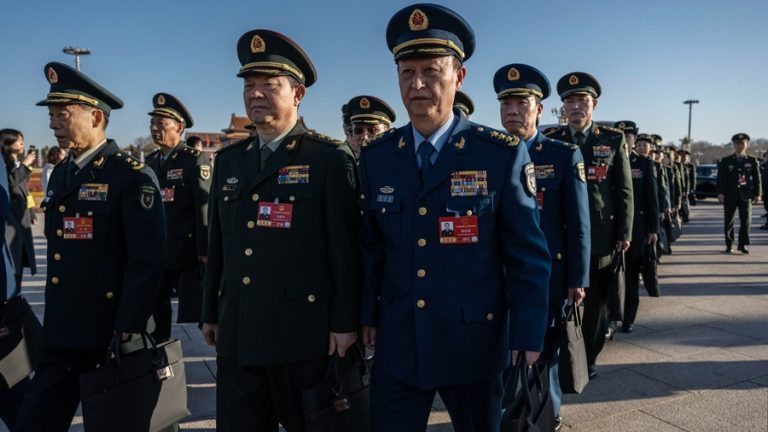
Xi Jinping, the Chinese Communist Party’s general secretary and China’s top leader, has spent the past two years removing senior officers from the People’s Liberation Army in one of the most extensive military shake-ups in decades. The impact is now visible in the chain of command: posts traditionally held by full generals are vacant or filled by lower-ranking officers, acting appointments have become common, and leadership roles within key bodies remain unclear.
The scale of the military purge has become increasingly visible. Du Wen, a former Inner Mongolia official now living in Europe, outlined the situation on April 9, 2026, citing publicly available officer rosters and sources with access to internal CCP information. His review indicates that across major service branches and theater commands, many positions are now held by lieutenant generals, a rank typically one level below what is required. Some posts have no publicly identified occupant.
Under established practice, commanders and political commissars of major branches and theater commands are expected to hold the rank of general. Political commissars serve as the Party’s representatives within the military hierarchy, responsible for enforcing political loyalty. That arrangement has shifted. The Army, Air Force, and Rocket Force are now led at both the commander and commissar levels by lieutenant generals serving in acting capacities, most of whom assumed their roles during 2025.
Army Lieutenant General Cai Zhijun has served as acting commander since July 2025, alongside acting commissar Lieutenant General Zhang Shuguang. For China’s largest service branch, both top positions being held by lieutenant generals marks a departure from previous practice.
The Air Force and Rocket Force show a similar pattern beginning in December 2025. Lieutenant General Wang Gang and Lieutenant General Shi Honggan serve as acting commander and commissar of the Air Force. In the Rocket Force, Lieutenant General Lei Kai and Lieutenant General Zhou Jingjiong hold the corresponding acting positions.
Success
You are now signed up for our newsletter
Success
Check your email to complete sign up
The Navy presents a more complicated picture. Public rosters indicate that Admiral Hu Zhongming served as commander from December 2023 until an unspecified point in 2025. Navy Lieutenant General Zhang Zheng, listed as chief of staff, also appears in the commander role with a start date of December 2025.
The commissar position is similarly unsettled. Lieutenant General Hu Yuhai is listed as acting commissar since December 2025 while also serving as director of the Navy’s Political Work Department. The overlap suggests that key positions are being held concurrently, with no clear indication of permanent appointments.

New military forces also show leadership gaps
The newer branches established during Xi’s military reforms show similar patterns.
The Information Support Force, responsible for communications and information operations, has been commanded by Lieutenant General Bi Yi since April 2024. Its commissar position remains unclear following the reported departure of General Li Wei at some point in 2025.
The Cyberspace Force lists Lieutenant General Zhang Minghua as commander and Lieutenant General Han Xiaodong as commissar, both serving since 2024. The Aerospace Force is commanded by Lieutenant General Hao Weizhong, while its commissar position has not been publicly filled since December 2024.
The Joint Logistic Support Force is led by Lieutenant General Wang Kangping as commander and Lieutenant General Gao Daguang as commissar.
Across these commands, lieutenant generals predominate, and several positions lack publicly confirmed leadership.
The five theater commands, which would oversee military operations in wartime, show comparable personnel arrangements.
In the Western Theater Command, Lieutenant General Wen Junfei has served as acting commander since September 2025. General Li Fengbiao formally holds the commissar title, while Lieutenant General Zhang Shaoying is listed as acting commissar responsible for political work.
The Northern Theater Command lists Lieutenant General Liu Wenqi as acting commander and Lieutenant General Li Dongyou as acting commissar, with Lieutenant General Peng Jingtang later appearing as acting commander as of April 2026.
The Central Theater Command, responsible for the defense of Beijing, has General Han Shengyan as commander and Lieutenant General Liang Ping as acting commissar.
The Eastern Theater Command, which would play a central role in any Taiwan-related operations, is led by General Yang Zhibin as commander and General Zhang Jichun as acting commissar.
The Southern Theater Command lists Lieutenant General Wang Xianfeng as acting commander, with no publicly identified successor to former commissar Wang Wenquan following his departure in October 2025.
The Central Military Commission shows vacancies at the top
At the highest level, the Central Military Commission reflects similar gaps.
The commission’s General Office is currently led by Major General Qiu Yang in an acting capacity. The Joint Staff Department lists Lieutenant General Zhu Chuansheng as acting deputy chief overseeing daily operations. The Political Work Department lists Lieutenant General Chen Demin as acting deputy director in charge of overall work.
The Logistic Support Department, Training and Administration Department, and National Defense Mobilization Department are each led by lieutenant generals appointed during 2025.
The Equipment Development Department, responsible for weapons procurement, has no publicly identified director or commissar.
Other gaps include the absence of a secretary for the commission’s Political and Legal Affairs Commission. The Discipline Inspection Commission is chaired concurrently by General Zhang Shengmin. The Science and Technology Commission lists Lieutenant General Xu Weijin as director as of April 2026.
Available information indicates a shift from earlier arrangements in which full generals led most major commands and departments. Lieutenant generals and acting appointments now account for a larger share of leadership roles, while some positions remain unfilled.
Several key areas, including procurement and internal legal oversight, lack clearly identified leadership. Commissar positions in certain branches have not been publicly reassigned following reported departures.
Du Wen said that, based on publicly available information, the first phase of personnel changes across the military structure appears largely complete. The process of filling remaining vacancies has not been clearly outlined.
Editor’s Note: This article is based on media reports, publicly available personnel rosters, and commentary by analysts citing access to internal Chinese Communist Party information. Details regarding military appointments and removals have not been independently verified and are presented as described by the sources.
By Li Deyan