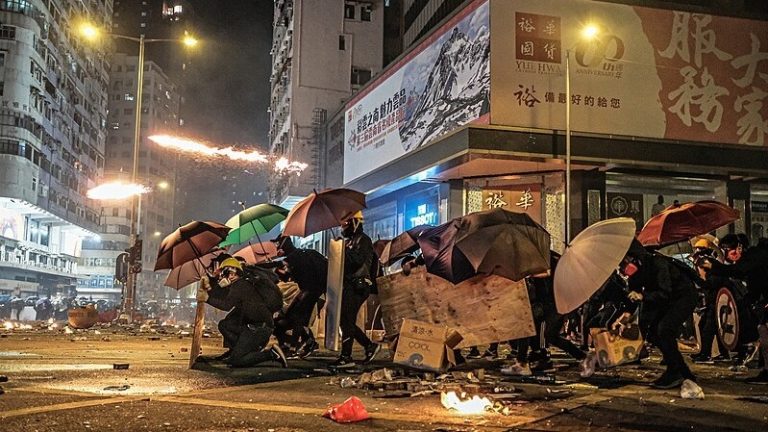
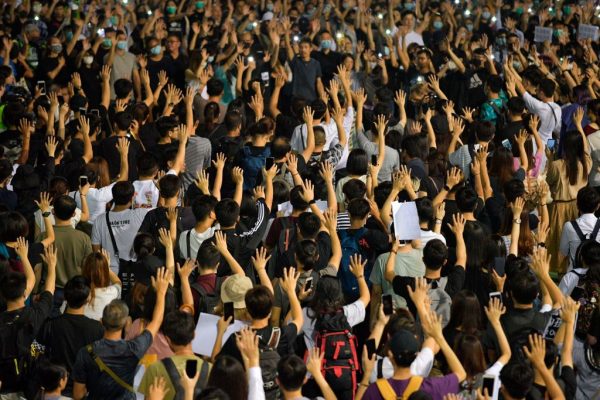
When Hong Kong police cracked down on the 2019 protests against a proposed extradition law, which would have allowed Hong Kong residents to be sent to mainland China to face trial in courts controlled by the Communist Party, they arrested more than 10,000 people. Of those, roughly 3,000 faced prosecution. The remaining 7,000 were left in legal limbo, with no charges filed and no resolution announced.
Tang Ping-keung, who serves as Hong Kong’s secretary for security and is responsible for the city’s policing and national security apparatus, broke that silence in an interview broadcast by Cable TV Hong Kong on April 11. Tang said the government had launched a “special program” one to two years earlier, targeting those arrested but not charged. Its stated purpose was to give them “rehabilitation” opportunities outside the courtroom while remaining, Tang insisted, within the law.
The program’s centerpiece is organized trips to mainland China. Participants are taken across the border to experience life in the country and, in Tang’s framing, to “understand national security.” Tang acknowledged that some participants were reluctant or worried they might be detained once on the mainland. In those cases, authorities offered to accompany them personally. Back in Hong Kong, participants could be placed in government internship positions and, Tang suggested, might even qualify for civil service jobs if they met eligibility requirements.
Asked whether participants would be shielded from future prosecution, Tang said the government had handled these cases in a manner that did not require a court appearance, in compliance with existing law. He declined to give figures on how many people had entered the program, but said a number of participants had gone on to help promote “national security” within the community.

Human rights lawyers describe program as ideological coercion outside legal framework
The program has drawn sharp condemnation from legal professionals and human rights advocates outside mainland China’s jurisdiction.
Success
You are now signed up for our newsletter
Success
Check your email to complete sign up
Wu Shaoping, director of the Overseas Human Rights Lawyers Alliance, a group of Chinese legal professionals practicing in exile, told overseas Chinese-language media that the program’s purpose is to make Hong Kong people internalize loyalty to the Party’s political authority. The Hong Kong government, he said, is using the threat of unresolved prosecution as leverage: offering a way out of legal uncertainty in exchange for participation in supervised ideological programs on the mainland. Wu said the approach reduces international scrutiny while achieving similar outcomes through administrative means. “Using a so-called ‘rehabilitation program’ to achieve total thought control over Hong Kong people is, in substance, the CCP’s political re-education and brainwashing,” he said.
Lai Jianping, a former Beijing-based lawyer and independent legal scholar, was more direct. The program treats people as political subjects to be reshaped, subjecting them to “political, psychological, and personal transformation.” The authorities are substituting political management for the legal process, he argued: “They use politics to replace law, punishing these so-called suspects in their hearts, with the goal of making them submit to the CCP’s authoritarian rule.”
These individuals were never convicted of anything. The Hong Kong government has constructed an off-books arrangement in which avoiding prosecution is tied to compliance with ideological requirements, including supervised travel to mainland China and participation in state-linked activities, without any court proceeding subject to public scrutiny or appeal.
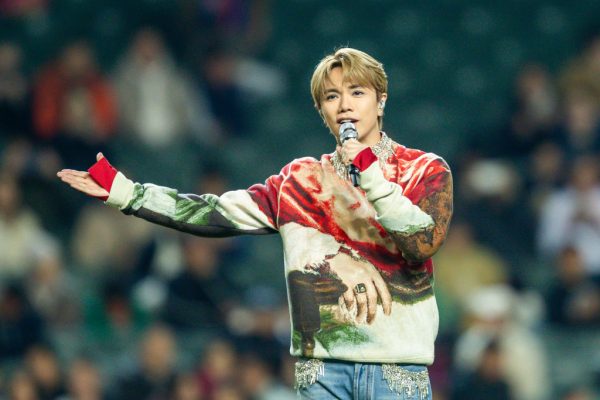
Pop star’s apology highlights scope of ‘rehabilitation’ program
The workings of the “rehabilitation” program became visible this week through the public behavior of Hins Cheung, one of Hong Kong’s most popular Cantonese-language pop singers, who was born in the southern Chinese city of Guangzhou and built his career in Hong Kong.
Cheung spent years on the visible side of Hong Kong civil society. In 2014, when Taiwan was convulsed by the Sunflower Movement, a wave of student-led demonstrations against a proposed trade agreement that critics said would tie Taiwan too closely to the mainland, he posted a black-and-white image of clasped hands on Instagram with the caption: “To the students across the strait, keep going.” The post was read widely as an expression of solidarity with Taiwan’s protesters. Later that year, when Hong Kong erupted in its own mass pro-democracy demonstrations, known as the Umbrella Revolution, a separate movement from the 2019 protests that first put the question of Hong Kong’s political future onto the world’s front pages, Cheung joined a group of Hong Kong entertainers in recording “Who Has Not Yet Spoken Up.”
The song’s title was a pointed public challenge to the many celebrities who had calculated that silence was safer than solidarity. Recording it carried real professional risk: the mainland Chinese market is the dominant revenue source for Hong Kong’s entertainment industry, and any public association with pro-democracy politics can close that market permanently. He paid exactly that price: nationalist voices on the mainland labeled him a supporter of Hong Kong independence, and when he appeared on “Singer,” a nationally televised mainland talent competition with enormous commercial stakes, in 2017, the backlash was strong enough that he withdrew from the program and deleted the recordings he had already made.
That background did not fully anticipate what followed. Cheung issued a public apology to Hong Kong media, saying he regretted his past criticism of the Hong Kong government and was sorry for his earlier statements. He then announced he would personally lead a group of young people arrested during the 2019 protests, but never charged, on an exchange trip to mainland China. The announcement placed him inside the government’s “rehabilitation” program, as a high-profile escort for the group Tang had described.
The apology coincided with a mass unfollowing on Instagram. Cheung removed dozens of people from the list of accounts he follows, including fellow entertainers Sammi Cheng and Joey Yung, who are among Hong Kong’s most prominent pop figures, as well as singer-songwriter Terence Lam, musician Tyson Yoshi, actress Gillian Chung, and prolific lyricist Wyman Wong. The unfollowing swept across a wide range of his professional and personal contacts.
The pattern quickly drew attention among his followers and across Hong Kong media. Comments flooded in: “Something feels very off here.” “I’m heartbroken. How did it come to this?” “Was he threatened?” “Why unfollow so many people? There must be more to this.” “In the end, he just couldn’t hold on.”
Many observers interpreted the developments in similar terms: the apology appeared to have been made under pressure, the mainland trip announcement was seen as linked to official arrangements, and the unfollowing was viewed either as distancing or as a signal to those he cut off, or both.
Program applies beyond protesters to individuals with public record of dissent
Cheung was not among those arrested in 2019. His public profile and his earlier statements, rather than any criminal case, appear to have contributed to his involvement.
His career gave him influence among younger audiences in Hong Kong and recognition in Taiwan. A court case, had one taken place, would have been part of the public record and subject to legal procedures. His participation in a mainland exchange program is different: it is public and presented as voluntary, though in the broader context of pressure on dissenting voices in Hong Kong, that characterization has been questioned. It also suggests that figures associated with earlier pro-democracy activity are now appearing in state-linked initiatives. The “rehabilitation” framework, as described by Tang, applies to individuals seen as posing political risk, whether or not they face formal charges.
The scale and speed of the unfollowing point in a similar direction. Social media connections among Hong Kong entertainment figures carry political implications in the current environment, and visible associations can create risk. The unfollowing was broad and rapid, extending across Cheung’s network rather than focusing on specific individuals. It marked a visible separation from earlier associations, observed publicly in a context where such signals are closely watched.
By Li Jingyao