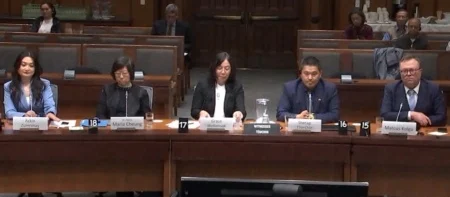
On April 20, Canada’s Parliament held a high-profile hearing to examine the “global impact of transnational repression,” with witnesses from research institutions, human rights organizations, and affected communities testifying on intimidation, surveillance, and interference linked to the Chinese Communist Party (CCP).
The session, hosted by the Subcommittee on International Human Rights, was live-streamed publicly and featured testimony from experts including Marcus Kolga of the Macdonald-Laurier Institute, Peter Mattis of the Jamestown Foundation, and representatives from disenfranchised groups in China, including Tibetans, Uyghur Muslims, and Falun Gong communities.
Witnesses described how transnational repression operates across borders, the risks faced by targeted groups, and the broader implications for Canada’s national security and democratic institutions.
Escalating threats
One of the most striking testimonies came from Grace Wollensak, national coordinator of the Falun Dafa Association of Canada, who described an escalation in threats targeting Shen Yun Performing Arts and Falun Gong practitioners.
“In Canada alone, there have been 20 false bomb and shooting threats over the past two years—and globally, such violent threats have exceeded 270 cases. This year, the targets expanded to include Canadian leaders and Parliament Hill, including one threat stating: ‘If Shen Yun dares to perform in March, Justin Trudeau and Mark Carney will be in trouble, and a massive explosion will occur on Parliament Hill.’”
Success
You are now signed up for our newsletter
Success
Check your email to complete sign up
She added, “Two leaked CCP documents show that Xi Jinping personally ordered a new coordinated campaign. Over the past two years, transnational repression has clearly escalated, including disinformation, legal warfare, and false bomb threats targeting Shen Yun and Falun Gong.”
RELATED: Bomb Threats Halt Shen Yun Shows in Canada Despite Police Clearance
Despite law enforcement determining the threats were not credible, six performances at Toronto’s Four Seasons Centre were canceled. Wollensak noted that perpetrators later boasted in Chinese-language emails: “The battle at the Four Seasons Centre in Toronto was my most successful one… I still think small Canadian politicians are not worth mentioning.”
Investigators traced related phone numbers to China, and the sender referred to the CCP as “the Communist Party of my motherland,” with timestamps matching China Standard Time. The individual also allegedly impersonated Falun Gong practitioners to issue threats to international targets, including the White House and a theater in Tokyo.
Disinformation as a tool
Maria Cheung, a senior researcher, described the CCP’s campaign against Falun Gong as a sustained global effort rather than isolated incidents. “The CCP’s transnational repression of Falun Gong is a continuous global campaign, not a series of isolated cases. When these actions occur on Canadian soil, they represent a direct erosion of our sovereignty, democratic values, and fundamental freedoms.”
She explained that since 1999, when Beijing launched its persecution of Falun Gong, the campaign has included mass detention, torture, killings, and state-backed organ harvesting in China.
In Canada, she said, repression has taken multiple forms over nearly three decades, including disinformation campaigns, surveillance, harassment, cyberattacks, political interference, and threats against family members in China. She noted that a former senior Chinese diplomat who defected testified that persecuting Falun Gong was a routine task for Chinese diplomatic missions abroad.
Cheung emphasized the central role of propaganda: “Disinformation is one of the CCP’s core and enduring tools.” She added, “Canadian adjudicative bodies have recognized such content as defamatory and inciting hatred, and have confirmed that Falun Gong is a protected belief.”
“Long-term disinformation has fostered social apathy, weakened public support, and undermined Canada’s ability to respond to serious human rights abuses and repression taking place within its own borders,” she said.
United Front system
Testimony also highlighted the CCP’s United Front system as a key infrastructure behind transnational repression. According to research cited by Jamestown Foundation, Canada has one of the highest concentrations of organizations linked to the CCP’s United Front network among major democracies, with approximately 575 such groups.
Mattis described the system as a “never-ending political mobilization machine” embedded across party, government, and social institutions. Its activities include influencing media, academic institutions, community groups, and businesses to shape narratives, identify perceived threats, and expand political influence.
While some of its operations are overt, Mattis warned that its ultimate objective remains “subversion and control.” He urged policymakers to assess the system based on its structure and intent to safeguard democratic institutions.
Calls for action
Witnesses urged the Canadian government to take stronger measures to counter foreign interference. Wollensak recommended publicly condemning CCP transnational repression, directing security agencies to investigate such threats as organized foreign interference, and implementing provisions under Bill C-70 to address foreign influence. She also called for clear guidance to performance venues facing false threats, stressing that lawful cultural events should not be canceled when no credible danger exists.
“If Canada cancels performances without understanding foreign interference, it sends a dangerous signal — it amounts to yielding to the CCP,” she said.
Kolga, drawing from his own experience facing sanctions and harassment, called for Canada to treat transnational repression as a national security threat and to establish clearer reporting mechanisms and stronger coordination between law enforcement and intelligence agencies.
Uyghur representative Zumretay Arkin warned of escalating repression targeting diaspora communities, including coercion of family members and surveillance, while Tibetan representative Sherap Therchin highlighted decades-long efforts to control Tibetan Buddhism, including interference in the succession of the Dalai Lama and Panchen Lama.
The hearing underscored growing international concern over the scope and sophistication of CCP-linked transnational repression. As democratic governments grapple with foreign interference, witnesses emphasized that safeguarding sovereignty, protecting targeted communities, and preserving democratic institutions will require coordinated and sustained responses.