By Li Xin, Vision Times
According to The Wall Street Journal, the Trump administration has drafted a hardline proposal for the upcoming July 1 renegotiation of the U.S.-Mexico-Canada Agreement (USMCA). The plan would require automakers to ensure that at least 50 percent of a vehicle’s parts and materials are produced in the United States in order to qualify for lower tariffs under the agreement’s framework.
The proposal has pushed the already unsettled North American trade landscape into a new flashpoint.
Based on the dollar value of components, this new requirement would significantly increase the share of U.S.-made content required for vehicles produced under the USMCA framework. The current agreement only requires 75 percent of materials to originate in North America, with no specific requirement for U.S. origin content.
Sources say the 50 percent U.S. content requirement is only an initial bargaining position, and the figure could still change over the coming months as negotiations proceed. At the same time, the Office of the U.S. Trade Representative announced that the U.S. and Mexico will hold a series of bilateral talks under the joint USMCA review process, with the first round focused on economic security and rules of origin for key industrial goods.
US and Mexico move ahead, Canada left behind
Success
You are now signed up for our newsletter
Success
Check your email to complete sign up
For many automakers, this requirement represents a high barrier. Taking General Motors’ GMC Terrain SUV assembled in Mexico as an example, only about 11 percent of its component value comes from the U.S. or Canada, while core parts such as engines and transmissions are manufactured in Mexico.
If the new rule is implemented quickly, such models would face significant compliance pressure. However, labor organizations such as the United Auto Workers (UAW) may welcome the move, seeing it as a potential boost to U.S. employment.

The USMCA includes a mandatory six-year review clause requiring the three countries to decide by July 1, 2026, whether to extend the agreement for another 16 years. If no agreement is reached, a countdown to expiration would be triggered, and the pact would ultimately terminate on July 1, 2036. This has made the negotiating window extremely tight.
At present, the United States and Mexico have already begun talks, with two additional rounds scheduled in the coming weeks. However, formal negotiations between Canada and the United States have not yet begun. This arrangement has led some trade observers to characterize the process as increasingly bilateral rather than trilateral.
On the Canadian side, according to Reuters, Prime Minister Carney has called for building a “North American fortress,” arguing that the North American market is the “best and most durable way” to respond to intense global competition. Currently, about 85 percent of Canada–U.S. trade still occurs tariff-free.
Carney and Trump: alternating cooperation and deadlock
Relations between Canada and the United States represent the most complex dimension of the USMCA renegotiation. Since Prime Minister Carney took office in March 2025, the two countries have gone through direct calls, retaliatory measures, and diplomatic friction over tariffs, fundamentally reshaping their trade relationship.
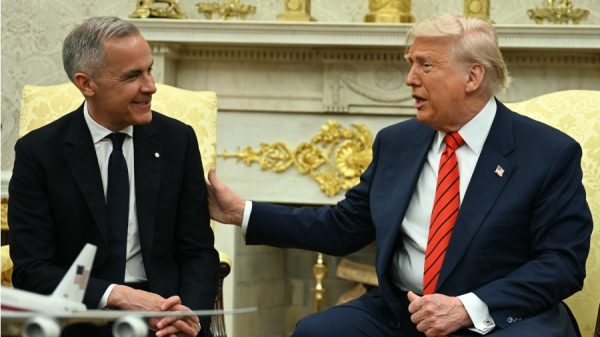
The negotiation process has been uneven. In October 2025, Trump and Carney met at the White House, where Trump again referenced the idea of a U.S.–Canada “merger,” a remark that generated media attention but underscored the broader tensions surrounding bilateral relations. Trump has repeatedly joked that Canada should become America’s “51st state” and that former Prime Minister Justin Trudeau could serve as its governor. The comments have drawn criticism from Canadian political leaders and prompted negative reactions among many Canadians.
Entering 2026, tensions have not fully eased. U.S. Trade Representative Greer stated that talks with Mexico are progressing smoothly, while negotiations with Canada are far less so. Greer criticized Ottawa’s retaliatory tariffs and argued that Canada has been less willing to make concessions than some other U.S. trading partners.
In response, Carney has taken a firm stance, stating that negotiations will take time and insisting that the United States cannot unilaterally dictate the terms of the agreement, emphasizing that any deal must be mutually beneficial. Canada has not yet joined the formal review discussions, raising questions about how and when trilateral negotiations will proceed.
Uncertain outlook for the USMCA agreement
Mexican President Sheinbaum and Canadian Prime Minister Carney announced last September the establishment of a “comprehensive strategic partnership,” aimed at offsetting uncertainty from Washington and presenting a unified front ahead of the mandatory USMCA review.
The Trump administration’s true intentions remain uncertain. Trump has previously threatened to terminate the USMCA, and Greer has floated the idea of splitting the trilateral agreement into two separate bilateral deals. In December 2025, Trump stated that the U.S. would allow the agreement to expire or seek to renegotiate it in 2026, arguing that Canada and Mexico have benefited at the expense of the United States.
Some foreign automakers have warned the Trump administration that if the USMCA is not renewed as a low- or zero-tariff trilateral agreement, they may consider withdrawing low-cost vehicle models from the U.S. market. This warning highlights that, should negotiations fail, American consumers would also bear part of the cost.
With the July 1 deadline rapidly approaching, whether the three countries can find common ground in this highly divided negotiation remains uncertain, and the future direction of the North American trade system is still unresolved.