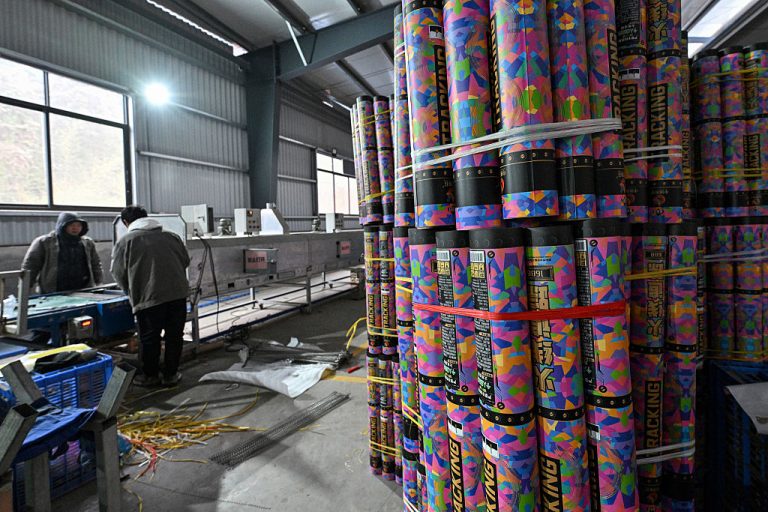
A massive explosion at the Huasheng Fireworks Factory in Liuyang, Hunan Province, during China’s May Day holiday has triggered backlash among analysts and netizens, with some questioning whether the blast involved materials far beyond ordinary firework explosives. The holiday is a five-day national break surrounding International Workers’ Day and one of the country’s busiest travel periods.
The May 4 explosion at the factory’s production workshop officially left at least 37 people dead, 61 injured, and one missing as of May 8, according to Chinese state media. However, outside observers have questioned whether the true casualty figures may be much higher.
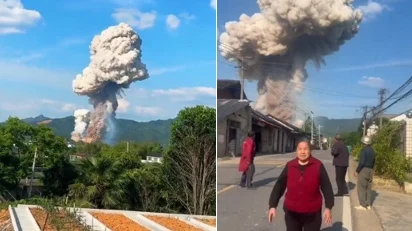
The scale of the destruction quickly drew national attention. Satellite images and aerial footage circulated by Chinese media showed that at least 20 factory buildings were leveled. Windows within a radius of roughly 500 meters were shattered, while some buildings as far as two kilometers away also suffered structural damage. One eyewitness described the scene online as “a complete disaster — it looked as though the area had been bombed.”
Xi issues rare directives
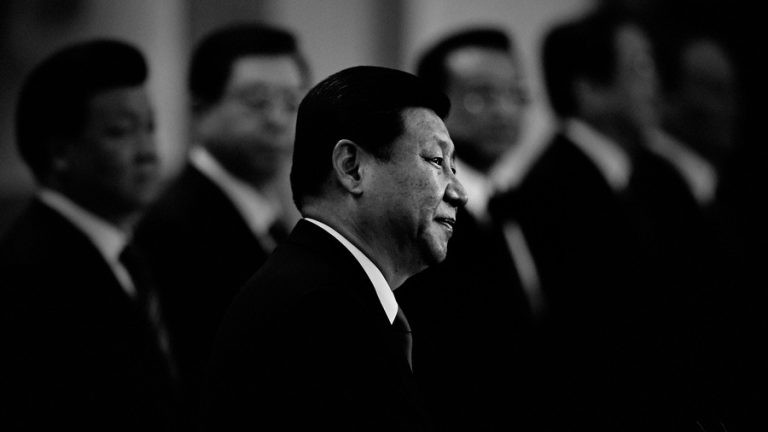
The unusually violent nature of the blast prompted immediate reactions from top Chinese leadership. Chinese leader Xi Jinping issued two separate directives within hours of the explosion, one shortly after midnight and another early the following morning, an uncommon move even by Beijing’s emergency response standards. In addition, Chinese Premier Li Qiang issued instructions, while Vice Premier Zhang Guoqing traveled to the site on May 5 to oversee the response and investigation.
RELATED: China Deploys Black-Clad Security Forces Around Tiananmen During Holiday Rush
Success
You are now signed up for our newsletter
Success
Check your email to complete sign up
The timing of the incident has also attracted scrutiny. Just one week earlier, on April 28, the Politburo held a collective study session focused specifically on “improving disaster prevention, mitigation, and emergency response capabilities,” chaired by Xi himself. The Politburo serves as China’s top ruling body.
U.S.-based commentator Cai Shenkun wrote on social media that the casualty figures were likely far higher than officially reported and claimed Xi’s urgent response suggested authorities understood the seriousness of the disaster. “The death and injury toll from the Liuyang fireworks explosion is far beyond what officials are currently reporting,” Cai wrote. “Xi Jinping issued instructions overnight, likely because he knew the blast caused catastrophic casualties. Some say its destructive power exceeded that of a U.S. cruise missile.”
Online discussion surrounding the explosion intensified further as some Chinese netizens compared the blast to a heavy military detonation. Others openly questioned whether the explosion could truly have been caused solely by fireworks materials.
Foul play?
The background of the factory itself has also come under scrutiny. Corporate registration records show Liuyang Huasheng Fireworks Manufacturing and Display Co., Ltd. was established in 2000, with businessman Hu Zhengping listed as legal representative. Chinese financial bloggers later claimed the actual controllers behind the company were well-known Hunan fireworks industry figures Hu Mingyue and his son Hu Miao.
Hu Liren, a former Shanghai entrepreneur now living in the U.S., argued during an appearance on the program Elite Forum that the explosion scale appeared inconsistent with a standard fireworks factory accident. According to Hu, the company occupied roughly 800 acres, and based on aerial footage released by Chinese state broadcaster CCTV, he estimated there were likely more than 300 workers on-site at the time of the blast.
More importantly, Hu said the explosive force appeared far beyond what traditional gunpowder could produce. “I cannot rule out the possibility that someone deliberately caused this explosion,” he said.
The political fallout from the disaster has also become a subject of speculation. Guo Jun, another U.S.-based commentator speaking on Elite Forum, said rumors had circulated that Hunan Party Secretary Shen Xiaoming was considered a leading candidate to become China’s next public security minister. Shen is viewed as having ties to the Shanghai political faction rather than to Wang Xiaohong’s camp.
Political implications
Guo argued that the Liuyang explosion could damage Shen’s political future because major industrial disasters in China often result in disciplinary action against regional officials.
Cai Shenkun similarly wrote on X that Changsha Deputy Party Secretary and Mayor Chen Bozhang was viewed as “the first person responsible” for the disaster. “Because Xi Jinping has already issued directives on this matter, the scope of accountability may not stop at Changsha’s municipal leadership and could extend to Hunan provincial officials,” Cai wrote. “If the investigation expands, Shen Xiaoming’s hopes of promotion to vice-national level status could also vanish.”
Some analysts believe the combination of Xi’s rare back-to-back directives, Zhang Guoqing’s rapid arrival at the scene, and growing speculation surrounding the blast suggests the incident may carry broader political implications beyond a standard industrial accident.
Either way, observers say the disaster has intensified discussion about internal factional struggles, accountability battles, and deeper instability within China’s political system.