According to the New York Times, a high-stakes courtroom battle between two of Silicon Valley’s most prominent figures is now underway in Oakland federal court. Tesla, SpaceX, and xAI chief Elon Musk and OpenAI CEO Sam Altman, once co-founders of OpenAI, are now legal adversaries before U.S. District Judge Yvonne Gonzalez Rogers. Musk has sued OpenAI, Altman, OpenAI President Greg Brockman, and Microsoft, alleging that OpenAI’s leaders betrayed the company’s original nonprofit charter, violated fiduciary trust duties, and enriched themselves at the expense of donors and the public.
Musk’s complaint asks the federal court to remove Altman and Brockman from OpenAI’s leadership, restore OpenAI’s nonprofit structure, and award damages of more than $150 billion. Any monetary recovery is pledged to OpenAI’s charitable parent rather than to Musk personally. Trial began with jury selection on Monday, April 27, 2026, and is expected to run for two to three weeks. Judge Gonzalez Rogers has indicated she will deliver her binding ruling by mid-May 2026 after receiving findings from a nine-juror advisory panel. Because the case is being tried in equity rather than at law, the jury’s verdict is advisory and the judge issues the final ruling.
The stakes extend well beyond OpenAI’s roughly $500 billion private valuation and the company’s planned initial public offering, which has been reported as targeting a market capitalization near $1 trillion. The outcome could reshape the structure of the global artificial intelligence industry and the U.S. competitive position against China-based AI labs that have closed much of the gap with U.S. frontier model developers over the past three years. Musk has long warned that artificial general intelligence presents existential risks to humanity, and his complaint frames the case as a defense of the original safety-focused charter against what he characterizes as a commercial capture of one of the most important AI institutions in the world.
Major witnesses, including former OpenAI Chief Technology Officer Mira Murati and Microsoft CEO Satya Nadella, are expected to testify. Judge Gonzalez Rogers told the parties at the opening of trial that wealth, power, and celebrity status would not receive special treatment in her courtroom.
The 2015 founding: Co-founders aligned on AI safety
In late 2015, Musk co-founded OpenAI with Sam Altman, Greg Brockman, and several other researchers, against a backdrop of rapid AI advancement and rising concerns within parts of the tech industry that artificial intelligence posed potentially existential risks to humanity if developed without robust safety guarantees. The founding pledge was for $1 billion in initial funding. Musk was the largest single donor in the early years, providing approximately $38 million in cash and substantial in-kind contributions including the name “OpenAI,” recruitment of key talent, computing resources, and the original strategic vision.
Success
You are now signed up for our newsletter
Success
Check your email to complete sign up
OpenAI’s founding statement committed the organization to advancing digital intelligence in a manner most likely to benefit humanity as a whole, free from the pressure to generate financial returns. The early relationship between Musk and the company’s other founders was close. Musk served as co-chair while Altman and the younger AI researchers handled operations. OpenAI positioned itself as a safety-oriented counterweight to commercial AI giants such as Google, emphasizing open-source research and public-interest mission.
“I came up with the idea, the name, recruited the key people, taught them everything I know, provided all of the initial funding. It was specifically meant to be for a charity that does not benefit any individual person. I could’ve started it as a for-profit and I specifically chose not to,” Musk testified during the trial. Early communications between the founders, introduced into evidence, show Musk’s enthusiastic support for the original mission.
The 2017–2018 power struggle and Musk’s departure
By 2017, AI development costs were rising dramatically, and OpenAI’s nonprofit structure became difficult to sustain against the computing requirements of frontier model training. Internal discussions turned toward establishing a for-profit entity to attract capital, with Musk being initially part of those discussions.
According to court evidence and emails OpenAI has since disclosed, in 2017 Musk proposed taking majority equity, controlling the board, and serving as CEO of a converted for-profit OpenAI. He suggested the for-profit OpenAI could be made a subsidiary of Tesla, where it would function as what he described as a “cash cow.” Altman, Brockman, and the other OpenAI founders rejected handing over control. In February 2018, Musk announced his resignation from the OpenAI board and withdrew further funding commitments.
Musk testified during the trial that he had lost faith in OpenAI’s direction and concluded that the company’s leadership had abandoned the original founding promise. OpenAI has responded by arguing that Musk himself had pushed for commercialization, and that after his departure he established the directly competing AI company xAI. In opening statements, OpenAI’s counsel argued that Musk had sought “the keys to the kingdom” and sued only after that effort failed.
After Musk left, OpenAI under Altman’s leadership accepted a massive 2019 investment from Microsoft, established a capped-profit subsidiary, and gradually shifted toward closed-source development and aggressive commercialization. ChatGPT, released at the end of 2022, ignited a global AI boom, and OpenAI’s valuation surged. Musk founded xAI in 2023 as a direct competitor.
Public conflict between the two men escalated. Musk repeatedly attacked Altman on the X platform, which Musk owns, and the relationship became openly hostile.
Musk’s lawsuit and OpenAI’s October 2025 public benefit corporation conversion
In 2024, Musk filed his initial lawsuit, alleging that Altman, Brockman, and OpenAI’s other senior leaders had violated the founding charter, breached fiduciary duties, and unjustly enriched themselves by transitioning OpenAI from a nonprofit to a for-profit entity. The complaint argued that Musk had been defrauded into making his donations under the original “for the benefit of humanity” framing. OpenAI’s response framed the suit as a product of Musk’s jealousy and an attempt to slow a competitor.
Musk later refined his complaint to focus on breach of charitable trust and unjust enrichment. The October 2025 conversion of OpenAI to a public benefit corporation, which formally separated the for-profit entity from the nonprofit parent’s previous controlling structure, intensified the legal stakes. Musk now seeks the removal of OpenAI’s senior leadership, substantial damages directed to the OpenAI nonprofit, and a court-ordered restoration of OpenAI’s original nonprofit structure.
Musk testified for more than seven hours during the trial. He told the court that he had been deceived, and that converting a nonprofit into a for-profit entity amounted to, in his words, “stealing a charity.” He warned the court that allowing the conversion to stand would undermine the legal foundation of the U.S. charitable sector. OpenAI’s lawyers in cross-examination challenged his motives, pointing to his own early support for commercialization and his ongoing competition through xAI.
Mira Murati, OpenAI’s former chief technology officer, and other witnesses have offered testimony about internal company dynamics, including disputed elements of Altman’s leadership style. Musk’s lead attorney Steven Molo argued in opening statements that “without Elon Musk, there would be no OpenAI” and accused OpenAI’s leaders of having “stolen a charity.”
The competing cases: AI safety mission vs. commercial necessity
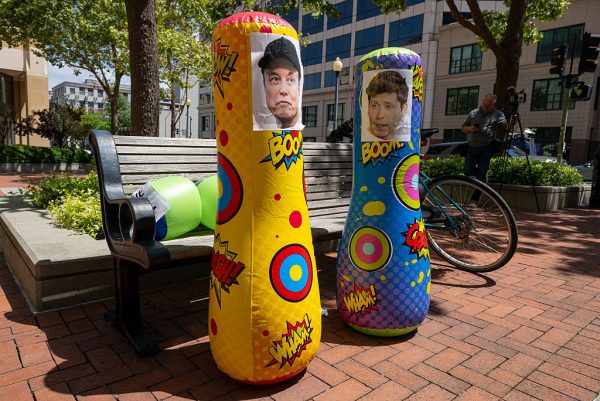
Musk has argued that OpenAI has abandoned its founding principles and become what he describes as a “wealth-creation machine” dominated by Microsoft and other commercial interests. The remedies he is seeking would force a restoration of the original nonprofit structure, remove Altman and Brockman from leadership, redirect substantial damages to public-interest causes, and potentially derail OpenAI’s planned initial public offering. Musk has framed AI safety as a matter of human survival, and presents the case as a defense of both the U.S. charitable system and the long-term safety trajectory of artificial intelligence development.
Musk’s competing AI company xAI, founded in 2023, gives the litigation a separate commercial dimension. xAI is positioned as a direct competitor to OpenAI and plans to pursue an IPO in tandem with SpaceX, with a high target valuation. A judicial finding against OpenAI would directly benefit xAI’s market position. Musk has publicly framed his AI mission through xAI as pursuing the understanding of the universe. Before trial, he attempted to settle the case, but warned OpenAI’s leaders that if they did not, they would become “the most hated people in America.”
OpenAI’s position is that the for-profit transition was a necessary response to the financial requirements of frontier AI development. Only by securing massive capital commitments could the company compete with Google and other AI giants and continue to develop AI for the benefit of humanity. From OpenAI’s standpoint, aggressive commercialization is in fact the mechanism that funds the safety mission. The October 2025 reorganization established OpenAI as a public benefit corporation with the nonprofit parent retaining a substantial equity stake. OpenAI’s counsel has cast Musk as a “sore loser” who is obstructing AI progress because he failed to seize control of the company himself.
Altman’s objectives in the litigation are to maintain his leadership position, push forward with OpenAI’s IPO and data center expansion plans, and preserve OpenAI’s global lead in AI capability. The company has emphasized that its partnership with Microsoft has produced significant innovation while still permitting open release of substantial portions of its technology. A favorable verdict would clear the principal obstacle to OpenAI’s commercial trajectory.
The trial proceedings have been confrontational, with Musk accusing OpenAI’s lawyers of trying to deceive him on the stand. Brockman’s testimony has described tense internal meetings during the 2017 control fight.
What a verdict against OpenAI would mean for the US-China AI race
The case reaches well beyond personal grievance and touches on the architecture of AI governance, charitable-trust law, and Silicon Valley power dynamics. If Musk prevails, OpenAI could be forced to split, restructure, or revert to its original nonprofit form, with cascading effects on thousands of employees and on the broader global AI supply chain. Microsoft and other commercial backers would face significant losses on their investments. If OpenAI prevails, the verdict will reinforce the commercial-driven model of AI development that has dominated Silicon Valley since 2022, while also potentially intensifying public concern about AI monopolization and safety risks.
Reuters has reported that the verdict could materially affect the future trajectory of AI development. The BBC has framed the case as the legal expression of the underlying conflict between the co-founders over control and mission. The deeper question is whether the dominant U.S. AI institutions will continue to be governed by commercial logic or whether a return to a public-interest model is legally possible at this stage of the industry’s development.
The geopolitical backdrop is the AI competition with China. Chinese state-aligned AI labs including DeepSeek, Alibaba’s Qwen team, and several others have closed much of the gap with U.S. frontier model developers over the past two years. OpenAI’s leadership has argued internally and publicly that without aggressive commercialization and capital deployment, U.S. AI capability would lose ground to a state-supported Chinese AI sector. Musk’s argument is that the commercial capture of the original safety-focused institution leaves the United States with no AI organization structurally aligned with humanity’s long-term interest, which is its own form of weakness against a strategic competitor.
The conflict between Musk and Altman is the legal expression of an underlying tension in the AI industry between AI as research mission and AI as commercial empire. The Oakland courtroom has become the venue where that tension is being adjudicated. The outcome will shape OpenAI, xAI, and Microsoft directly, and may shape the structural future of how artificial intelligence is governed in the West.
By Meng Hao, Vision Times