Mao Zedong’s personal security chief, Wang Dongxing, had spent thirty years as the most feared man in Zhongnanhai, the walled Party leadership compound in Beijing. He controlled the files that could destroy any senior official, commanded the elite troops who guarded the leadership, and after arresting the so-called Gang of Four in 1976, he had risen to become the fifth-ranking member of the Communist Party’s Politburo Standing Committee, its supreme ruling body. Within two years, Deng Xiaoping and the veteran economic planner Chen Yun had reduced him to nothing. They did it with a speech and a sentence.
Wang Dongxing’s power rested on secrets and soldiers
Inside Zhongnanhai, Wang was a figure of genuine menace. He could turn away Jiang Qing, Mao’s wife and the most powerful woman in China, at the door. Senior officials feared his late-night phone calls. He was known to hold extensive compromising files on the Party leadership, including records of Jiang Qing’s romantic life during her Shanghai years in the 1930s and accounts of her arrest before she became Mao’s wife. Jiang Qing herself believed Wang had fed Mao damaging accounts of her private meetings with foreigners, including material later published abroad under the title The Empress of the Red Capital, and blamed him for poisoning her relationship with Mao. She reportedly said of him: “Wang Dongxing is a ticking bomb planted at the Chairman’s side.”
His institutional power was equally formidable. He commanded Unit 8341, the elite force that physically guarded Mao and the entire Zhongnanhai compound, a praetorian corps that answered to him alone. When Wang helped orchestrate the arrest of the Gang of Four in October 1976, eliminating Jiang Qing and her three radical allies, he was rewarded with a seat on the Standing Committee and positioned as one of the architects of the post-Mao order. He became the chief defender of what was called the “Two Whatevers” doctrine: whatever Mao had decided was correct, and whatever Mao had instructed must be followed. The formula was designed to prevent any revisitation of Mao’s record and, by extension, to block the political rehabilitation of officials who had been purged under Mao.
Among those officials was Deng Xiaoping, who had twice been purged and was now maneuvering to consolidate power. Wang had dismissed him privately: “Deng’s abilities fall far short of Hua Guofeng’s,” he reportedly said, referring to Mao’s chosen successor, who was then formally the Party’s top leader.

Chen Yun detonated the political equivalent of a bomb at a Party work conference
The instrument of Wang’s destruction was the Central Work Conference held between November and December 1978, which immediately preceded the pivotal Third Plenary Session of the 11th Central Committee, the meeting that officially launched China’s reform era. The conference had been convened ostensibly to discuss agricultural policy. Chen Yun, a veteran Party elder who had built his reputation managing China’s planned economy and who commanded deep respect among the older generation of officials that Wang had spent years browbeating, walked into one of the conference’s regional caucus sessions, the Northwest Group, and deliberately derailed the agenda.
Success
You are now signed up for our newsletter
Success
Check your email to complete sign up
He raised six unresolved historical grievances, among them the case of the so-called “61 traitors,” a group of officials including Bo Yibo, father of the later Politburo member Bo Xilai, who had been accused of betraying the Party during wartime imprisonment by the Japanese and who had never been rehabilitated. He called for the reversal of the verdict against Peng Dehuai, the defense minister Mao had purged in 1959 for criticizing the Great Leap Forward. He demanded a reassessment of the April Fifth Movement, the mass mourning demonstration at Tiananmen Square in 1976 that the Party had suppressed as a “counter-revolutionary incident.”
Every one of those files sat in Wang Dongxing’s archive. As head of the Central Special Case Investigation Group, Wang controlled the documentary record of all the major political purges from the Cultural Revolution era. He had used the authority of “Mao’s final verdict” as a shield, refusing to release material that would allow the rehabilitation of victims. Chen Yun’s speech was a surgical strike. By framing the issue as one of justice for wrongly accused comrades, he positioned Wang as the man personally obstructing the exoneration of an entire generation of senior officials. In a single address, he transformed Wang from a powerful institutional player into the collective enemy of every veteran cadre in the room.
Wang’s counterattack collapsed when Deng refused to be embarrassed
Wang Dongxing did not accept the attack passively. He went to the Central Archives and retrieved a transcript of remarks Deng had made at the 1959 Lushan Conference, where senior leaders had gathered to assess the catastrophic failures of the Great Leap Forward. At that meeting, Deng, like most officials present, had joined in criticizing Peng Dehuai after Mao turned on him. Wang passed the documents to Hua Guofeng, hoping to demonstrate that Deng was demanding rehabilitation for a man he had himself denounced and that his position was therefore hypocritical and politically disqualifying.
Deng’s response stripped the maneuver of all its force. When word reached him, he addressed the conference directly: “I did criticize Marshal Peng in the past. That criticism was wrong. Now that I understand it was wrong, it should be corrected.” The assembled officials rewarded him with exactly the response Wang had been trying to prevent. An admission of error, delivered without apparent defensiveness, struck the senior cadres present as the posture of a leader secure enough to hold himself accountable. Wang’s archival weapon misfired.
As the conference moved into its final sessions, the attack on Wang became direct and named. Jiang Yizhen and Hu Yaobang, the reformist official who would later serve as CCP general secretary before his own purge in 1987, spoke openly against Wang in the group sessions with the tacit approval of Deng and Chen. They accused him of suppressing newspapers and enforcing ideological conformity during the debate over whether practice, rather than Mao’s pronouncements, should be the test of truth, a controversy that had become the reform faction’s central battle against the “Two Whatevers” line Wang defended. The verdict of the room was clear. Wang surrendered the real levers of his power, relinquishing the directorship of the Party’s Central General Office and the commandership of the Central Security Bureau.
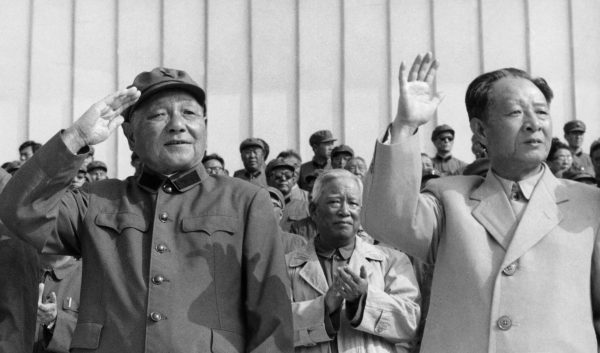
Deng stripped Wang of his troops and his bureaucratic base
The ideological defeat was followed by an institutional dismantling. Wang’s power ultimately rested on Unit 8341, the military formation that physically controlled Zhongnanhai. As long as he held the compound’s keys, every senior leader faced at least a theoretical personal risk. Deng had spent the months before the conference reorganizing personnel across the Beijing Garrison Command and the major regional military commands, quietly removing Wang’s allies from positions of authority.
He then moved against the institutional structure itself. Under the rubric of “systemized management,” Deng argued that the Central Security Bureau should report to the Party’s Central Military Commission, the body overseeing China’s armed forces, rather than remain under the personal control of any single official. He was simultaneously moving to chair that commission himself. Wang was removed from the Central General Office directorship, which passed to Yao Yilin, and stripped of his security command.
Cheng Xiaonong, a former policy adviser to Zhao Ziyang, the reform-era prime minister who was eventually placed under house arrest after the 1989 Tiananmen crackdown, later analyzed the significance of the reorganization: “Wang Dongxing’s fall marked a major turning point in the CCP’s guard system. After consolidating power, Deng rapidly transferred the Security Bureau, the Confidential Documents Bureau, and the Health Bureau, all of which had previously reported through the Central General Office on Wang’s personal authority, into the Military Commission’s chain of command.”
Ming Jucheng, a scholar of Chinese politics and honorary professor at National Taiwan University, described the operation in blunter terms. What was packaged as a debate over political “line” was a power execution. Deng had built a new legitimating formula, one centered on pragmatic reform and the reversal of Mao-era injustices, and that formula left Wang Dongxing with nothing to stand on. Wang had derived his entire authority from his status as Mao’s personal retainer. Once Mao’s legacy became a liability rather than a shield, Wang’s position evaporated.
Wang’s archives kept him alive but consigned him to silence
Wang Dongxing was compelled to resign from all his leadership positions in 1980. He was not arrested. He was not tried. He received what the Chinese political system calls a “soft landing:” a managed retirement that allowed him to retain his personal privileges and avoid prosecution.
The calculation behind that outcome was transparent. Wang held archives that could damage virtually every senior figure then consolidating power, including Deng and Chen Yun themselves. The Cultural Revolution had generated blackmail material against all factions. Put Wang in a courtroom, and the testimony, or the threat of testimony, could have been catastrophic. A quiet retirement, secured by an implicit understanding that the files would remain sealed, was the price of stability.
Wang Dongxing lived until 2015, dying at the age of 100. He never gave a significant public interview, never published memoirs, and never broke the silence that his retirement had purchased.
He had spent thirty years accumulating the instruments of permanent power: the compromising files of every senior leader, the loyalty of the troops who guarded the compound, the institutional control of the bodies through which the Party’s most sensitive operations ran. Against all of that, Chen Yun had read a prepared statement calling for justice for wrongly convicted comrades, and Deng Xiaoping had said, in front of a room full of veteran officials, “I was wrong.” Those two interventions, one positioning Wang as the obstacle to justice and the other demonstrating that his most powerful weapon could be disarmed with a public admission, reduced thirty years of accumulated leverage to rubble in the course of a single winter.