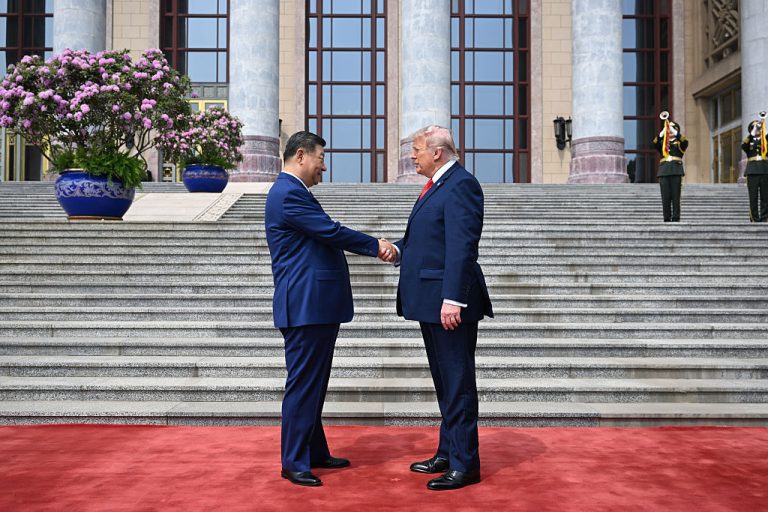
Trump’s May 2026 trip to Beijing was the first American presidential visit to the Chinese capital in years. The CCP’s leadership was managing simultaneous crises: a sweeping purge of senior military officers on corruption charges, an economy that had not recovered the growth trajectory or international confidence it held a decade earlier, and a technology sector severed from the advanced components it needed to build competitive artificial intelligence. Xi Jinping, the CCP’s general secretary and China’s top leader, had presented each of these as a sign of strength. Trump arrived to test that claim.
Trump planted a mobile White House in Beijing’s center
On the evening of May 13, Air Force One touched down at the capital’s airport. China’s government dispatched a vice president to the tarmac, along with a line of schoolchildren bearing flowers and a formation guard, the full ceremonial trappings of an era when American presidents arrived on friendlier terms. The American side answered all of this pageantry with 70 armored vehicles, more than a dozen U.S. Air Force C-17 heavy transport aircraft, and an encrypted satellite communications system that mirrored the White House Situation Room in real time.
Analysts traveling with the delegation described the setup with unusual bluntness: Trump had placed a functioning mobile White House inside Beijing’s geographic core. From his hotel suite, he retained direct command links to American military assets worldwide, including strike forces still conducting the final stages of operations against Iranian targets in the Middle East. He could have ordered action anywhere on earth from a city his hosts nominally controlled. No previous American president had accepted Chinese terms on Chinese soil; Trump imported his own.
Musk and Nvidia’s CEO came to Beijing to set technology terms
Seventeen American business executives accompanied the president. Two defined the visit.
Elon Musk, chief executive of SpaceX and the architect of Starlink’s low-Earth-orbit satellite network, sat across from Chinese officials who have spent years and enormous resources building the Great Firewall, the world’s most elaborate system of internet censorship and information control. Starlink’s satellite-to-satellite connections have already created a technical pathway around ground-based censorship systems, and the firewall’s days as a reliable information-control mechanism are numbered. Musk’s presence in Beijing was a quiet reminder of that fact. The CCP’s monopoly on what its population reads, watches, and thinks about is eroding from orbit.
Success
You are now signed up for our newsletter
Success
Check your email to complete sign up
Jensen Huang, founder and chief executive of Nvidia, the California company that manufactures the most powerful artificial intelligence chips in existence, confirmed his place on the delegation at the last minute. Control over advanced semiconductors is now, in practical terms, control over which countries can build competitive militaries, which can run sophisticated surveillance states, and which can govern at scale in the AI era. China has tried to close this gap through theft, through purchases when export controls were lax, and through domestic research programs that have thus far failed to deliver at scale. By 2026, the computational gap between American and Chinese AI capability had widened to something approaching a generational lag.
Huang came to Beijing to set the conditions under which any future chip access might be possible. The framework under discussion would require China to accept rigorous checks on how the chips are used; any chips found to have been redirected to military targeting systems, advanced surveillance systems, or offensive AI applications could be remotely disabled from the United States. If accepted, the offer would mean that Beijing’s most sensitive digital systems would operate under permanent American oversight. That is the operating system of future great-power competition, and the question on the table was whether Beijing would accept Washington’s licensing terms or continue falling further behind.
Beijing’s readout stressed Taiwan; Washington’s listed Chinese concessions
Beijing’s state media led its account of the May 14 plenary with strident warnings about Taiwan, the self-governing island democracy that the CCP claims as its territory and has repeatedly threatened to take by force. The language was maximally alarming: the Taiwan question was described as the most core issue, as sitting in an extremely dangerous position, as something that could produce collision if mishandled. To a domestic Chinese audience, this framing conveyed strength, resolve, and a leadership that had refused to be pushed around by Washington.
The White House summary did not mention Taiwan at all.
American officials concentrated their written account on three concrete items. First, the Strait of Hormuz: the narrow waterway at the mouth of the Persian Gulf through which roughly a fifth of the world’s oil supply transits, and which Iranian forces had threatened to close in response to American military strikes. Second, fentanyl precursor chemicals: Beijing’s continued failure to stop Chinese manufacturers from supplying the Mexican cartels that produce the synthetic opioid killing tens of thousands of Americans each year. Third, Chinese purchasing commitments: expanded Chinese imports of American energy and agricultural products.
Beijing shouted about Taiwan because it needed to show its domestic audience something, anything, that looked like resistance. China is the world’s largest oil importer. When American forces weakened Iran’s military capacity in the Middle East, they did not merely eliminate a regional adversary; they tightened a chokehold around China’s energy supply chain. The CCP had calculated that backing Iran would bog Washington down, forcing American strategists to prioritize the Middle East over the Pacific. Instead, China found itself more exposed. It had picked up a rock to throw, as one analyst put it, without noticing the chain connecting the rock to its own foot.
Beijing committed to buying more American oil to reduce its dependence on Gulf supply routes it no longer controls, and agreed in principle to expand the overall list of cooperative economic arrangements while shrinking the list of contested ones. Xi opened his formal remarks with the phrase “cooperation benefits both sides, confrontation harms both sides,” a formulation that, in context, described his constraints rather than his vision.
A gun standoff at an imperial temple delayed Trump’s schedule by 30 minutes
On the afternoon of May 14, Trump’s motorcade proceeded to the Temple of Heaven, the fifteenth-century imperial complex in central Beijing where Chinese emperors once performed rituals affirming the divine mandate of their rule. At the entrance, Chinese security personnel demanded that a member of the U.S. Secret Service detail surrender his sidearm before entering the grounds. The agent refused. The standoff continued long enough to delay the entire presidential schedule by half an hour, with American and Chinese security personnel facing each other in front of the temple’s main ceremonial hall.
The White House press corps fared no better. Chinese officials physically confined the traveling American journalists to a single room, cutting them off from the presidential motorcade. The reporters broke out and sprinted across the temple grounds to rejoin the presidential party. Bret Baier, the Fox News anchor traveling with the delegation, posted in real time from the scene: cameras everywhere, he wrote, this is what the CCP’s China actually looks like.
There was no joint press conference at the conclusion of the summit. There was no joint statement of principles. There was no U.S.-China business roundtable, no ceremony of shared commitments.
Xi Jinping read from scripts while American officials sat relaxed across the table
Xi, who is of average height, wore noticeably elevated footwear, apparently to reduce the visual gap with Trump, who stands close to six feet three inches tall. More telling was Xi’s frequent consultation of briefing notes during the meeting, a habit suggesting his responses were scripted rather than spontaneous, and that the Chinese side had not prepared adequately for Trump’s method of negotiation, which tends to ignore established diplomatic templates and press directly for concessions. American officials and business representatives seated across from them appeared relaxed; Chinese officials projected the particular kind of controlled blankness that in Party political culture signals suppressed anxiety rather than calm authority.
Compare this to Trump’s first visit to Beijing in 2017, when Xi walked the American president through the Forbidden City in a display of confident theatrics, projecting China as an ascending civilization receiving a respectful peer. Xi was now managing a military leadership in the middle of an unprecedented corruption purge of senior officers, an economy that had not recovered the growth rates or the international confidence it commanded a decade ago, and a technology sector increasingly walled off from the components it needed to advance. The self-assurance of 2017 had been replaced by something visibly more defensive.
The summit produced four concrete outcomes, all on Washington’s terms
The military campaign against Iranian targets served notice to Beijing that arming, financing, and diplomatically shielding regional proxies to tie down American power carries real costs that ultimately land on China.
China will not receive advanced American chips without accepting the conditions attached to them, and those conditions include the technical capacity for Washington to terminate access remotely, a constraint with no historical equivalent in great-power commercial relations.
Beijing accepted expanded purchasing obligations for American energy and agricultural goods, a concession driven by the energy vulnerability that American Middle East operations had exposed.
The era in which the CCP could extract benefits from Washington while systematically undermining American interests, biding its time and waiting for American attention to fragment, has ended. China’s leaders now face that reckoning cut off from advanced American chips, locked into energy dependency, and without the Iranian proxy buffer they spent years building.
By Fengyun Daqiju, Vision Times