From the moment Air Force One touched down at Beijing Capital Airport on May 14, 2026, something was conspicuously missing. Peng Liyuan, who has been one of the CCP’s most reliable instruments of soft power for more than a decade, was nowhere to be seen.
Li Muyang, a U.S.-based political commentator who covers CCP internal affairs, catalogued the absences in detail on his independent media program. Peng did not appear at the airport welcome ceremony. She did not accompany Xi and Trump during their visit to the Temple of Heaven. She was absent from the state banquet that evening, where the head table included prime minister Li Qiang, Cai Qi (the Politburo Standing Committee member who oversees the Party’s day-to-day operations as director of the Central Secretariat), and foreign minister Wang Yi. The following day, when Xi hosted Trump for a small-group meeting and a private garden walk through the inner courtyards of Zhongnanhai, the walled leadership compound in central Beijing, Peng again did not appear.
Her absence stands in sharp relief against previous practice. When Trump and his wife Melania visited Beijing in November 2017, Peng accompanied Xi throughout. She co-hosted tours of the Forbidden City and stood beside Xi at formal events. On that trip and on many others, including state visits to Europe, Africa, and Latin America, Peng was Xi’s constant public companion. The contrast with the 2026 summit is total.
One detail drew particular attention. At the state banquet on the evening of May 14, Trump publicly invited Xi and Peng to visit the White House on Sept. 24 of this year. Li Muyang pointed out that the phrasing was telling: Trump extended the invitation to the couple, rather than thanking them for the evening’s hospitality. Had Peng been seated at the head table as the host’s wife, standard diplomatic protocol would have called for a word of thanks to the hosts. Trump’s formulation implied he was working around her absence.
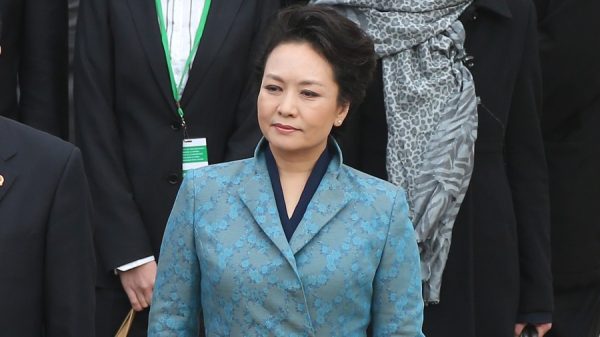
She also skipped the 2025 APEC summit in Seoul, with no explanation from Beijing
The Trump summit was not an isolated incident. In Oct. 2025, Xi traveled to Seoul for the Asia-Pacific Economic Cooperation summit and a state visit to South Korea. South Korean media had reported in advance that Peng would accompany him. She did not. Xi was flanked instead by Cai Qi and Wang Yi.
Success
You are now signed up for our newsletter
Success
Check your email to complete sign up
The contrast with Xi’s first state visit to South Korea, in July 2014, is stark. On that trip, Peng not only attended all official functions but toured Seoul’s Changdeokgung Palace independently and visited the Dongdaemun shopping district. She was the face of Chinese soft diplomacy, performing the role of cultured, accessible first lady for audiences that Beijing wanted to charm.
In the intervening years, Peng accompanied Xi to virtually every major international engagement. Beijing has offered no explanation for either absence.
Two of three explanations fail; the third points to Peng’s role inside the military
Illness is the first explanation to collapse. On the morning of May 12, 2026, just two days before the summit, Peng appeared at an official function in Beijing, meeting Audrey Azoulay, the director-general of the United Nations Educational, Scientific and Cultural Organization (UNESCO). Peng holds the title of UNESCO Special Envoy for the Promotion of Girls’ and Women’s Education, a formal position under the UN body, and the meeting was documented on China’s foreign ministry website. A woman receiving foreign dignitaries two days before a state summit is plainly not incapacitated.
Diplomatic symmetry is the second explanation to fail. The argument holds that because Melania Trump did not travel to Beijing, Peng stayed home in reciprocal deference. Li Muyang dismantles this with a single historical precedent. In June 2013, then-South Korean President Park Geun-hye visited Beijing as a head of state traveling without a spouse. Peng nonetheless attended the welcome ceremony alongside Xi and hosted Park for a private luncheon on June 28. A single female head of state’s visit did not keep Peng off the stage then. Beijing has not claimed any protocol that required her withdrawal now.
The third explanation concerns Peng’s institutional position rather than her personal circumstances. Since 2018, according to analysts who track CCP organizational changes, Peng has held a full-time seat on the Cadre Evaluation Committee of China’s top military command body, the Central Military Commission, a body that reviews the performance and promotion of senior military officers. This is a substantive position, classified at the full corps-grade level in China’s military internal rank hierarchy, placing Peng inside the military bureaucracy as a functioning official rather than as a ceremonial spouse. The argument here is that Peng’s identity within the system has shifted: she is now a Party-military insider, and the CCP may be managing that shift by quietly withdrawing her from diplomatic spectacle.
Li Muyang declines to endorse any of the three explanations. His bottom line: the CCP is deliberately keeping Peng out of sight.
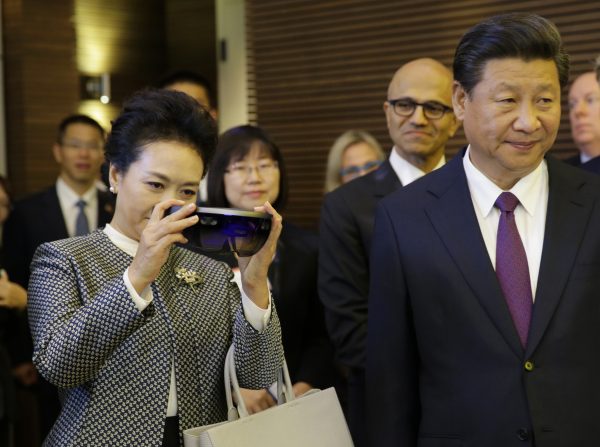
Commentators cite house arrest rumors; Sept. 24 White House visit will be a public test
Jiang Feng, a U.S.-based political commentator with a substantial following among overseas Chinese audiences, addressed the Peng situation on his own program. According to Jiang, rumors have been circulating since early 2025 that Peng has been placed under residential surveillance, a form of extrajudicial detention used by the CCP against figures under investigation, in which the subject is confined to a designated location and can appear in public only when the authorities require it.
The claimed basis for this surveillance, according to the rumors Jiang is reporting, is that Peng has been drawn into investigations connected to two figures: the late Li Keqiang, who served as prime minister under Xi from 2013 until 2023 and died in Oct. 2023 under circumstances that drew significant public scrutiny, and Ma Xingrui, a senior regional official whose political fate remains a subject of intense speculation in dissident circles.
Jiang makes no claim to have verified these rumors. He frames them instead against a specific future event that can serve as a public test. Trump’s White House invitation, delivered at the state banquet in front of cameras, on a specific date, has created an observable benchmark. If Peng does not appear at Xi’s side in Washington on Sept. 24, or if Xi finds a pretext to cancel the visit altogether, it will demonstrate that someone inside Zhongnanhai has the power to suppress the “first lady” card even at the cost of a bilateral summit.