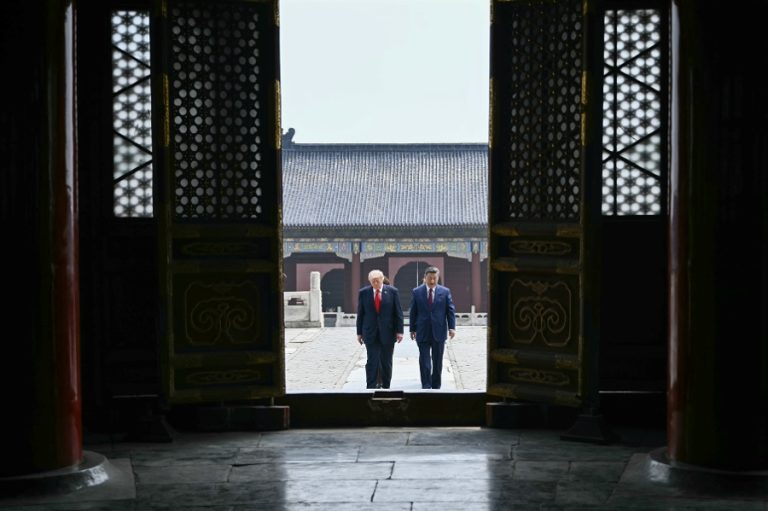
In full view of the international press, Chinese leader Xi Jinping personally shook hands with U.S. Secretary of State Marco Rubio at the welcoming ceremony for President Donald Trump at the Great Hall of the People on May 14, 2026. Rubio remains formally under Chinese government sanctions, twice imposed in 2020, that nominally bar him from entering China.
To allow Rubio to travel to Beijing aboard Air Force One, the Chinese government engineered a workaround. State media and the Foreign Ministry began transliterating Rubio’s name with a different Chinese character (鲁比奥 instead of the previously-used 卢比奥), allowing Beijing to claim that the original sanctions still applied to one spelling while engaging with Rubio under the other.
The day before Trump’s arrival in Beijing, White House Communications Director Steven Cheung posted an image of Rubio aboard Air Force One in a gray Nike tracksuit closely resembling the one worn by Venezuelan dictator Nicolás Maduro after his January 2026 capture by U.S. forces. Cheung captioned it: “Secretary Rubio rocking the Nike Tech ‘Venezuela’ on Air Force One!” The White House’s official account followed with a video pairing a photograph of the handcuffed Maduro in his tracksuit, labeled “January 2026,” with footage of Rubio in his matching outfit, labeled “May 2026.” The clip ended with the caption “full circle moment.”
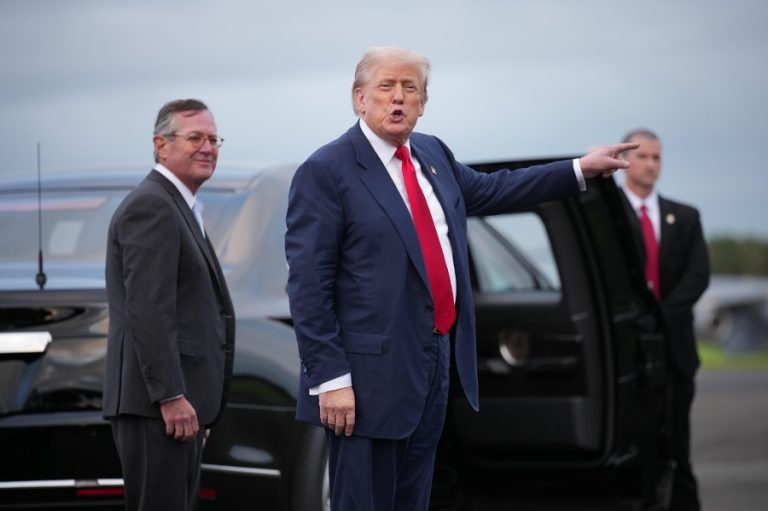
The Beijing reception was visibly upgraded from Trump’s 2017 first-term visit to China. Vice President Han Zheng, a “national leader-level” official by CCP ranking, received Trump at Beijing Capital International Airport, a higher protocol level than the 2017 reception by then-State Councilor Yang Jiechi.
The shift fits a pattern George Kennan, the architect of America’s Cold War containment strategy, described in his 1947 essay “The Sources of Soviet Conduct.” Soviet leadership, Kennan wrote, was “more sensitive to opposing force, more flexible in concessions, and most amenable to retreat when force on the other side is felt to be too strong.” Kennan also warned that effective containment required “long-term, patient but firm and vigilant” pressure, and that bluster and theatrical toughness were counterproductive substitutes for actual power.
Success
You are now signed up for our newsletter
Success
Check your email to complete sign up
In the few months since Trump returned to office, U.S. forces have captured Maduro in Venezuela, struck Iran’s nuclear program in joint operations with Israel that killed Supreme Leader Ali Khamenei, and forced Iran’s effective surrender of its naval and air capabilities. Beijing’s compromise on Rubio’s sanctions, on Trump’s reception protocol, and on the larger choreography of the summit follows the Kennan model: a Communist leadership adjusting to the underlying balance of force.
Taiwan, which remains the principal target of CCP coercion, has reason to study the demonstration carefully.
On Polymarket, the world’s largest prediction market, a market titled “Who will Xi Jinping purge in 2026?” has accumulated approximately $157,000 in trading volume since opening in late January. The current top three by implied probability are Defense Minister Dong Jun (around 17 percent), Central Military Commission Discipline Inspection Secretary Zhang Shengmin (around 16 percent), and Politburo Standing Committee member Cai Qi (around 12 percent). Foreign Minister Wang Yi sits at around 10 percent.
Several of the individuals listed by name on that prediction market stood within meters of Xi during the welcome ceremony, including Cai Qi, Wang Yi, and Dong Jun. When Xi introduced them in turn to Trump for handshakes, both leaders were greeting officials whom international observers had already publicly identified as likely candidates for political destruction in the months ahead.
When Xi began introducing members of the visiting U.S. delegation to himself, he arrived at Marco Rubio. According to video circulated by White House and international media, a moment of visible hesitation passed before Xi extended his hand. Footage shows Cai Qi, Wang Yi, Dong Jun, and other senior CCP officials leaning forward to watch. After the brief handshake, Xi turned his head back toward Rubio briefly before continuing down the line.
Standing behind Xi as the handshake occurred, Trump’s expression was difficult to read. An X user later posted footage suggesting Rubio briefly winked at Trump as the U.S. delegation moved past the Chinese officials. The clip was widely shared on social media. The wink, like Trump’s expression, has been read by overseas Chinese-language commentators as a moment of acknowledgment between the U.S. president and the secretary of state who had just been received by the same Chinese government that had officially banned him.
Western media commentary on the handshake reached a similar reading without the body-language interpretation. As one analyst observed, the moment marked a public performance of “the sanctioner and the sanctioned sharing the same stage.” Chinese-language social media users put it more cuttingly: the red line had become a red carpet.
Xi never lifted the sanctions on Rubio. He engineered a transliteration workaround that allowed him to greet Rubio while leaving the formal sanctions architecture intact. The CCP’s preference for face-saving fictions over open concessions held. The fictions themselves are now visibly thinner.
The 2020 sanctions on Rubio came from a moment of confident Chinese hostility toward an American senator who had spoken plainly about Xinjiang, Hong Kong, and the persecution of Falun Gong practitioners. The 2026 Beijing handshake came from a moment of accommodation. Whether the accommodation extends beyond protocol into concessions on Iran, Taiwan, or technology is the open question that the next months will answer.
By Jian Yi, Vision Times