Walk into almost any Chinese wedding today and you will see white gowns, Western style vows, and a bouquet toss, customs that now feel ordinary even though they were once entirely absent from traditional Chinese marriage ceremonies.
Six betrothal rites and three formal documents once made a marriage official
The Zhou dynasty framework governing every stage of marriage, dating back roughly three thousand years, was known as the Three Documents and Six Rites. The Three Documents were the betrothal letter, the gift inventory, and the wedding-day greeting letter. Each was a formal written record, shared with family members and ancestral shrines, that gave the marriage its legal and social standing. A union conducted without them was considered irregular.
The Six Rites followed a precise sequence: the formal proposal, the exchange of birth characters for astrological compatibility, the announcement of the engagement, the delivery of betrothal gifts, the setting of the wedding date, and the groom’s procession to receive the bride. Each step required its own protocols, and the whole sequence could span months.
Modern life has compressed this into an afternoon at the marriage registry office. The documents have become decorative props, ordered online and left on a shelf. The casualness of contemporary marriage, including a rising divorce rate, follows directly from the disappearance of this ceremonial weight.
An elder prepared the marriage bed days before the wedding
Several days before the wedding, the groom’s family would invite an elder considered “fortunate” to set up the marriage bed. The qualification was specific: both parents still living, children of both sexes. This person would spread new red bedding and scatter dates, peanuts, longans, and lotus seeds across the sheets. In Chinese, the names of those four items, read together, approximate the phrase “may you soon bear a precious child.” Red envelopes were tucked under the pillows. Children were invited to climb on the bed and play, their noise and movement thought to bring the new household its first dose of good fortune.
Success
You are now signed up for our newsletter
Success
Check your email to complete sign up
Once the bed was set, no adult was permitted to sit or lie on it until the wedding night.
In cities today, most couples move into new apartments or stay in hotel suites. The bed-setting ritual is almost never performed.
A hair-combing ritual marked the transition from unmarried child to spouse
The night before the wedding, or early in the morning itself, a fortunate elder would comb the bride’s and groom’s hair separately in their respective family homes. The combing followed a set chant: “First brush, from root to tip; second brush, until your hair turns silver-white together; third brush, until grandchildren fill the house.” Each pass of the comb was a blessing spoken aloud.
The moment the comb moved through the hair, the young man and woman ceased to be unmarried children and became, in the eyes of their families and community, a husband and a wife. The coming-of-age combing has been almost entirely replaced by the work of hair and makeup artists. Many couples today have never heard of it.
The bridal procession required fire-crossing, gate games, and a sedan chair
The groom led his party to the bride’s home in person. Before the bride left, she performed the crying farewell, a ritual lamentation expressing sorrow at leaving her parents; in some regions, a bride who failed to cry was considered ill-omened. A red umbrella was held over her head as she crossed the threshold, shielding her from malevolent spirits in the open air.
The bride traveled to her new home in a decorated sedan chair. On arrival, she stepped over a burning brazier to drive away any lingering evil, then walked along a red carpet or a path of red lotus-shaped mats. In Chinese, the word for lotus sounds similar to the word for “continuous,” signaling unbroken good fortune.
The groom, meanwhile, faced a series of staged obstacles at the door. Relatives and friends of the bride demanded he answer riddles and perform party tricks before they would allow him entry. A man willing to work and be embarrassed to claim his wife had passed a small but public proof of commitment.
The three-part bow and the tea ceremony formally joined two families
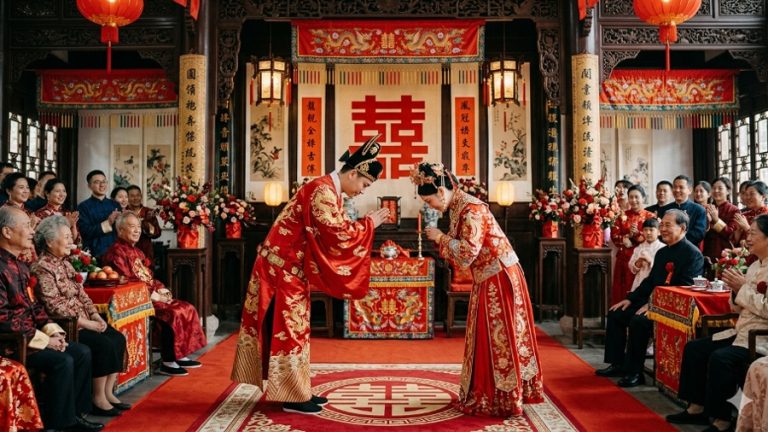
“One bow to heaven and earth; two bows to the parents; husband and wife bow to each other.” This three-part sequence was the ceremonial climax of the traditional wedding. The couple knelt and bowed first to the sky and earth, calling the cosmos to witness their vow. They turned and bowed to the groom’s parents, acknowledging the family that received them. They faced each other and bowed, pledging their lives to one another.
After the bowing came the tea ceremony. The bride presented tea to her parents-in-law and to each senior member of the family in turn. She addressed them for the first time as “Father” and “Mother.” They accepted the tea and returned red envelopes and gifts. It was the formal moment of incorporation: the bride became a member of her husband’s family, recognized and welcomed by its elders.
The wedding celebration extended to a raucous bridal chamber and a third-day homecoming
The traditional post-ceremony festivities included a raucous celebration in the bridal chamber, in which guests teased the newlyweds with games and jokes. The practice, sometimes translated as “disturbing the bridal chamber,” was understood as communal joy and a way of helping the couple relax into their new life together. It affirmed that the marriage was a community event, witnessed and celebrated by the people who would share in the couple’s life.
Three days after the wedding, the bride returned to her parents’ home for the first time as a married woman. She brought gifts. The visit, known as the third-day return, was an act of gratitude and a declaration that marriage had not severed her bond with her original family.
The bridal chamber celebration has been curtailed or eliminated in many families, partly because modern interpretations have sometimes pushed the teasing into uncomfortable territory. The three-day return is frequently skipped due to work schedules.
Modern couples prize freedom and personal expression, and there is nothing wrong with that. But marriage has always carried obligations beyond the feelings of two people on a single afternoon.
The old rites were specific to this culture and this understanding of what marriage means, and the obligations they encoded do not automatically transfer to whatever replaces them.
By Wei Ran, Vision Times