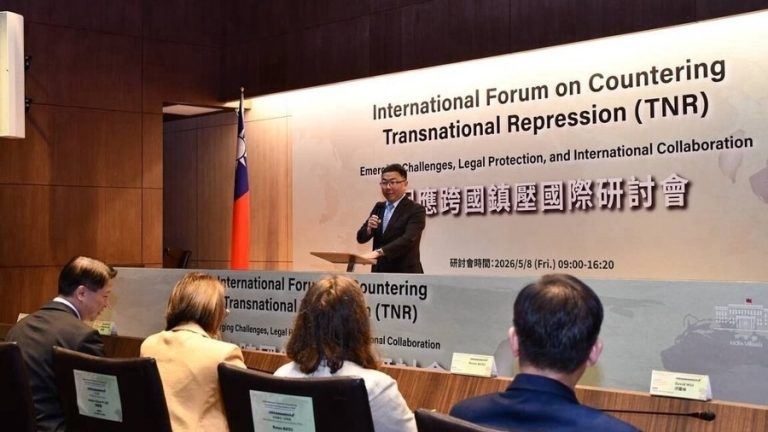
Taiwan’s Ministry of Foreign Affairs recently held its first “International Symposium on Countering Transnational Repression,” bringing together legislators, experts, and scholars from like-minded countries including the United States, United Kingdom, Germany, Ireland, and New Zealand, along with representatives from relevant Taiwanese government agencies, to discuss issues related to cross-border pressure by authoritarian states and democratic defense.
Lin Ming-hsin, Minister without Portfolio in Taiwan’s Executive Yuan said during the meeting that, in the face of expanding authoritarianism, no country can independently respond to the challenges of transnational repression, according to a press release by Taiwan’s Ministry of Foreign Affairs.
He added that the Executive Yuan is promoting inter-agency coordination and working to establish more comprehensive legal frameworks and administrative procedures, with the aim of ensuring that those who exert authoritarian pressure, as well as their local collaborators, have nowhere to hide.
The symposium was held on May 8 at the Taiwan Academy of Foreign Affairs and was organized by Taiwan’s Ministry of Foreign Affairs.
The Ministry stated that the conference focused on the dynamics of transnational repression, cooperation models among democratic countries, and how to build a more robust international defense network, with the goal of enhancing awareness of such threats through shared experience exchange.
Success
You are now signed up for our newsletter
Success
Check your email to complete sign up
Zhen Guoqing, speaking on behalf of Foreign Minister Lin Chia-lung, said that in recent years authoritarian states have combined artificial intelligence with disinformation and false information, extending surveillance and intimidation tactics into overseas and cyberspace. He warned that this constitutes a systemic threat to democratic systems, civil liberties, and the sovereignty of other countries.
He noted that Taiwan’s Ministry of Foreign Affairs has introduced the “2P1R” strategy.
Prevention, protection and response
The strategy aims to strengthen public ability to identify disinformation, improve assistance mechanisms at overseas representative offices, and enhance cooperation with like-minded countries to jointly build a democratic defense framework.
Lin Ming-hsin said the government will continue strengthening inter-agency cooperation and also review relevant institutional and legal frameworks to ensure that both Taiwanese citizens and foreign nationals in Taiwan are protected under constitutional safeguards and can live free from fear.
He emphasized that Taiwan is willing to share practical experience in responding to authoritarian threats with international partners, and to use international cooperation to safeguard democratic and human rights values.
The Ministry of Foreign Affairs said the forum included three thematic panel discussions. Experts participating in the event also provided multiple recommendations on response mechanisms to transnational repression, information security, and democratic resilience.
In the evening, Deputy Minister of Foreign Affairs Ger Bau-xuan hosted a banquet on behalf of Foreign Minister Lin Chia-lung for visiting foreign guests.
He emphasized that Taiwan will continue to promote “integrated diplomacy,” combining government, industry, academia, and research resources, to deepen cooperation with democratic partners and jointly counter authoritarian coercion.
By Li Ming, Vision Times