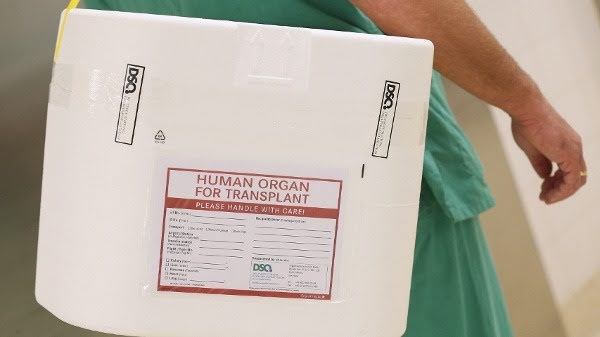
According to a press release by the Changhua District Prosecutors Office, a prominent Taiwanese physician, Chen Yao-li, was found to have illegally arranged for multiple patients to travel to China for liver and kidney transplants while allegedly earning substantial profits from the referrals. The Changhua District Prosecutors Office indicted him for violations of Taiwan’s Human Organ Transplant Act and sought a prison sentence of six years.
Last year, the Changhua District Court sentenced Chen to two years in prison, suspended for five years, and ordered him to pay NT$5 million to the public treasury.
Now, Taiwan’s Ministry of Health and Welfare has revoked his physician’s license under the Human Organ Transplant Act, making him the first doctor in Taiwan to lose a medical license for illegal organ-transplant brokerage activities, CNA reported.
Profiting from referrals to China for organ transplants
According to a report by Liberty Times, court records indicate that beginning in 2008, Chen worked with a pharmaceutical sales representative surnamed Huang to send patients to The Third Xiangya Hospital of Central South University in Hunan Province for liver-transplant operations.
After one patient died following surgery, the Changhua County Public Health Bureau determined that Chen had violated provisions of Taiwan’s Physicians Act concerning medical ethics. However, the local physician disciplinary committee ultimately decided not to impose disciplinary sanctions.
Success
You are now signed up for our newsletter
Success
Check your email to complete sign up
In 2012, Chen allegedly worked with another medical agent surnamed Lin, who specialized in cross-strait organ-transplant services, to refer patients to the same hospital for liver-transplant procedures. According to the report, one patient died during a failed operation.
Continued referrals after the law was strengthened
In 2015, Taiwan’s Legislative Yuan amended the Human Organ Transplant Act, upgrading illegal organ-brokerage activities from an administrative violation to a criminal offense.
The report states that despite the legal changes, Chen continued from 2016 to 2019—while serving as a surgeon at the Organ Transplant Center of Changhua Christian Hospital—to arrange for patients seeking liver or kidney transplants to travel to China for transplant surgery.
According to the court judgment, Chen Yao-li instructed patients to contact a man surnamed Huang to negotiate what were described as “organ donor fees.”
The reported prices were:
- Approximately 350,000 to 400,000 yuan (RMB) for a liver (about NT$1.4 million to NT$1.6 million).
- Approximately 200,000 yuan (RMB) for a kidney (about NT$800,000).
When combined with post-operative medical care, payments to Chinese physicians, and other related expenses, the total cost of each transplant reportedly ranged from NT$3 million to NT$7.5 million.
The judgment states that Chen, Huang, and others arranged for:
- Six patients undergo organ-transplant procedures at hospitals in Qingdao, Shandong.
- Three patients to receive transplants at hospitals in Changsha, Hunan.
According to the ruling, Chen charged each patient a brokerage fee of NT$900,000 and personally traveled to China to provide guidance in the operating room during the procedures.
The judgment further states that Chen paid a nurse surnamed Hsieh, who assisted in caring for the patients, NT$200,000 per case. After participants received their compensation, payments intended for Chinese physicians were allegedly transferred through a man surnamed Hong using an underground remittance system.
Among the nine patients who were allegedly referred to China for organ transplants, five received liver transplants. According to the article, one patient spent a total of NT$14 million, of which NT$7.46 million allegedly went to Chen Yao-li. However, that patient died less than two weeks after surgery.
The report further states that three other liver-transplant recipients died within two years of their operations, while the remaining patient also died within five years after surgery.
Chen Yao-li’s medical license revoked
According to a report by SET News, Taiwan’s Minister of Health and Welfare Shih Chung-liang said on June 2 that arranging for Taiwanese patients to travel overseas for organ transplants constitutes a serious violation of medical ethics and Taiwan’s Human Organ Transplant Act. In severe cases, a physician’s medical license may be revoked.
Shih stated that after a review by a medical disciplinary committee, authorities determined that the evidence of violations was clear and that the circumstances were serious. As a result, the committee imposed its harshest penalty, ultimately revoking Chen’s physician’s certificate and license to practice medicine.
Shih emphasized that Chen is the first physician in Taiwan to have his medical license revoked for organ-brokerage activities. Previous cases involving license revocations reportedly included physicians who falsified cancer diagnoses to facilitate insurance fraud or who were involved in illegal drug use.
According to the report, before Taiwan enacted stricter legislation in 2015, between 100 and 300 Taiwanese citizens traveled to China annually for organ transplants. Following the legal amendments, Taiwanese patients seeking organ transplants abroad became subject to mandatory registration requirements. Violators may face penalties under the Human Organ Transplant Act and restrictions on coverage through Taiwan’s national health insurance system.
Authorities report that the number of notified cases involving transplants in China has since declined to only several dozen per year.
Claims regarding organ harvesting in China
The media report goes on to state that various independent investigations, human-rights organizations, and some United Nations experts have alleged that China has engaged in large-scale, state-supported forced organ harvesting from prisoners of conscience, including practitioners of Falun Gong and members of the Uyghurs.
Citing data from the World Organization to Investigate the Persecution of Falun Gong (WOIPFG), the article claims that at least 788 medical institutions and 7,423 doctors in mainland China have been implicated in organ-harvesting activities.
The article further alleges that, in recent years, such practices have expanded beyond prisoners of conscience to ordinary citizens. It claims that as many as one million people disappear in China each year, and that some recovered bodies have reportedly been found with missing organs, raising suspicions of organ harvesting. Finally, the article argues that the unusually short waiting times for organ transplants in China and the lack of transparency regarding organ sources have led many in the international medical ethics community to criticize and seek to prevent so-called “transplant tourism.”