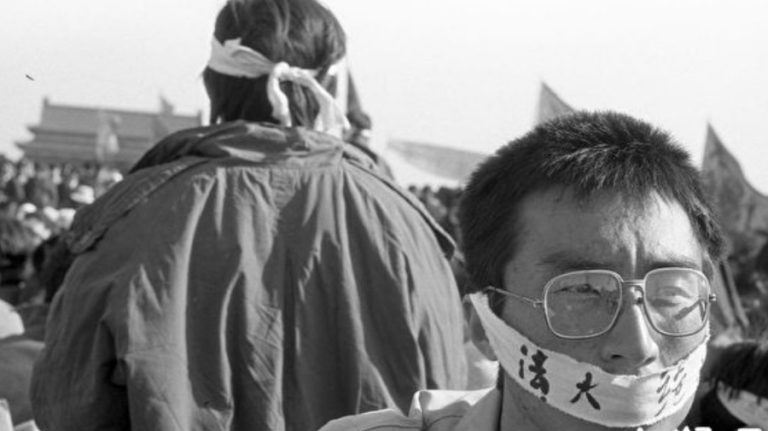
On the 37th anniversary of the June Fourth massacre, Beijing continues to insist that army units fired no shots in Tiananmen Square and that no one died there, while simultaneously claiming that troops were suppressing a violent armed insurrection. Li Hengqing, student union president of Tsinghua University’s chemistry department in 1989 and a standing committee member of the Tiananmen protest movement, has published memoir accounts that directly demolish both claims. His testimony is corroborated by declassified Western diplomatic cables, survivor records compiled by the Tiananmen Mothers advocacy group, and the historical research of historian Wu Renhua, who has spent decades documenting the crackdown.
Students refused protective gear to deny the Party its propaganda photograph
In the late hours of June 3, as units of the 38th Group Army advanced on central Beijing with armored vehicles and tear gas, residents who had intercepted troops along the route brought helmets and gas masks to the students in Tiananmen Square. Li Hengqing issued an immediate, unambiguous order: pile everything up and touch none of it.
The reasoning was political, not tactical. The students understood that any image of protesters wearing military-style headgear would be repackaged by the Party’s propaganda apparatus as evidence of “armed militarization.” The photographs would be used to justify the crackdown retroactively, lending the massacre the veneer of a counter-insurgency operation carried out against an organized armed force. Li refused to give the regime that photograph.
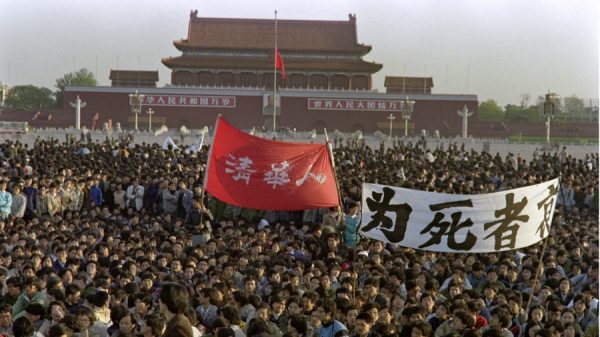
Students smashed the rifles they found rather than use them against advancing troops
By the early hours of June 4, a small number of rifles had come into the hands of people at the square, either seized from soldiers or abandoned during the chaos of the military advance. Li Hengqing joined Hou Dejian, a Taiwanese musician and activist best known for composing the pro-democracy anthem “Descendants of the Dragon,” in publicly destroying the weapons.
Li later wrote in his memoir: “We smashed the only steel rifles with a heavy weight. We defended our dignity with our bodies alone.”
Success
You are now signed up for our newsletter
Success
Check your email to complete sign up
Facing roughly 300,000 troops and hundreds of tanks, any armed resistance would have been annihilation. Keeping the rifles would have given the Party exactly the pretext it needed. Li and Hou chose to destroy the weapons to protect the movement’s moral record.
Li Hengqing had spent weeks on the front lines of the protest. By the afternoon of June 3, he was in Tsinghua University’s campus clinic, receiving an intravenous glucose drip, too exhausted to continue. Comrades from the square arrived, pulled the needle from his arm, put him in a vehicle, and told him on the way: tear gas had already been used near Muxidi, a neighborhood in western Beijing, and a major military operation was expected that night.
“On June 3, I was exhausted and had returned to Tsinghua’s clinic for an IV drip. The nurse had settled me in bed and the glucose had just begun when I immediately fell asleep. That afternoon, people from the square side intercepted a car, pulled the IV needle from my hand, and took me away. Only en route did they tell me: tear gas had been deployed around Muxidi, and there might be a major action tonight. When I arrived at the square, only one tent and one flag remained from the Tsinghua contingent. I entered the tent and lay down, saying: ‘Rest first. No telling how long tonight will last.’ Zhou Fengsuo lay down beside me. Neither of us could sleep.”
Zhou Fengsuo, another Tsinghua student leader who became a prominent figure in the overseas democracy movement, was among those who remained in the square through the final hours.
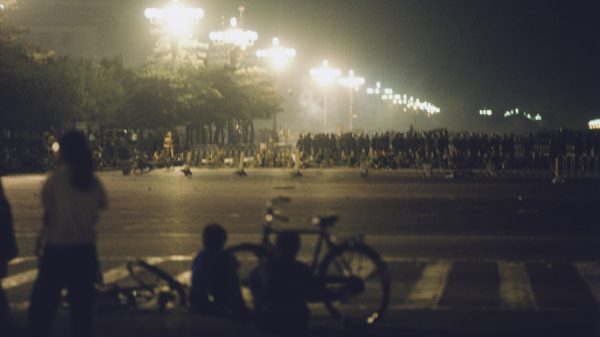
The army killed civilians on residential streets; the Party exploited that geography to deny responsibility
Muxidi became one of the bloodiest sites of the massacre. On the evening of June 3, units including the 38th Group Army encountered unarmed residents blocking their path and opened fire with live ammunition. The killing that followed along Muxidi and the adjacent Chang’an Avenue, as well as at Xidan, Nanchizi, and Qianmen, produced most of the civilian deaths recorded that night.
This geography is the foundation of the Party’s most cynical sleight of hand. Yuan Mu, who served as spokesman for the Chinese State Council and became the regime’s public face in the days after the crackdown, told NBC News anchor Tom Brokaw on June 17, 1989 that troops in Tiananmen Square had not killed a single person and that no one had died in the square itself.
Both statements were technically constrained by geography in ways that made them worthless as claims of innocence. The killing happened on the streets leading to the square. Inside the square, bullets struck the marble base of the Monument to the People’s Heroes, the granite obelisk at the center of Tiananmen Square, shattering its stone carvings. At Liubukou, an intersection just west of the square, tanks ran over students who were withdrawing peacefully under a negotiated exit agreement. Yuan chose his spatial reference carefully to make mass murder sound like restraint.
The Tiananmen Mothers, an advocacy group founded by the retired academic Ding Zilin after her seventeen-year-old son was shot dead near the square, has spent more than three decades collecting testimony from victims’ families and compiling a list of documented deaths. The group’s records, combined with Wu Renhua’s quantitative historical research and footage taken by Western journalists at Fuxing Hospital and along the approach routes, establish beyond reasonable doubt that the army killed large numbers of civilians that night. The exact total remains unknown because the Party sealed the hospitals, confiscated film, and classified the military’s own casualty assessments.
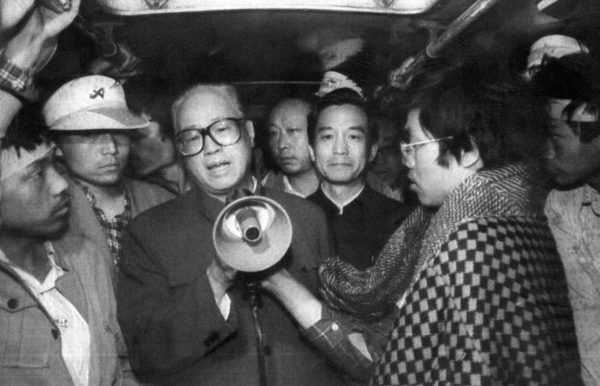
The Party’s ‘violent insurrection’ narrative inverts the sequence of events
Beijing’s official account asserts that troops suffered heavy casualties from violent mob attacks, that soldiers were “brutally killed,” and that the entire operation was provoked by foreign powers and overseas “separatist” elements.
The instances of civilian retaliation against military vehicles, including fires set on military trucks and buses, occurred after soldiers opened fire on crowds, killing bystanders, family members, and passersby in the neighborhoods through which the army advanced. Residents who had watched neighbors shot in the street set vehicles alight in despair, not as part of a coordinated armed attack. A handful of soldiers died or were injured in those incidents. The Party’s framing presents the retaliation as the cause and the massacre as the response.
Multiple witnesses, and photographs taken by Western journalists, document students forming human chains to shield stray soldiers from angry crowds, physically escorting separated army units to safety, a direct contradiction of the armed-insurrection narrative.
Declassified cables from the British and American embassies in Beijing, released under freedom of information procedures in subsequent decades, corroborate the sequence: troops fired first, on unarmed people, along the approach routes. The cables, drawn from Western diplomats who observed or received firsthand accounts of the night, describe a military operation ordered to clear the square regardless of casualties, not a defensive response to an armed uprising.
The photographic record contradicts Beijing’s account
The footage and photographs that survive, taken in the square and on the surrounding streets by Chinese and foreign journalists before the army confiscated cameras and expelled reporters, show students seated peacefully at the base of the Monument to the People’s Heroes, raising hands in collective votes, and observing silent mourning. Those same students were still sitting there when bullets struck the monument’s marble base.