Political analysis
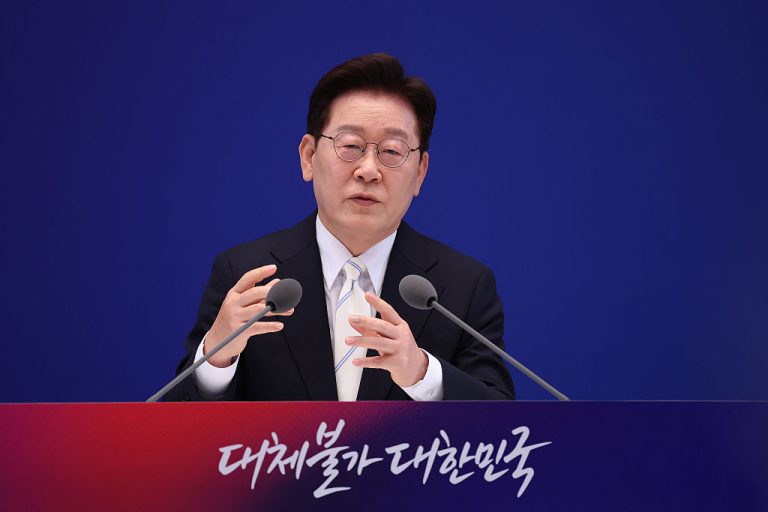
As South Korean President Lee Jae-myung settles into office following the high-profile impeachment and removal of former President Yoon Suk Yeol, one defining feature of his administration’s foreign policy has been an effort to maintain equilibrium between Washington and Beijing. Lee has sought to reassure the U.S. of South Korea’s commitment to the bilateral alliance while avoiding unnecessary confrontation with China, the country’s largest trading partner.
But the increasingly adversarial nature of Sino-U.S. relations raises a new question: How long can Seoul continue to navigate between the world’s two largest powers without being forced to choose a side?
RELATED: Xi Heads to Pyongyang as North Korea Doubles Down on Nuclear Ambitions
Security dependence meets economic reality
For decades, South Korea enjoyed a strategic arrangement that offered the best of both worlds. The U.S. provided security guarantees through their longstanding military alliance, while China’s rapid economic growth created enormous opportunities for South Korean exporters.
Success
You are now signed up for our newsletter
Success
Check your email to complete sign up
But analysts say that formula is becoming harder to sustain. Washington has increasingly called on allies to align more closely on issues ranging from semiconductor supply chains and advanced technologies to defense cooperation and broader China policy. Beijing, meanwhile, has signaled its expectation that regional partners avoid joining efforts aimed at containing China’s rise.
As competition between the two powers shifts from economic rivalry to structural strategic competition, the room for middle powers to maneuver has narrowed considerably. Recent developments have underscored this reality. The temporary redeployment of some U.S. THAAD missile defense assets to the Middle East drew attention in South Korea, even as American officials emphasized that Seoul’s overall defense posture remained intact. The episode nevertheless served as a reminder that Washington’s strategic priorities can evolve quickly in response to global events.
For South Korea, the message was clear: Reliance on alliance commitments does not eliminate the need to adapt to rapidly changing geopolitical circumstances.
A shrinking space for strategic ambiguity
Lee’s approach differs in tone from that of his predecessor, Yoon Suk-yeol, who pursued closer alignment with the U.S. and Japan. Lee has instead emphasized pragmatism, arguing that South Korea’s national interests require stable relations with both Washington and Beijing.
But analysts increasingly question whether such strategic ambiguity remains viable. China remains South Korea’s largest export destination and an essential market for many Korean industries. At the same time, South Korea’s security architecture, advanced semiconductor sector, and access to critical technologies remain deeply intertwined with the U.S., especially as decoupling efforts gain traction.
The artificial intelligence boom illustrates this dilemma. South Korean firms such as Samsung Electronics and SK Hynix have become key players in the global semiconductor industry, yet much of the emerging AI ecosystem is being built around American technology platforms, advanced packaging capabilities, and U.S.-led supply chains.
This growing integration means South Korea’s economic and national security interests are increasingly linked to the broader strategic framework established by Washington.
A strategic crossroads
The larger challenge confronting Lee’s administration extends beyond short-term market fluctuations or isolated diplomatic incidents. At stake is whether South Korea’s traditional balancing strategy remains suited to an era defined by intensifying great-power competition.
If Seoul moves closer to Washington, it risks economic friction with Beijing and potential repercussions for exporters dependent on the Chinese market. If it seeks to preserve maximum flexibility, it could face growing doubts in Washington about South Korea’s reliability as an ally. This tension is not unique to Lee Jae-myung, analysts note. It reflects the broader predicament facing middle powers attempting to navigate an increasingly polarized international system.
During the globalization era that followed the Cold War, strategic flexibility was often an advantage. In today’s environment, however, ambiguity itself may increasingly become a source of vulnerability.
The question, therefore, is not whether South Korea is facing an immediate crisis. Rather, it is whether the country has arrived at a historic moment requiring a reassessment of its place in the emerging international order. Seoul may still retain some room to maneuver. But the era in which it could comfortably enjoy both America’s security umbrella and China’s economic dividends is narrowing.
Editorial note: Views expressed in this article are the opinions of the author and do not necessarily reflect the views of Vision Times.