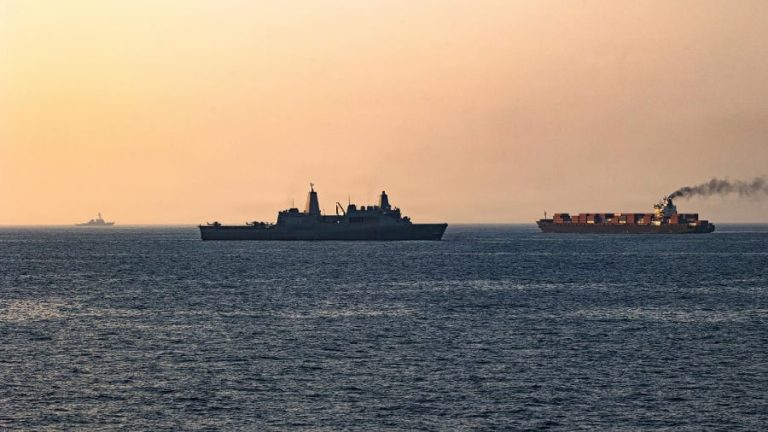
The U.S. Central Command (CENTCOM) announced on June 8 that U.S. forces took action in the Gulf of Oman the same day, rendering a tanker attempting to sail to an Iranian port unable to navigate. CENTCOM stated that the vessel was in violation of the current blockade measures against Iran.
According to information released by CENTCOM, the empty tanker “Marivex,” flying the flag of Palau, was sailing in international waters in the Gulf of Oman and heading toward Iran when it was intercepted by U.S. forces.
CENTCOM said that because the vessel’s crew did not comply with U.S. instructions, an F/A-18 “Super Hornet” fighter jet deployed from the aircraft carrier USS Abraham Lincoln (CVN-72) and fired precision-guided munitions at the ship’s propulsion and steering compartments.
The strikes disabled the vessel’s propulsion and operational systems, leaving the “Marivex” immobilized and unable to proceed to Iran.
CENTCOM stated that following the operation, the “Marivex” was no longer capable of continuing its voyage to Iran.
Success
You are now signed up for our newsletter
Success
Check your email to complete sign up
The command also noted that since the blockade operation began on April 13, U.S. forces have disabled seven vessels that failed to comply with directives, redirected 134 compliant vessels, and allowed 42 vessels carrying humanitarian aid to pass.
U.S. President Donald Trump recently stated that as long as Iran has not signed a final agreement, the maritime blockade will continue to be fully enforced to pressure Tehran into advancing negotiations. He also said the blockade has been highly effective, even more so than military strikes.
Due to the blockade, Iran’s crude oil exports have declined significantly. Market tracking data shows that Iran’s oil and condensate exports in May fell to their lowest level in at least six years.