On Wednesday, June 24, two powerful earthquakes struck northern Venezuela in rapid succession, causing widespread devastation, killing at least 164 people, and injuring hundreds more.
Acting President Delcy Rodriguez publicly reported the casualty figures in a televised address on June 25, with the toll expected to rise due to ongoing search-and-rescue efforts amid collapsed buildings.
According to the United States Geological Survey (USGS) the event was a “doublet” with the first “foreshock” registering 7.2 on the Richter scale followed by a larger 7.5 “mainshock,” 39 seconds later.
The magnitude 7.2 foreshock struck at 18:04 local time (22:04 UTC) and the larger magnitude 7.5 mainshock struck at 18:05 local time. Both epicenters were in Yaracuy state, northern Venezuela, roughly 100-110 miles west of Caracas, near the Caribbean coast.
The earthquakes prompted a nationwide state of emergency and were the strongest to strike the region in more than a century. The previous record was set by a magnitude 7.7 earthquake in 1900.
Success
You are now signed up for our newsletter
Success
Check your email to complete sign up
Tsunami advisories had been issued for Puerto Rico and the U.S./British Virgin Islands, but were later cancelled.
Caracas’s Maiquetía International Airport is closed and all metro and rail services have been suspended.
Acting President Rodríguez described the northern coastal state of La Guaira as “a true tragedy” and officially declared it a disaster zone after the earthquakes caused widespread building collapses and severe infrastructure damage across the region.
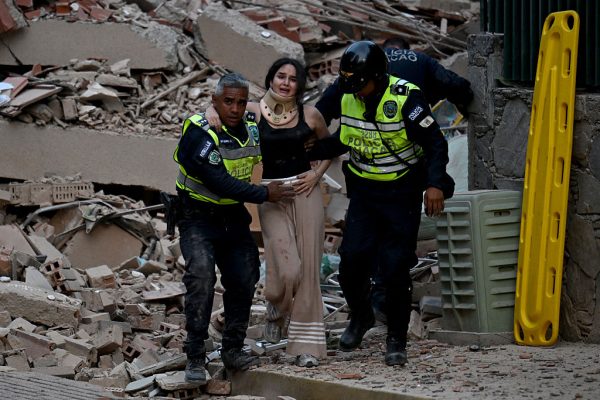
Widespread devastation across Venezuela
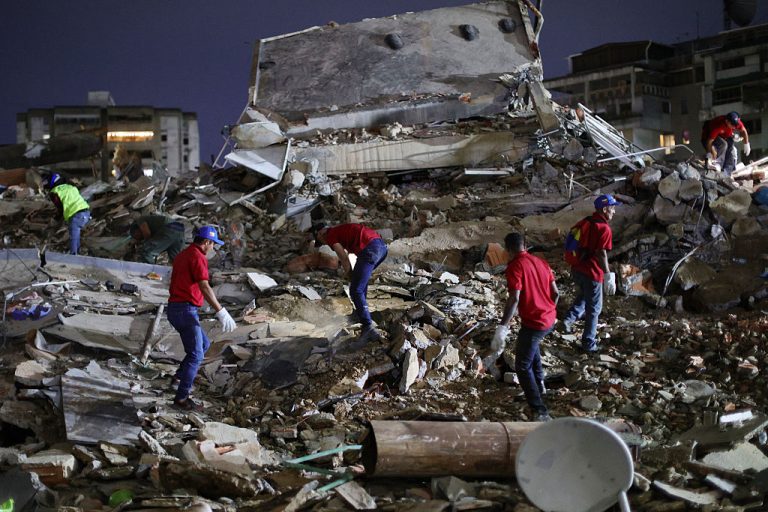
According to Reuters and other outlets, The twin earthquakes inflicted widespread devastation across northern and central Venezuela, collapsing dozens of buildings and leaving entire neighborhoods in ruins from the coastal epicenter region westward of Caracas to the capital and beyond.
In La Guaira state a beachfront hotel was reduced to rubble, high-rises tilted precariously, and the Simón Bolívar International Airport suffered severe structural damage that forced its indefinite closure.
Caracas saw catastrophic scenes in districts such as Altamira, Los Palos Grandes, and Chacao, where multiple high-rise buildings fully collapsed or became uninhabitable, forcing thousands to sleep in the streets amid ongoing aftershocks.
Damage extended to surrounding states including Carabobo (especially Morón), Aragua, Miranda, Yaracuy, Falcón, and Trujillo, with reports of homes destroyed, power and water outages, and infrastructure failures stretching across a broad swath of the country.
The USGS described the disaster as likely widespread, with high casualties and extensive structural failures probable in the densely populated region.
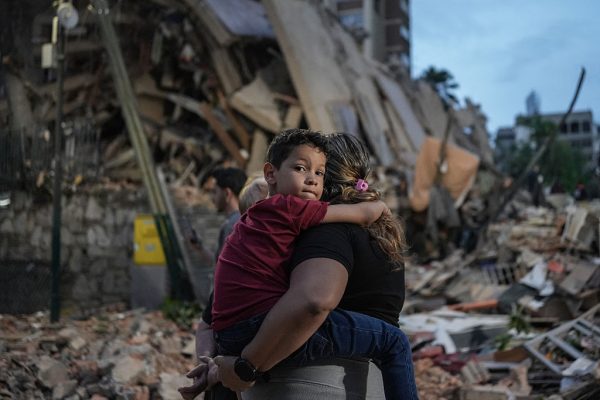
American response
According to the U.S. Department of State, the United States is “mounting an immediate response and mobilizing support for affected communities.”
The department has deployed a Disaster Assistance Response Team, along with urban search-and-rescue units, to “assess needs and provide search and recovery assistance.”
Officials say the response is being coordinated in collaboration with UN agencies, NGOs, and host governments to deliver aid effectively.
U.S. citizens in Venezuela affected by the earthquakes are advised to call +1-202-501-4444 for assistance, while family and friends in the United States can contact +1-888-407-4747 for support.
Authorities are urging those who wish to help to donate cash where possible, while first verifying the legitimacy of any recipient before sending funds.
“Always verify the legitimacy of organizations before donating,” the State Department says. “There is a risk of scams following disasters, including fake charities, AI generated appeals, and fraudulent crowdfunding.”
The State Department also cautions against in-kind donations such as food, clothing, medicine, or bottled water, noting that they “often clog supply chains, divert resources, and increase logistical costs.”
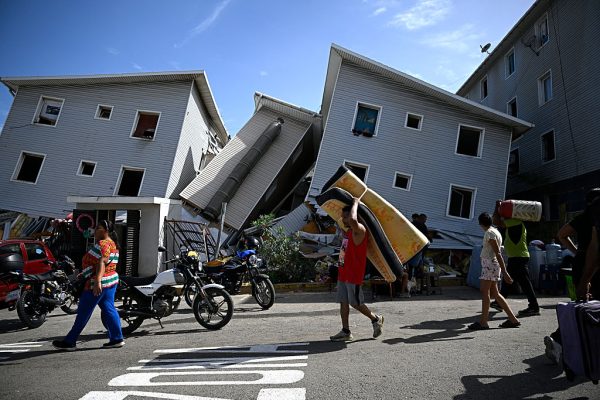
Several other notable earthquakes
According to the USGS, several other notable earthquakes struck along the Pacific Ring of Fire on June 24, adding to a day of heightened seismic activity worldwide.
A magnitude 5.6 quake hit Northern California in the early morning, centered near Redwood Valley in Mendocino County. It was felt across a wide area including the Bay Area but caused no major damage or injuries.
Later that day, a magnitude 6.9 earthquake struck off Japan’s Iwate Prefecture in the North Pacific, approximately 22 miles east-northeast of Kuji. The quake injured nine people and caused structural damage across the region.
A magnitude 6.6 event also occurred offshore east of Russia’s Kamchatka Peninsula near Petropavlovsk-Kamchatsky, part of the active subduction zone along the northwestern Pacific Rim.
To put this in perspective, an earthquake measuring 5.0 on the Richter scale is considered moderate. Because the scale is logarithmic, a magnitude 6.0 earthquake releases about 32 times more energy than a 5.0 quake, while a magnitude 7.0 earthquake, like the quakes that struck Venezuela, releases roughly 1,000 times more energy than a 5.0.
These events, alongside the major quakes in Venezuela, underscore the ongoing tectonic stresses around the Pacific plate boundaries. No significant tsunamis were reported from the California or Japan events.