On July 3, 2026, the CCDI held a meeting of its standing committee, chaired by Li Xi, a member of the Politburo Standing Committee, the innermost circle of Chinese political power, and the commission’s top-ranked secretary. Footage broadcast on CCTV’s evening news, the state broadcaster that functions as the Party’s official mouthpiece, showed six of the commission’s eight deputy secretaries in attendance: Liu Jinguo, Yu Hongqiu, Fu Kui, Liu Xuexin, Sun Xinyang, and Zhang Fuhai, with two deputy secretaries missing: Zhang Shengmin and Xiao Pei.
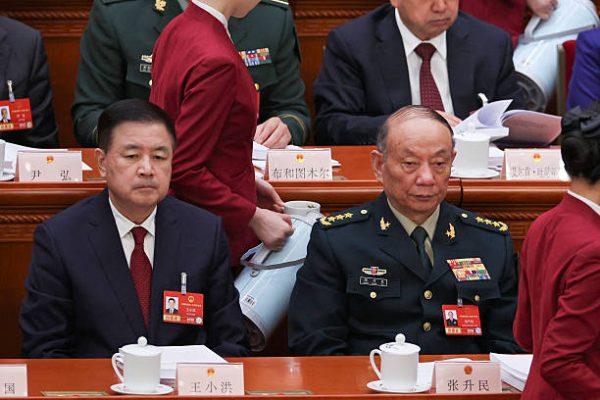
On Oct. 23, 2025, during the CCP’s Fourth Plenum, a closed-door Central Committee meeting held roughly once every five years to set policy direction, Zhang Shengmin was promoted to vice chairman of the Central Military Commission, the body that commands China’s armed forces, yet he skipped the CCDI’s standing committee meeting the very next day, October 24. Under Party convention, the secretary who heads the military’s internal disciplinary body, a parallel institution to the civilian CCDI, automatically holds a concurrent deputy secretary title at the CCDI. On July 3, 2026, the same day as the meeting in question, Zhang Shuguang, head of the military’s disciplinary commission, was promoted to full general alongside air force commander Wang Gang. That promotion confirmed Zhang Shuguang has already replaced Zhang Shengmin as the military’s top disciplinary official, meaning Zhang Shengmin’s deputy secretary title at the CCDI has effectively lapsed.
Hong Kong’s Ming Pao newspaper reported that Zhang Shengmin had already stepped down as secretary of the Central Military Commission’s Discipline Inspection Commission, with Zhang Shuguang taking over, making his absence from the CCDI meeting unremarkable. Xiao Pei’s absence carries a different weight, as Ming Pao’s sourcing suggests it signals he has already been forced out of the commission and pushed into early retirement from his post.
Why Xiao’s absence doesn’t add up
On June 24, 2026, Xiao was added as a deputy director of the Social and Legal Affairs Committee of the CPPCC, the Party’s political advisory conference. Two other disgraced officials, Shen Deyong and Fu Zhenghua, held leadership posts there before their own arrests, a pattern online commentators have been quick to point out.
A review by Vision Times of the CCDI’s official website found that among the commission’s eight deputy secretaries, Xiao ranks third. On the roster of the National Supervisory Commission, the state body that shares overlapping leadership with the CCDI and formally handles corruption investigations across the government, Xiao’s name appears first among deputy directors, ranking above colleagues who continued attending the July 3 meeting without incident.
Success
You are now signed up for our newsletter
Success
Check your email to complete sign up
Some observers argue his CPPCC reassignment reflects a retreat to a secondary, less powerful role rather than a genuine transfer of authority. The timing raises its own questions, though. Xiao is 65, the standard retirement age for a Chinese official at his ministerial rank, but CCDI deputy secretaries are conventionally exempt from that age limit. Current deputy secretary Liu Jinguo, born in April 1955, is 71. Yu Hongqiu, born in October 1960, is about to turn 66. Both are older than Xiao and continue to attend meetings normally, undercutting the retirement explanation.
READ MORE:
- China Is Not Becoming North Korea — It Already Is One on a Global Scale
- Behind Xi Jinping’s Purge of China’s Inner Military Circle in Early 2026
A career built alongside China’s former anti-corruption czar
Xiao’s political rise traces directly back to Wang Qishan, the former CCDI secretary who ran China’s anti-corruption campaign under Xi Jinping from 2012 to 2017 and remains one of the most powerful figures to emerge from the Party’s disciplinary apparatus. Wang served as Beijing’s deputy party secretary and mayor from April 2003 to November 2007. During an overlapping period, from March 2002 to February 2009, Xiao served as deputy head of the Beijing party committee’s propaganda department and deputy director of the city’s “610 Office,” the extralegal task force created specifically to coordinate the persecution of Falun Gong practitioners, a spiritual discipline the CCP outlawed in 1999 and has targeted for imprisonment, forced labor, and documented organ harvesting ever since.
While Wang served as Beijing’s mayor and executive chairman of the city’s Olympic organizing committee, Xiao headed that committee’s news and publicity department, frequently accompanying Wang to diplomatic events in his capacity overseeing Olympic media relations.
The two men’s careers stayed intertwined as Wang rose further. Wang became CCDI secretary in November 2012 and held the post until October 2017. In March 2014, Xiao transferred into the CCDI itself as head of its propaganda department, gaining vice-ministerial rank the following month. In June 2015, he moved to the Ministry of Supervision as a deputy minister, and by September 2017 he had been promoted to full-ministerial rank as an inspector with the Central Inspection Group, the roving teams the CCDI dispatches to audit local and institutional corruption.
After the CCP’s 19th Party Congress in October 2017, Xiao was elevated to CCDI deputy secretary and deputy director of the National Supervisory Commission, a position he retained through the 20th Party Congress.
Xiao’s career advanced in lockstep with Wang’s patronage. The BBC’s Chinese-language service previously reported that Xiao’s transfer into the CCDI was widely seen as a personal appointment by Wang, who was serving as CCDI secretary at the time.

An informant’s confession reportedly named him
Wang’s former subordinates have been falling in a steady sequence in recent years. On March 24, 2026, Zhou Liang, formerly Wang’s personal secretary and, more recently, deputy head of China’s National Financial Regulatory Administration, was placed under investigation for serious disciplinary and legal violations, the Party’s standard euphemism for a corruption purge that typically precedes prosecution.
On May 20, 2026, Cai Shenkun, a U.S.-based independent political commentator, posted on the social media platform X that Zhou had implicated Xiao during questioning, and that Xiao had subsequently been removed from his post, with the CCDI forming a special task force to investigate him as an alleged mole inside the disciplinary system. Rumors that Xiao was under investigation had circulated as early as 2025, but according to Cai, it was only after Zhou’s arrest that a fuller account of Xiao’s alleged violations came to light.
On May 27, Cai posted a follow-up, writing that Xiao’s reassignment to the CPPCC likely represented a survivable outcome given the circumstances, and noting that Xiao’s only son had already died, a detail Cai suggested made further punishment seem needlessly cruel. Cai also pointed out that Xiao had spent nearly a decade as a CCDI deputy secretary handling major cases assigned directly by Xi Jinping, and speculated this record of loyal service may have earned him leniency.
One user noted that Xiao’s son had died years earlier in a car accident while socializing with other children of high-ranking officials. Another pushed back on the idea that Xiao had landed safely at all, pointing out that he was moved to the CPPCC’s Social and Legal Affairs Committee before completing even a single term as CCDI deputy secretary, and reiterating that both Shen Deyong and Fu Zhenghua were arrested while serving as the committee’s chairman and vice chairman.
The same user added that during Wang Qishan’s tenure, Xiao’s role at the CCDI centered on propaganda and messaging, while the actual work of pursuing senior corrupt officials, the campaign’s signature “tiger hunting,” fell to Dong Hong, then director of the commission’s inspection office.