Many Chinese immigrants spend years working toward American citizenship, then enjoy the country’s freedoms, rule of law, and property protections once they have it. Yet their thinking often remains shaped by the Chinese Communist Party’s overseas propaganda apparatus. Some cheer for the CCP from American soil, never embracing the founding claim in the Declaration of Independence that all men are created equal.
Financial leverage keeps some immigrants loyal to Beijing
CCP leaders have long understood the fragility of their own system, and for years have quietly run what some Chinese-language commentators call a “sinking ship” plan, moving money and family members to the United States ahead of any crisis at home. The Party’s United Front Work Department uses hometown associations and chambers of commerce abroad as intermediaries, leveraging Chinese Americans’ business interests in China as points of pressure. Cooperating with a Chinese consulate on political tasks, such as suppressing dissidents or protesting the transit of Taiwanese officials, keeps business back home running smoothly. Refusing invites tax audits and asset seizures.
Entrepreneurs with factories, suppliers, or investment partners in China face the same pressure in miniature: publicly criticizing the Party risks a sudden loss of that relationship. Family members still living in China add another layer of leverage.
The United Front Work Department has also come close to monopolizing traditional Chinese-language media and WeChat groups overseas. When U.S. national security agencies shut down the Chinese consulate in Houston in 2020, officials alleged it had become a hub for technology theft and a base for pressuring dissidents and their families to return to China, according to State Department and embassy statements at the time. Years of consuming a filtered, Party-approved version of the news leaves many Chinese immigrants with a distorted picture of the United States.
READ MORE:
- Jamestown Foundation Identifies 2,294 Overseas United Front Organizations Linked to the CCP in Democratic Nations
- How CCP-Linked Networks Reach Deep Into American Political Institutions
Taiwan’s National Security Bureau has identified two core goals behind the Party’s cognitive warfare targeting Chinese Americans: sharpening existing divisions by amplifying disinformation around real social frictions such as crime, race, and inflation, and eroding trust in democratic institutions by convincing overseas Chinese that “all crows are equally black,” that American elections and courts are no fairer than China’s.
Success
You are now signed up for our newsletter
Success
Check your email to complete sign up
The Party’s core trick is conflating three distinct things: China the country, the Chinese people as an ethnicity, and the Chinese Communist Party as a political organization. That conflation leads some overseas Chinese to mistake opposition to the CCP for opposition to China itself, making it harder to accept an American founding built on universal ideals rather than ethnic or national loyalty.
Trump marked America’s 250th with blunt warnings about communism
2026 marks the 250th anniversary of the founding of the United States. During the America 250 commemorations, the Trump administration elevated anti-communism to the level of defending the Constitution itself, a posture that lines up with the broader national security push now underway against foreign agents and united front networks.
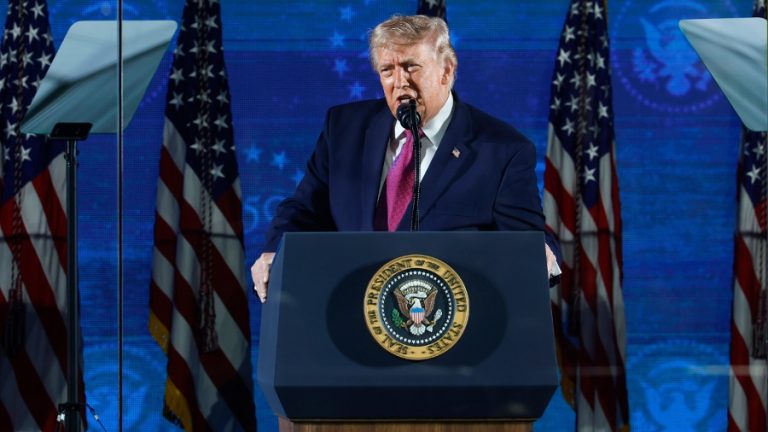
Speaking at Mount Rushmore National Memorial in Keystone, South Dakota, on July 3, 2026, Trump delivered a stark warning: “Communism is a mortal threat to American liberty,” posing a greater danger, he said, than World War I, World War II, Pearl Harbor, or the September 11 attacks. He described communist ideology as “an ideology of mass theft, mass control, mass lies, and mass murder,” and told those living in America while remaining loyal to the CCP: “You can be a Communist, or you can be a Patriot. You cannot be both. America will never be a Communist country!”
The next day, in a separate address on the National Mall, Trump declared communism doomed to fail: “Communism is a loser, and it always will be.” He added: “Our warriors did not fight communism on battlefields across the world only to have that menace rear its ugly head right back here in America. We’re not going to let it happen.”
Washington is backing its rhetoric with new enforcement
Washington has stopped treating Beijing’s overseas influence operations as a purely diplomatic matter and started prosecuting them as a domestic security threat. The Justice Department and FBI are using the Foreign Agents Registration Act (FARA) to conduct a broader sweep, and individuals operating under the cover of hometown associations and business chambers face unprecedented scrutiny.
The Combating Chinese Communist Party Influence Act, introduced in March 2026 by a bipartisan group including Derek Tran and Don Bacon, would direct the Director of National Intelligence to assess the CCP’s malign influence operations worldwide. It remains under review in the House Intelligence Committee.
In September 2025, Trump signed National Security Presidential Memorandum 7 (NSPM-7), directing the FBI’s Joint Terrorism Task Forces to prioritize FARA investigations and widen scrutiny of funding at nonprofits, think tanks, and cultural organizations. Issued primarily to counter domestic political violence after the assassination of Charlie Kirk, its FARA provisions nonetheless give investigators a tool that can be turned on China-linked united front networks.
The Justice Department has intensified prosecutions under 18 U.S.C. § 951, the statute governing unregistered foreign agents. In 2026, Eileen Wang, a former Arcadia, California, city council member, pleaded guilty to acting at the direction of Chinese officials to advance CCP influence operations in the United States.
READ MORE:
- Taiwan Opposition Leader’s Meal With China-Linked Figure During US Visit Triggers Controversy
- Democracy Activist Sheng Xue Exposes CCP Intimidation as Canada Pushes Back
The Securing Partner Supply Chains Act, advanced out of the House Foreign Affairs Committee in March 2026, would authorize the State Department to help allied governments build foreign-investment screening tools to block Chinese capital from penetrating critical minerals, energy, and telecommunications.
The Countering PRC Influence Fund, established by Congress in 2020 to counter Belt and Road debt traps and propaganda, is now under tighter oversight. A 2026 Government Accountability Office report found lawmakers demanding clearer data-tracking to confirm the money is actually disrupting CCP influence operations.
In the broader contest between the free world and authoritarian systems, the gray zone once occupied by people who enjoy America’s freedoms while working on Beijing’s behalf is starting to disappear.