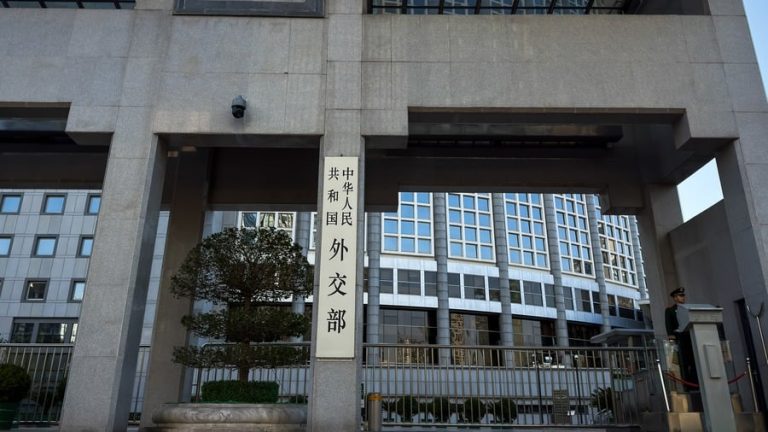
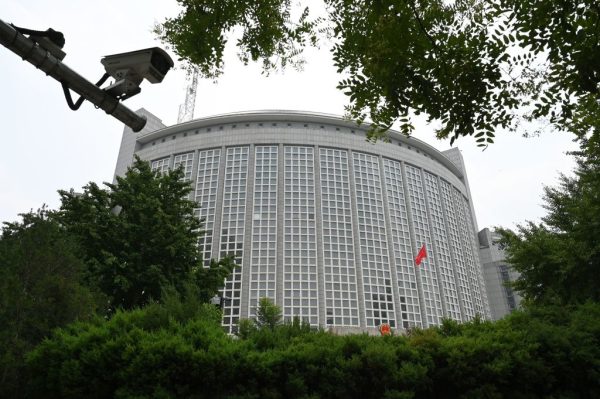
China’s Foreign Ministry recently updated its official leadership roster to show Li Qian as a member of the ministry’s Communist Party committee and head of its internal discipline inspection team, a body jointly staffed by the Central Commission for Discipline Inspection, the Party’s top disciplinary watchdog, and the National Supervisory Commission, its state counterpart. Discipline inspection teams answer to the Party rather than to the ministries they police, giving them authority to investigate officials and monitor political loyalty outside the ministry’s own chain of command. Li is now listed alongside senior vice ministers despite holding no formal diplomatic portfolio.
Li previously served as a vice minister at the Ministry of State Security, the Party’s main civilian intelligence and counterintelligence agency. Like several other MSS vice ministers, his career record before this appointment was largely undisclosed. His predecessor in the role, Zhang Ji, spent most of his career in China’s commerce and trade bureaucracy before moving into Party discipline inspection work in 2017 and taking over the Foreign Ministry post in 2019, a career track with no apparent ties to the intelligence services. Vietnamese state media reported in August 2025 that Luong Tam Quang, Vietnam’s public security minister and a member of the ruling Communist Party’s Politburo, met with a delegation led by Li in Hanoi, a meeting Chinese state media did not report at all. Meetings involving officials of ministerial rank are typically covered by state outlets, an omission some China analysts have noted.
China’s foreign affairs and security bureaucracies share a formal history
Liu Haixing, a former assistant foreign minister, later became executive deputy director of the office of the Central National Security Commission, the Party body that oversees domestic and international security policy. In September 2025, Liu took over as head of the Party’s International Liaison Department, the body that manages relations with foreign political parties, replacing Liu Jianchao, who had vanished from public view without explanation. Sun Weidong made the same move in reverse: removed as a Foreign Ministry vice minister in March 2026, he reappeared publicly in June as deputy director in charge of day-to-day operations at the office of the Central National Security Commission, a full-ministerial-rank post.
The Party and State Council jointly established a foreign affairs leading group in 1958, and the arrangement was formalized further in 2014 with the creation of the Central National Security Commission as a body operating alongside it. Li Linyi, a China affairs commentator who writes for the Epoch Times, said the national security apparatus originated as an offshoot of the Party’s foreign affairs system and the two have never been fully separate, an overlap he called consistent with longstanding claims that some Chinese diplomats have also performed intelligence-related functions.
READ MORE:
- China Is Not Becoming North Korea — It Already Is One on a Global Scale
- Former Xinjiang Party Chief Ma Xingrui Sacked From CCP Ahead of Beidaihe
- Xi Jinping Rewrites Communist Party History to Place Himself Alongside Mao
Diplomatic cover has shielded Chinese intelligence work for decades
Chen Yonglin, a former political consul at China’s consulate in Sydney who defected from his post in 2005, testified at a joint hearing of the U.S. Congress that foreign government officials were a primary target of Chinese Communist Party influence operations abroad, alongside non-governmental organizations, libraries, schools, consulate visitors and media outlets. Chen said local Chinese-language media in Australia were largely under Party influence because they depended on advertising and sponsorship from major Chinese state-linked companies, and that conditions in the United States were likely similar.
Success
You are now signed up for our newsletter
Success
Check your email to complete sign up
Ottawa expelled Chinese diplomat Zhao Wei in May 2023 after Canadian intelligence alleged he took part in an effort to intimidate Conservative MP Michael Chong and his relatives in Hong Kong over Chong’s role in a parliamentary motion condemning Beijing’s treatment of Uyghurs. Beijing denied wrongdoing and expelled a Canadian diplomat in response. Testifying before a House of Commons committee days later, Michel Juneau-Katsuya, a former head of the Canadian Security Intelligence Service’s Asia-Pacific unit, said he estimated that about 70 percent of Chinese diplomatic staff then serving in Canada were conducting illegal intelligence activity.
Independent commentator Du Zheng, writing for Taiwan’s Up Media, has reported that several foreign language institutes in Beijing maintain close ties to China’s state security system. Beginning in the 1980s, as China opened to the outside world, the Ministry of State Security began recruiting heavily from these programs, a practice Du said became standard procedure. Students selected for short-term training by the ministry remained bound to it for the rest of their careers, according to Du, who named Liu Jianchao as one such longtime operative.
John Tkacik, a retired American diplomat who worked at the U.S. liaison office in Beijing, the U.S. embassy and several Chinese consulates, wrote in Taiwan’s Liberty Times that Chinese staff assigned to those postings consistently arrived early and stayed late, showing unusual eagerness to learn how the American offices operated. Among them, he wrote, was a young employee who later became China’s foreign minister, Qin Gang. The experience led Tkacik to suspect some Chinese diplomatic staff, including, in his view, Qin Gang, had intelligence responsibilities alongside their diplomatic duties.
Trump ordered the closure of China’s consulate in Houston, with a deadline of July 24, 2020. Then-Secretary of State Mike Pompeo said diplomatic status should not be used as cover for industrial espionage and intellectual property theft, and in a policy address described the consulate as a hub for both. Days before the deadline, video footage circulated online showing consulate staff burning documents in metal drums in the compound’s courtyard, prompting widespread speculation that the material was related to intelligence work.
Analysts see security influence expanding inside the ministry
Li Linyi said a discipline inspection team functions as the eyes and ears of the Party’s disciplinary apparatus, effectively serving as a political supervisor over the ministry it is stationed in, and that placing an intelligence veteran in that role suggests China’s security services are gaining influence, with Beijing now treating politically sensitive cases involving diplomats as a higher priority than ordinary corruption enforcement.
Whether the appointment reflects a routine personnel reshuffle or a broader tightening of political control, placing a veteran intelligence official in charge of supervising China’s diplomats points to the increasingly central role the security apparatus now plays across the Chinese Communist Party’s bureaucracy.