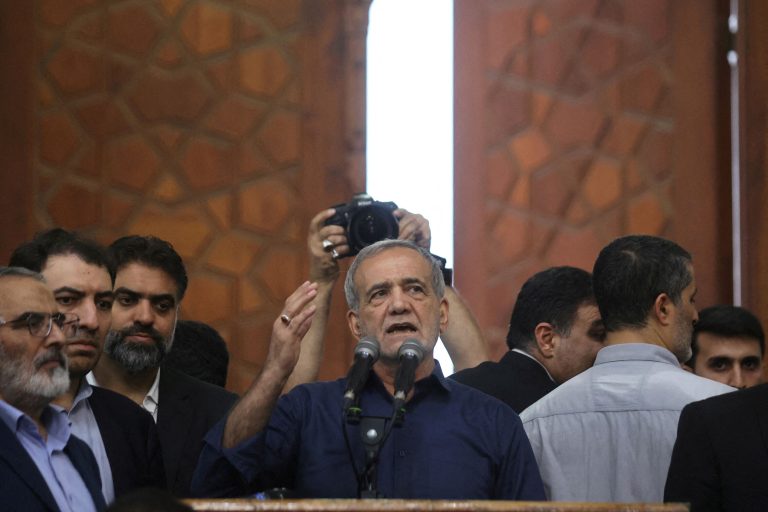
Iran’s president-elect Pezeshkian urged Iranians on July 6 (Saturday) to stick with him on “the difficult road ahead” after winning the run-off vote on Friday.
Masoud Pezeshkian, the sole moderate in the original field of four candidates, won against former nuclear negotiator Saeed Jalili and will replace the administration of hardline President Ebrahim Raisi, who died in a helicopter crash in May.
Pezeshkian is a relative moderate, but will likely be constrained in how much change he can effect, given that Iran’s politics are otherwise dominated by an Islamic theocracy and its Supreme Leader.
A 69-year-old cardiac surgeon, Pereshkian has pledged to promote a pragmatic foreign policy, ease tensions with major powers to revive the nuclear deal and improve prospects of political pluralism.
However, many Iranians are skeptical about his ability to fulfill his campaign promises.
- Iran’s President Ebrahim Raisi and Foreign Minister Dead in Helicopter Crash
- Xi and Putin Strengthen Sino-Russian Ties at Shanghai Cooperation Organization Summit
Success
You are now signed up for our newsletter
Success
Check your email to complete sign up
The Supreme Leader Ayatollah Ali Khamenei, not the president, is the ultimate authority in the Islamic Republic.
Pezeshkian said in a post on social media platform X: “Dear people of Iran, the election is over, and this is just the beginning of our working together. A difficult road is ahead. It can only be smooth with your cooperation, empathy and trust”.
Pezeshkian will take the oath of office before parliament in Tehran in the coming days, after the voting result is confirmed by an election watchdog body and approved by Khamenei.
Turnout was almost 50 percent in the second-round vote, following a historically low turnout in the first ballot on June 28.
One Iranian source said Pezeshkian enjoys a close relationship with the theocratic Supreme Leader Khamenei, and may be able to build bridges between factions, but not bring about fundamental changes that many Iranians yearn for a long time now.
The Islamic Republic has seen two approaches to reform.
The first time was from 1997 to 2005, when President Mohammad Khatami sought political reforms, a stronger civil society, and more press freedom, but was opposed by Khamenei and the powerful Revolutionary Guards paramilitary group.
The second was led by President Hassan Rouhani from 2013 to 2021, when he used his political capital to secure Khamenei’s consent to the 2015 nuclear pact. But Rouhani’s negotiations did not secure political reforms.
Foreign stance
Pezeshkian’s victory lifted hopes of better relations with the West amid the international controversy over Iran’s nuclear program.
Khamenei congratulated Pezeshkian on his win and counseled him to continue Raisi’s policies, commending what he called a “high turnout” at the country’s elections.
The election coincided with escalating regional tension in the Middle East. Since the terrorist attack of Oct. 7, 2023 that killed an estimated 1,400 people, Israel has been at war with Iranian allies Hamas in Gaza and more recently, with Hezbollah in Lebanon.
Due to the limitations on his power, it is unlikely that Pezeshkian will bring forward any major policy shift on Iran’s nuclear program as president.
Nor can he change the status quo regarding the militias backed by Iran across the Middle East, since Khamenei is still the one who decides on top state matters.
However, the president can influence the tone of Iran’s policy and he will be closely involved in selecting the successor to Khamenei, who is now 85 years old.
Pezeshkian has expressed his loyalty to Iran’s theocratic regime and has no intention of confronting its powerful leaders.
Russian President Vladimir Putin and Saudi Arabia’s King Salman and Crown Prince Mohammed bin Salman were among the foreign leaders who sent congratulatory messages to Pezeshkian on his victory.
Reuters contributed to this report.