In October, a wave of violent incidents believed to be acts of retaliation against society have sparked fear and debate across China.
As cited in recent reporting by the U.S. state-funded Voice of America (VOA), observers believe that broad economic downturn has led to an increase in people in China experiencing various forms of setbacks and disenfranchisement, which could be a factoring driving desperate individuals to take out their anger on innocent people.
In combination with the increasingly repressive governance of the Chinese Communist Party (CCP), such “revenge on society” incidents represent a creeping wave of anxiety and discord throughout Chinese society that the authorities have few good answers for.
Rise in retaliatory incidents
In October alone, at least three cases were reported by the media.
On the night of Oct. 23 in Qingdao, eastern China’s Shandong Province, a concrete mixer truck collided with multiple vehicles. Local police suspect that the driver was intoxicated, and the incident left three people injured and hospitalized.
Success
You are now signed up for our newsletter
Success
Check your email to complete sign up
Videos circulating on social media show the alleged suspect shouting, “The Communist Party won’t let me live,” during the collisions. In another video, a witness is heard testifying that “over 50 cars were hit while the driver was going the wrong way.”
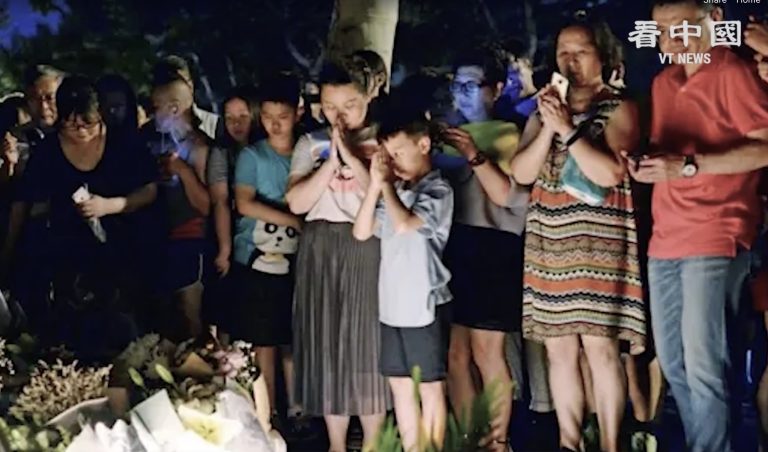
On Oct. 8, in Guangzhou, southern China, a man wielding a knife injured three people, including two elementary school children, near the gate of a local primary school. Several parents and nearby residents reported that the perpetrator had previously filed complaints with the authorities. The Guangdong Provincial Procuratorate is located near the scene of this incident.
On Oct. 2, a traffic accident in Jingdezhen, Jiangxi Province, claimed the lives of a couple and their infant. The father of the suspect claimed “extenuating circumstances,” stating that “the car was purchased just five days earlier, and my son had less than a day and a half of driving experience.” Nevertheless, the driver was arrested on suspicion of reckless homicide.
Since the beginning of this year and before, incidents perceived as revenge on society have attracted media attention throughout China. These cases typically involve car ramming or knife attacks. The perpetrators often target vulnerable groups, including elementary school children, intensifying social panic.
Parents anxious
Two parents of elementary school students living in Guangzhou told Voice of America that they remain deeply anxious following the Oct. 8 stabbing incident.
Guangzhou, the capital of Guangdong Province, has a population of 18 million and is one of the first-tier Chinese cities along with neighboring Shenzhen, as well as Shanghai and Beijing.
One parent residing in the city’s Fangcun district said, “The school is located in one of the busiest areas of Guangzhou. I never imagined something like this could happen. Even though half a month has passed since the stabbing, I’m still worried and take extra precautions when dropping off and picking up my child.”
Another parent with a child attending middle school in Yuexiu District said, “After the incident, I’ve tried to reassure myself that since Yuexiu has good medical facilities, my child could receive prompt treatment if something ever happened.”
Amid widespread anxiety, a police officer from a city in Henan Province told Voice of America, “In Chinese society, many people are under significant pressure, and emotional instability among some individuals has become a factor contributing to these serious incidents.”
Plight of the ‘Five Losts’
Amid the backdrop of these retaliatory incidents against society, attention is increasingly focused on a group referred to as the “Five Losts” (五失人員) This term, newly coined by the Chinese authorities, describes people at the lowest social strata who are struggling with five main challenges — lost at investing (投资失败), lost hope in life (生活失意), lost harmony in social relationships (关系失和), lost psychological stability (心理失衡), and lost mental bearings (失常).
In an article written in early October, Wang Shaojie, a committee member of the China Democratic National Construction Association in China’s Hubei Province, noted that, since the pandemic, a wave of incidents threatening public safety has spread across China, with many of these cases traced to members of the “Five Losts.”
Wang observed that “factors such as China’s slowing economic growth, widening wealth gap, and stagnating social mobility have intensified the psychological burden on those identified as the ‘Five Losts.’ This group numbers in the hundreds of millions, meaning practically any Chinese person could potentially fall into this category.”
Li Qiang, founder of China Labor Watch, a New York-based labor rights group, stated, “Due to the economic stagnation in China, workers struggle to find jobs and lack any substantial savings. In this environment, the working class is most impacted, and disillusioned workers may turn to extreme actions to express their discontent with society.”
Gong Ping, a resident of Hubei Province, told VOA, “The Chinese Communist Party lacks the rule of law, doesn’t keep its promises, and has little credibility, so nothing that happens is surprising.”
Police officers Gong spoke with lamented that “it’s impossible to prevent every serious incident, and our work is only going to get more challenging,” he said.
Li Qiang, of China Labor Watch, said that the Chinese government would have to implement genuine poverty alleviation measures and grant freedom of belief in order to stymie the abject hopelessness felt across the lower rungs of society. “This is key to resolving the problems,” he told VOA.
He also suggested that the lack of faith in Chinese society — something brought about by generations of persecution and indoctrination by the CCP — had a hand in the growing sense of hopelessness and desperation.
“Hardly anyone believes in communism anymore, and neither the Communist Party nor Xi Jinping can bring people peace of mind,” Li Qiang said. Religion has a role in providing comfort, and it can offer people spiritual support through grassroots faith practices.”
But does the Chinese Communist Party still have time to address such incidents?
Gong Ping, a citizen from Hubei Province, remarked, “[Communist] China is already in the dustbin of history. All officials and bureaucrats are ‘lying flat’ (tang ping) and just waiting to see how the Communist Party will fall. Everyone knows it’s destined to collapse.”