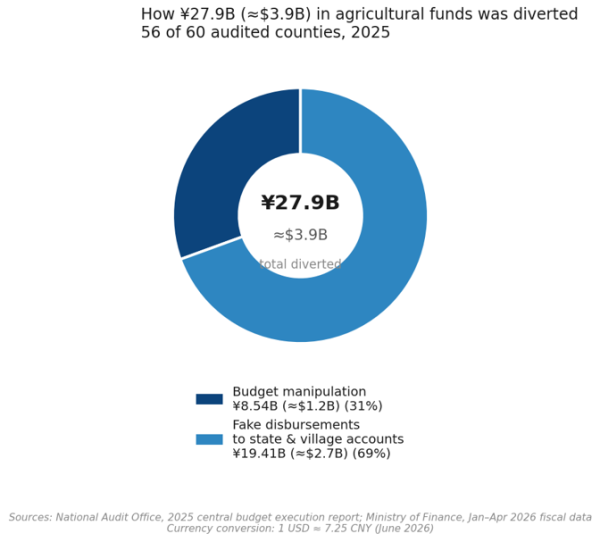
China’s National Audit Office has found that at least 56 county-level governments diverted 27.948 billion yuan (approximately US$3.9 billion) intended for agriculture and rural revitalization programs to repay debt and finance other government expenditures.
The findings were published June 23 in the National Audit Office’s annual report on the implementation of China’s 2025 central budget and other fiscal revenues and expenditures. According to the audit, inspectors reviewed agriculture-related funding across 60 counties in 16 provinces and found misuse in all but four jurisdictions.
But rather than directing the money toward rural development, many local governments reportedly used it to repay outstanding debt, finance the operations of state-owned enterprises, or support the government’s so-called “three guarantees,” maintaining public-sector payrolls, government operations, and basic public services.
Multiple methods to bypass oversight
The audit outlined several methods used to redirect the funds. In 31 counties, officials reportedly allocated 8.54 billion yuan through the fiscal management system before later withdrawing or reducing the allocations and redirecting the money elsewhere.
RELATED: Chinese Netizens Slam State Media for Glorifying Elderly Labor: ‘A Toxic Message’
Success
You are now signed up for our newsletter
Success
Check your email to complete sign up
Another 51 counties allegedly transferred 19.41 billion yuan to state-owned enterprises, village collectives, and other accounts, effectively moving the funds outside normal budget oversight before reallocating them.
Auditors also found that 28 counties improperly obtained 27.056 billion yuan in agricultural development loans by presenting non-agricultural projects as rural initiatives. According to the report, much of the financing was later used to support unrelated projects or the operations of local state-owned enterprises.
Widespread misuse of rural funds
The audit concluded that the diversions delayed or prevented the implementation of several rural revitalization initiatives. By the end of 2025, 37 counties still owed approximately 1.68 billion yuan in subsidies intended for more than 549,000 recipients, including wages for public welfare workers in rural areas and meal assistance for students from low-income families.
The report did not specify whether local governments would be required to repay the diverted funds or whether officials responsible would face disciplinary action. The findings come as China’s local governments continue to face mounting financial pressure following years of slowing property sales and heavy borrowing.
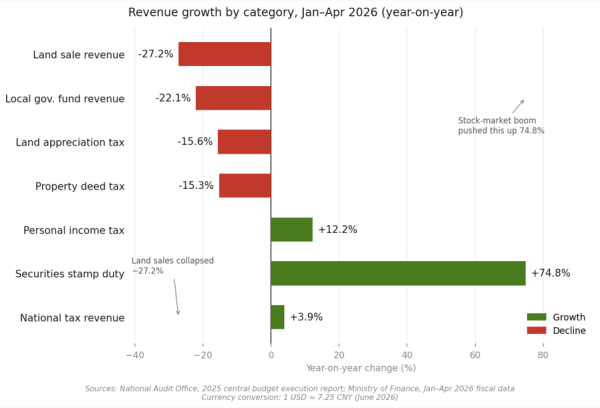
According to data released by China’s Ministry of Finance, total fiscal revenue increased 3.5 percent during the first four months of 2026. However, growth remained uneven, with central government revenue rising 4.6 percent, compared with just 2.7 percent for local governments.
Fiscal pressures continue to mount
Revenue from land sales, long a cornerstone of local government finances, continued to deteriorate. Income from the sale of state-owned land-use rights fell 27.2 percent year over year during the January-April period, while local government fund revenue declined 22.1 percent.
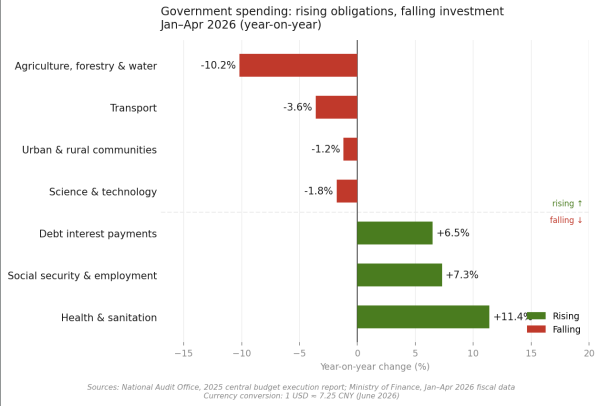
At the same time, expenditure on debt interest payments increased 6.5 percent, reflecting the growing burden of servicing local government debt. The Ministry of Finance’s data also showed significant declines in spending on agriculture, forestry, water conservation, transportation, and technology, suggesting local governments are scaling back investment as fiscal constraints tighten.
For years, many local governments relied heavily on land sales and borrowing through local government financing vehicles to fund infrastructure and development projects. As China’s property sector continues to struggle, those revenue streams have weakened substantially, leaving many local administrations under increasing pressure to meet debt obligations while maintaining public services.