On Jan. 13, Chinese authorities prevented aid workers and Buddhist monks from visiting areas in Tibet hit hard by last week’s earthquakes, local sources told Radio Free Asia (RFA)
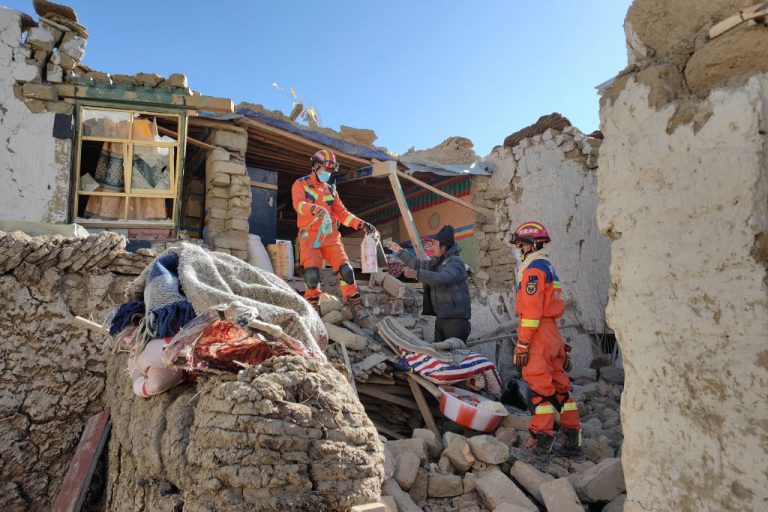
The magnitude 7.1 quake rocked Dingri county — close to the border with Nepal — on the morning of Jan. 7, with tremors felt as far as India, Nepal, Bhutan and Bangladesh. Chinese state media reported that 126 people were killed, with another 337 injured and more than 60,000 people displaced.
Beginning on Monday, officials restricted access to the disaster-stricken region, barring monks, aid workers, and relief volunteers from entering. This was justified as necessary for “cleanup” and “security work”, according to anonymous residents.
Not only are survivors denied proper care and aid, they are forced to conduct prayers or rituals without a monk to head the processions. Prayers are usually done at the end of each week for the first seven weeks after someone dies.
Residents also claim that Beijing is deleting photos and videos from social media depicting the earthquake’s impact.
Success
You are now signed up for our newsletter
Success
Check your email to complete sign up
“Chinese state media has been focusing on propaganda activities such as having Tibetan children wave Chinese flags. They are forcing affected residents to express their gratitude to the Chinese government, and they display [Chinese President] Xi Jinping’s photos in the temporary shelters provided,” one resident said.
On Sunday, Sikyong Penpa Tsering, the democratically elected leader of the Tibetan government-in-exile, the Central Tibetan Administration, issued a statement urging China to “ensure transparency and accountability in relief efforts by granting unrestricted and immediate access to international aid organizations and media delegations.”
“Strict information censorship by the [People’s Republic of China] government continues to pose significant challenges in verifying the accuracy of casualty reports and assessing the adequacy of relief operations,” Tsering said.
Tsering also requested that Beijing “provide adequate assistance in rebuilding efforts that takes into account the traditional Tibetan needs and fundamental rights of the Tibetan people.”
At a press briefing on Monday, Guo Jiakun, spokesperson for China’s foreign ministry, responded to a question about Tsering’s statement, saying, “The disaster response and relief work is generally proceeding smoothly. We are confident in winning this tough battle of quake response and returning work and life to normal in the affected areas as soon as possible.”
READ MORE:
- China Issues Pay Raise for Civil Servants Amid Economic Slump, Sparking Public Ire
- New Year Crackdown: Authorities in Shanghai Ban Mass Gatherings Amid Heightened Tensions
- Unspeakable Horrors: Former Chinese Official Exposes CCP-Run Organ Harvesting Machine
Aftermath
Following the quake, more than 1,200 aftershocks were recorded by authorities, including two strong ones measuring up to magnitudes of 5.1 and 4.6. “No casualties have been reported so far” due to the aftershocks, state media said.
The city of Shigatse, among the holiest cities in Tibet, was the site of the quake’s epicenter. Populated by 62,000 people, it is also the seat of the Panchen Lama, the most important figure in Tibetan Buddhism, second only to the Dalai Lama.
Far from the bigger cities in China, Shigatse’s isolated location made it difficult for rescue efforts to be done, and was made worse by the sheer cold with temperatures dipping to -18 °C or -0.4°F.
According to the Xinhua news agency, more than 1,000 houses were damaged by the quake.
In Dingri county, close to the epicenter, electricity and mobile phone services were restored by Jan. 8.
When the tremors reached Kathmandu — the capital of Nepal — residents panicked, and were reminded of the 2015 quake that killed 9,000 of their fellow people.
Dalai Lama’s prayers
After the quake, the Dalai Lama — currently living in South India — sent his prayers for the victims and those who perished.
“I offer my prayers for those who have lost their lives and extend my wishes for a swift recovery to all who have been injured,” he said in an official statement.
At the Tashi Lhunpo Monastery in South India — first founded by the First Dalai Lama, Gyalwa Gendun Drup — other Tibetans all held candles as they prayed on Jan. 9. During the ceremony, the Dalai Lama encouraged listeners that there should be “no reason to be angry” with Beijing, adding that the loss of life was still due to a natural disaster.
“Even though it is our human nature, do not feel dispirited or doomed by such disasters,” the Dalai Lama said during the ceremony. “It helps to think that events like earthquakes are natural disasters and not caused by political tensions.
“There is no reason to show anger or hatred towards China,” he said. “Hence, Tibetans inside and outside Tibet should develop a kinder, more compassionate heart.”