By Yan Jin, Vision Times
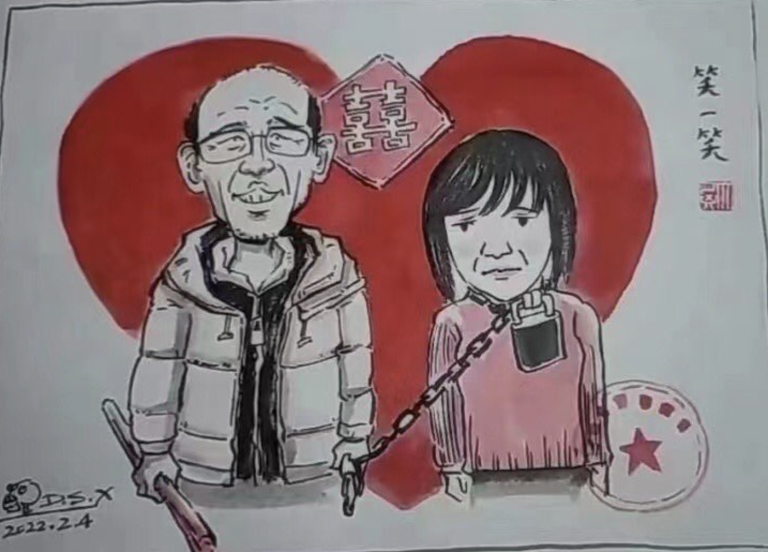
Three years after the “chained woman” case shocked China and the world, the truth behind the disturbing human trafficking incident remains shrouded in mystery. Despite widespread public outrage and relentless online discussions that amassed over 30 billion views, the Chinese Communist Party (CCP) has systematically silenced investigations related to the case.
Now, journalist-turned-exile Zhao Lanjian is determined to bring justice to the victim by declaring that “Xi Jinping is the real culprit for the tragedy of the chained woman and others.” He is preparing to testify in the upcoming World Citizens Court “China Tribunal,” where he aims to expose the regime’s dark role in suppressing human rights and perpetuating modern slavery.

A systematic cover-up
When the case first surfaced online in early 2022, the gruesome details of a woman found shackled in a remote village in Xuzhou ignited a firestorm of criticism against the CCP.
Initially, narratives oscillated between claims that she was in a “voluntary marriage,” to suggestions that she was a mentally-ill woman named Xiao Huamei who had been trafficked and was being held against her will. The woman was also the mother to eight children. But the ever-changing stories and theories — along with forged documents and contradictory reports — only fueled suspicions of a cover-up.
Success
You are now signed up for our newsletter
Success
Check your email to complete sign up
In the above video that went viral, the person filming the video can be seen bringing some clothes to the woman and helping her put on a jacket. He then asks her a few questions but she is unable to answer and just stares off into the distance, seemingly in a daze. Looking into the camera, the vlogger says, “Everybody please take a look. What has this woman been through in this weather? Where did our compassion go?”
“It has been three years, and the truth behind the chained girl incident is still unknown. The Chinese Communist Party government’s reaction to the chained girl incident is a reflection of itself,” Zhao told the Chinese-edition of Vision Times. “From the central government to the local governments, the way they handled the case was completely confusing right and wrong, and it had even entered a stage of systematic cover-up.”

As online discussions gained momentum, authorities swiftly moved to silence dissent. Reports, videos, and social media accounts discussing the case were deleted. Activists, journalists, and concerned citizens were arrested, threatened, or forced into silence. “The CCP is not solving problems, but solving the people who raise problems,” Zhao said, adding how whistleblowers were being “systematically targeted.”
State-sanctioned violence
Zhao himself became a target of the CCP after traveling to the rural village to report on the case. As a journalist and photographer, he first traveled to Fugong County in Nujiang, Yunnan, to investigate the case in early 2022. His findings shattered the official narrative — he obtained critical video evidence proving that the “chained woman” and the identified woman, Xiao Huamei, were not the same person. This revelation directly contradicted four official statements issued by the government.
Authorities acted swiftly to suppress Zhao’s work. On April 15, 2022, officers from a Jiangsu task force interrogated him for an entire day and demanded that he withhold evidence. By May, police from five different provinces were involved in efforts to silence him.
RELATED: Human Trafficking Remains a Persistent Challenge in Modern Day China
“On May 10, 2022, the Langfang police and national security officers in Hebei Province questioned me again, decrypted my phone, and deleted all the evidence and rescue plan materials related to the ‘chained woman,’” Zhao revealed. “They also forced me to leave Beijing and its surrounding areas immediately, otherwise I would be detained in the name of epidemic prevention.”
Facing mounting threats, Zhao had no choice but to flee China in June 2022. “At the time, my only choice was to flee China, otherwise my fate might be even more tragic than that of the woman in chains,” he said.
The media’s complicity
Beyond China’s borders, Zhao was disheartened by the lack of serious international coverage of the case. He particularly criticized The New York Times, accusing the publication of downplaying the gravity of the situation. “At the time, The Times published a report suggesting that similar sex slavery problems existed not only in China but also in the United States,” said Zhao, adding, “This was a misleading move that led readers to believe that this was a global problem, not a problem of the Chinese government.”
Furthermore, he raised concerns about the close relationships between certain reporters in the West and Chinese government officials. “I noticed that some ‘New York Times’ reporters stationed in China have maintained good relations with the Chinese government for a long time. When they interviewed me, they were more trying to find out information rather than sincerely wanting to reveal the truth.”
Zhao argues that the case is far from an isolated incident — it is part of a deeply entrenched system of human trafficking that has existed in China for decades. Statistics from as far back as the 1980s highlight the vast scale of the problem. According to historical reports, tens of thousands of women were trafficked to rural regions, with authorities often complicit in the crimes.
MORE ON THIS: Chained Mother of 8 in Xuzhou Draws Attention to Widespread Abduction and Trafficking of Chinese Women
A human trafficking epidemic
“For a bachelor in a poor rural area, spending several thousand yuan to buy a wife is a huge sum of money. It is not easy for trafficked women to escape, as they will be closely guarded by the ‘buyers’. Therefore, the buyer’s entire family is an accomplice,” said Zhao. “If a village is poor and there are many bachelors, spending money to buy a wife may become a trend. The whole village may form a community of interests, preventing victims from escaping or even obstructing law enforcement efforts.”
Zhao believes that the ongoing repression under Chinese leader Xi Jinping has only worsened the situation. “Xi Jinping is the real culprit for the tragedy of the chained woman and others,” he said, adding, “Instead of cracking down on crime, the government is using the state apparatus to suppress those who reveal the truth.”
In response to China’s growing human rights abuses, the World Citizens Court in The Hague held its first round of trials against Xi in July 2024, accusing him of genocide and crimes against humanity. Now, in April and May 2025, a new round of expanded trials at the China Tribunal will focus on additional crimes, including the case of the “chained woman.”
Zhao is also preparing to testify at the tribunal, where he hopes to shine a light on China’s long track record of human rights violations, including human trafficking, organ harvesting, and state-sanctioned suppression. “The essence of this regime is no longer to serve the people, but to maintain its own stability, which means sacrificing countless innocent people,” he said. “China is entering an unprecedented dark period.”