By Jin Yan, Vision Times
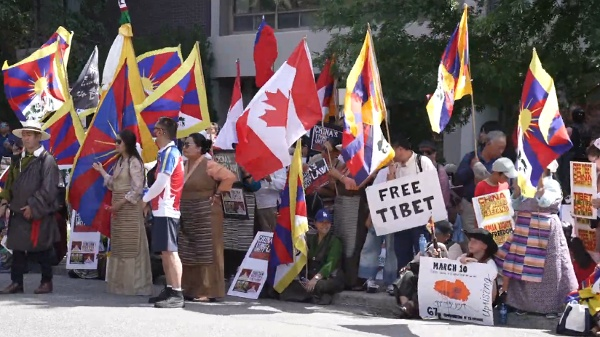
TORONTO, Canada — On July 1, nearly 100 demonstrators gathered outside the Chinese Consulate in Toronto to protest China’s newly-enacted ethnic “unity” law, warning that the legislation could further erode the rights of ethnic and religious minorities while expanding Beijing’s ability to target critics overseas and expand its campaigns of transnational repression, intimidation, and surveillance.
The rally, organized by Tibetan organizations and several human rights groups, coincided with both Canada’s national holiday and the law’s first day in effect. Despite scorching temperatures approaching 35°C (95°F), participants called on Ottawa and democratic governments to take a firmer stance against what they described as Beijing’s worsening human rights record.
RELATED: Taiwan Officials Warn CCP’s New Ethnic Unity Law ‘Legalizes Transnational Repression’
Among those attending was Feng Yulan, president of the Toronto Association for Democracy in China, who urged Canada and its allies to strongly condemn the legislation and impose sanctions on officials responsible for implementing it. Thupten Wangyal, a representative of Toronto’s Tibetan community, likewise argued that the law attempts to legitimize policies that undermine Tibetans’ rights while conflicting with protections nominally guaranteed under China’s own constitution.
Success
You are now signed up for our newsletter
Success
Check your email to complete sign up
Meanwhile, Toronto Hong Kong democracy activist Ng Wan-wan said the legislation represents another attempt to “erase the cultural memory and historical identity” of China’s diverse ethnic communities.
Protesters warn of broader crackdown
Chinese democracy activist Sheng Xue told the rally that the legislation should be viewed within the broader context of the Chinese Communist Party’s (CCP) human rights record. She argued that the law “is, in essence, another legal instrument for implementing the CCP’s system of repression,” and called on democratic countries to work together in confronting authoritarian influence abroad.
RELATED: China Releases Prominent Pastor Amid Ongoing Religious Freedom Concerns
Dean Baxendale, chief executive of the China Democracy Fund, described the legislation as particularly dangerous because, he argued, Beijing does not recognize the fundamental rights of Tibetans, Uyghurs, Falun Gong practitioners, Hong Kong residents, or Taiwanese people.
Many participants expressed concern that the law could provide additional legal justification for Beijing’s campaign of transnational repression, increasing pressure on members of overseas Chinese, Tibetan, and Uyghur communities who fear retaliation against relatives still living in China. Kalsang Dolker, representing the Amdo Tibetan community, said she worries about the safety of family members who remain in Tibet but feels compelled to continue speaking publicly to raise continued awareness.
Participants also criticized successive Canadian governments for prioritizing economic relations with China over human rights, arguing that commercial interests should not come at the expense of freedom, democracy, and justice.
New law further tightens state control
The legislation has drawn criticism on the global state. Passed by China’s legislature in March and officially implemented on July 1, the law promotes Beijing’s vision of a unified Chinese national identity, including the use of Mandarin Chinese as the country’s common national language across all regions and ethnic groups.
The law also includes a provision stating that overseas organizations or individuals who seek to undermine what Beijing defines as “ethnic unity and progress” or promote separatism may bear legal responsibility under Chinese law.
Another provision states that all Chinese citizens have a duty to safeguard national unity and oppose foreign interference carried out under the banner of ethnic, religious, or human rights concerns. Critics say those provisions could be used to further pressure ethnic minorities, religious communities, and overseas activists who speak out about Tibet, Xinjiang, Hong Kong, Taiwan, or other issues Beijing considers politically sensitive.
Global concerns
On July 2, the U.S. State Department described the law as “problematic” because it requires people outside China to actively promote Beijing’s “ethnic unity” agenda or risk retaliation. The department also said the United States would continue to protect individuals within its jurisdiction from foreign governments attempting to exercise unlawful authority beyond their borders.
The statement comes as Washington has increasingly focused on transnational repression stemming from Beijing. In 2023, U.S. federal prosecutors charged two New York men with operating an undeclared overseas police station in Manhattan on behalf of China’s Ministry of Public Security. Other documented cases of illegal Chinese police stations in cities include presences in San Francisco, Los Angeles, and Houston, with authorities warning these entities may be used to monitor or pressure dissidents abroad.
The European Union (EU) likewise expressed concern that the law could further restrict the cultural, linguistic, and religious rights of ethnic minorities while objecting to provisions that appear to extend Chinese law beyond its borders. EU officials reiterated their opposition to the extraterritorial application of national laws in violation of international law and warned against transnational repression within Europe.
Extraterritorial reach
Taiwan’s Mainland Affairs Council also condemned the legislation, describing it as another attempt by Beijing to intimidate people beyond China’s borders. The council stressed that Chinese law has no legal force in Taiwan and said Taipei would continue working with like-minded democracies to counter such pressure. Though Taiwan operates as an independent nation since its establishment in 1949, Beijing views the island as a “breakaway province,” and has vowed to reclaim it by any means necessary.
Meanwhile, Amnesty International warned that Article 63 could be used to justify targeting activists and diaspora communities overseas. Sarah Brooks, the organization’s deputy regional director, said peaceful advocacy on behalf of China’s ethnic minorities could now be portrayed as undermining “ethnic unity.”
“In this context,” Brooks said, “so-called ‘unity’ does not mean harmony among different communities. It means conformity with Beijing’s political agenda.”
Human rights groups say the legislation reflects China’s continuing effort to strengthen legal tools that critics fear could be used not only against ethnic minorities and religious communities within China, but also against activists, dissidents, and diaspora organizations abroad.