Amidst signs of warming relations between the United States and Russia, a prominent Russian policy expert and guest on state media has issued a rebuke of the People’s Republic of China (PRC) for aiding the Ukrainians in Russia’s ongoing invasion while outwardly proclaiming Beijing’s deep ties with Moscow.
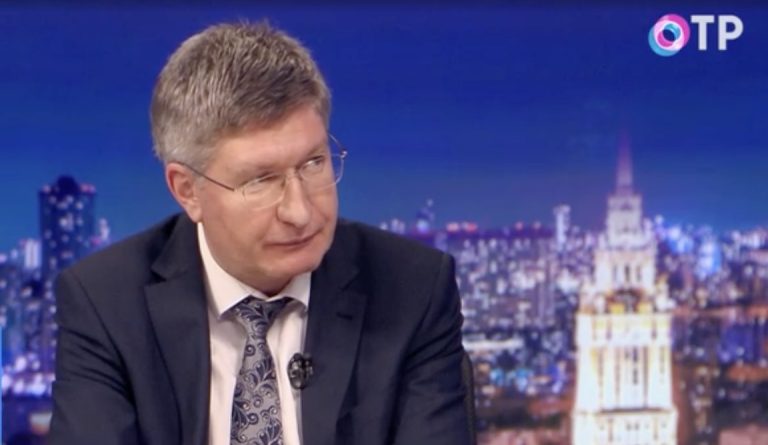
Alexander Losev, a member of the Presidium of the Russian Council on Foreign and Defense Policy, made his comments on Jan. 31 on the “Reflection” (Otrazhenie) program of Public Television Russia (OTR), a state-controlled broadcaster. Losev is a frequent guest commentator on OTR.
He questioned the decision to “lavishly” celebrate the Chinese New Year, which this year fell on Jan. 29, in the streets of Moscow, while “thousands of Chinese-made drones,” sold to Ukraine, “are killing [Russian] soldiers on the battlefield.”
“Let us ask ourselves, is it appropriate for us to be celebrating foreign holidays, especially so lavishly, when the special military operation is still in progress?” Losev remarked, using the official Russian term for its war on Ukraine.
- US Overtakes China to Become Germany’s Biggest Trading Partner for First Time in 9 Years
- Vance: ‘Not in Putin’s Interest to Be the Little Brother’ in Sino-Russian Coalition
“Look, most drones used by the Ukrainian Armed Forces are of Chinese origin,” he continued, before describing how these were responsible for the deaths of numerous Russian servicemen.
“On one side you have these Chinese red lanterns, while on the other our soldiers are spilling their red blood, he said. “Isn’t this mocking the troops who died by Chinese drones?”
‘No limits’ friends no longer?
Success
You are now signed up for our newsletter
Success
Check your email to complete sign up
Coming from Losev, a senior member of a Russian state policy institution speaking on Russian state media, the criticism of China is notable given that Moscow has been emphasizing its “no limits” friendship with Beijing for years. Coverage of Sino-Russian relations in the Russian media has been overwhelmingly positive, making Losev’s comments on OTR, which reaches 99.8 percent of the Russian TV viewership, all the more remarkable.
In 2024, bilateral Sino-Russian trade volume was over US$240 billion — up from around US$140 billion in 2019. Much of that trade increase occurred after Russia invaded Ukraine in February 2022, and incurred hefty Western sanctions for doing so.
Since Donald Trump took office on Jan. 20 for his second U.S. presidency, Washington has moved to re-engage with Russia on negotiating an end to the Ukraine war and improve overall ties. Senior Trump administration officials, including the president, have expressed hopes of working with the Kremlin as partners in future.
On the OTR program, Losev added that Communist China’s two-faced treatment of Russia despite purporting to be its “strategic partner” arises from its “consumerist culture” where there is “no God, they have no God in China.” He stated that while China had the “ancient wisdom” of Confucian and Daoist philosophy and occasionally still makes references to traditional teachings, it is no longer actually followed in modern times.
The Chinese Communist Party (CCP) mandates an atheist interpretation of Chinese culture and national identity. The five legally approved religious organizations listen to the CCP, and are being increasingly compelled to “sinicize” their teachings — that is, put loyalty to the Party over faith in their deities and holy scriptures. In recent years, the CCP has attempted to graft communism onto Chinese culture by promoting “sinicized Marxism.”
Since the fall of the Soviet Union in 1991, Russia has seen a resurgence of Orthodox Christian faith among the general public, while political figures frequently reference the religion in their rhetoric. The Church is regarded as having a close relationship with the Russian state.
The Russian Council on Foreign and Defense Policy, where Losev is a senior member, was founded in Moscow on Feb. 25, 1992. Its mission is to assist in formulating and implementing Russia’s strategic development plans, as well as foreign and defense policy.