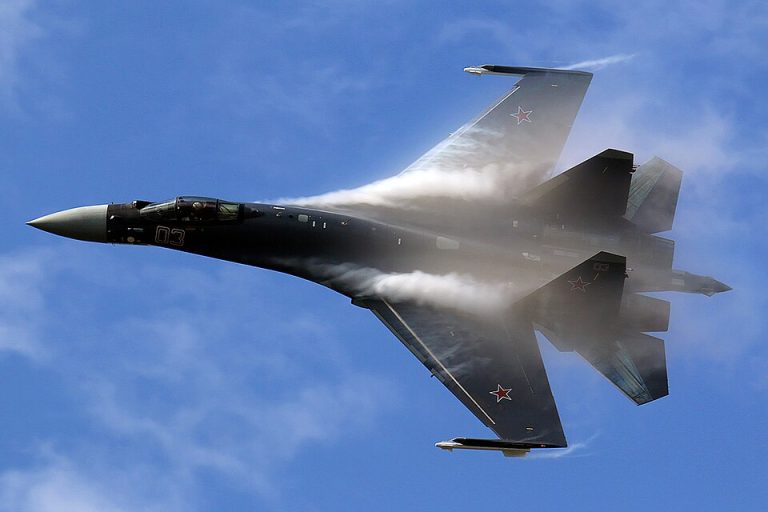
Russia has begun manufacturing Su-35S fighter jets for Iran, a move that could strengthen Tehran’s air force and potentially shift the military balance in the Gulf by 2027, according to sources cited by Malaysia-based defense news outlet Defense Security Asia.
The publication, citing sources close to the Islamic Republic of Iran Air Force (IRIAF), reported that Russia had completed 17 of the 30 aircraft ordered by April. That number is expected to reach between 19 and 20 by the end of July.
According to the report, production at the Komsomolsk-on-Amur Aviation Plant (KnAAZ), Russia’s primary Su-35 manufacturing facility located in the Far Eastern region of Siberia, has continued despite the demands of the Russia-Ukraine war.
Russia has been confirmed to have lost at least 8 Su-35s in the war, while Ukraine claims its forces have downed triple that number.
Iran’s air force continues to rely heavily on aging U.S.- and Soviet-era aircraft, including the F-4 Phantom II, F-14 Tomcat, and MiG-29. The addition of the Su-35 fleet is expected to mark a significant step in modernizing the country’s combat aviation capabilities.
Success
You are now signed up for our newsletter
Success
Check your email to complete sign up
The Su-35, an upgraded model of the Su-27 family of aircraft originally built by the Soviet Union, is roughly comparable in design and role to the later versions of the American F-15 fighter jet.
RECENT COVERAGE
- US Removes Four Indian Companies From Russia-Related Sanctions List as Trade Deal Nears
- Cuba’s Reform Agenda Faces New US Pressure After Latest Sanctions
- Indonesia and China Expand Push to Reduce US Dollar Dependence, Tout Program’s Success
Russian military and tech news outlet First Technical described the contract as the largest military-technical agreement between Tehran and Moscow in recent years.
However, Defense Security Asia reported that the aircraft are not expected to enter operational service immediately because of damage sustained at Hamadan Air Base, also known as Shahid Nojeh Air Base.
According to Iran War Attrition, a report published by aviation publication Key.AERO, Iran lost three F-4E Phantom II aircraft in an attack on Nojeh Air Base at an unspecified date after March 22 during the recent U.S.-Iran conflict.
As a result, the report said, the newly built Su-35s destined for Iran are expected to remain in Russia until the necessary infrastructure is restored. Moscow is expected to complete production of all 30 aircraft by early 2027.
Before the conflict, Hamadan Air Base was expected to serve as the main operating base for Iran’s Su-35 fleet because of its strategic location near the country’s western border with Iraq.
According to First Technical, the Su-35 could significantly improve Iran’s air combat capabilities. Classified as a “4++ generation” fighter, the aircraft features high maneuverability, long-range radar detection, and the ability to carry modern long-range air-to-air missiles.