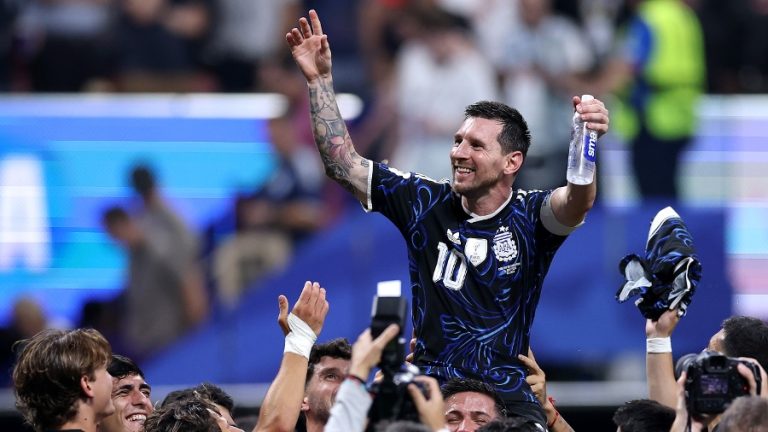
Argentina defeated England 2–1 in the semifinal of the 2026 FIFA World Cup on July 15, advancing to the World Cup final for the second consecutive tournament. The victory also preserved one of the nation’s most remarkable World Cup records: whenever Argentina reaches the semifinals, it always advances to the final.
Argentina has now reached the World Cup semifinals six times, and on every occasion has gone on to play for the championship, maintaining a perfect 100 percent conversion rate.
Argentina’s captain Lionel Messi once again proved decisive, recording two crucial assists. He first helped set up the equalizer before creating the winning goal.
With that, another chapter in one of football’s greatest rivalries came to an end.
Anyone familiar with World Cup history knows this was far from the first meeting between England and Argentina. Whenever the two nations have met in a major tournament, the story has extended well beyond ninety minutes on the pitch.
Success
You are now signed up for our newsletter
Success
Check your email to complete sign up
It is a rivalry spanning six decades—one involving the “Hand of God,” two generations of football legends, political conflict, a real shooting war, revenge, redemption, and national pride.
The story begins at Wembley in 1966.
1. The battle of Wembley (1966)
The 1966 World Cup was held in England, and the hosts faced Argentina in the quarterfinals.
In the 35th minute, Argentina captain Antonio Rattín angrily protested West German referee Rudolf Kreitlein’s decisions. After receiving two cautions, he was sent off.
Unable to understand German, Rattín refused to leave the field. The match was delayed for nearly ten minutes as he argued with officials. At one point he sat on the red carpet reserved for Queen Elizabeth II as a symbolic protest before eventually being escorted away. Argentina ultimately lost 1–0.
The controversy continued after the final whistle. England manager Alf Ramsey stormed onto the pitch to prevent his players from exchanging jerseys with the Argentinians and later referred to the Argentine players as “animals.”
In Argentina, the match became known as “The Robbery of the Century,” with many South Americans believing that officiating throughout the tournament systematically favored European teams.
Ironically, the controversy eventually led to one of football’s greatest innovations—the introduction of the yellow and red card system.
England defender Jack Charlton had been cautioned during the match but didn’t realize it until reading the newspapers afterward because of language barriers between the referee and players.
That incident inspired FIFA referees committee chairman Ken Aston. While driving through London after the match, he stopped at a traffic light. Watching it change from yellow to red, he realized that the same universally understood color system could eliminate confusion in football.
FIFA adopted the idea, and yellow and red cards officially debuted at the 1970 World Cup in Mexico.
2. The Falklands War (1982)
If the 1966 match represented a war of words, sixteen years later Britain and Argentina fought a real war.
The Falkland Islands (called the Malvinas Islands in Argentina) had long been administered by Britain, while Argentina claimed sovereignty over them.
In 1982, Argentina was under military rule and suffering severe economic problems. Hoping to rally public support, the junta invaded the Falkland Islands on April 2.
The initial occupation sparked celebrations in Buenos Aires.
Britain’s Prime Minister Margaret Thatcher responded forcefully, dispatching a naval task force over 8,000 miles to the South Atlantic.
After 74 days of fighting, British forces recaptured the islands on June 14, and Argentina surrendered.
The war transformed politics in both countries.
In Britain, Thatcher’s popularity surged, helping secure a landslide election victory in 1983.
In Argentina, military leader Leopoldo Galtieri resigned, and the military dictatorship soon collapsed.
The scars left by the conflict ran far deeper than any football match.
3. The ‘Hand of God’ and the Goal of the Century (1986)
Four years after the Falklands War, England and Argentina met again in the quarterfinals of the 1986 World Cup in Mexico City.
The match became one of the most legendary in football history.
In the 51st minute, Diego Maradona jumped alongside England goalkeeper Peter Shilton and punched the ball into the net with his left hand. The referee failed to spot the handball, and Argentina took a 1–0 lead.
Only minutes later, Maradona produced what is widely regarded as the greatest goal ever scored.
Collecting the ball inside his own half, he dribbled past five England players and the goalkeeper before scoring. The goal would forever be known as the “Goal of the Century.”
Argentina won 2–1 and eventually captured the World Cup.
After the match, Maradona famously described the opening goal as being scored “a little with the head of Maradona and a little with the hand of God.”
The phrase “Hand of God” immediately entered football history.
Maradona later admitted in 2005 that he had deliberately used his hand, but he never apologized to England. Perhaps, in his mind, the wounds left by the Falklands War had never truly healed.
4. Beckham’s costly mistake (1998)
Twelve years later, England and Argentina met again in the Round of 16 at the 1998 World Cup in France.
Early in the second half, 23-year-old David Beckham was fouled from behind by Argentina captain Diego Simeone.
As Beckham got up, he flicked his leg toward Simeone.
Simeone dramatically collapsed, and referee Kim Milton Nielsen immediately showed Beckham a red card.
Reduced to ten men, England eventually lost on penalties.
Back home, Beckham endured years of relentless criticism. British newspapers vilified him, and some pubs even burned effigies of the midfielder.
In the 2023 Netflix documentary Beckham, David Beckham described the period as the hardest time of his career, while his wife Victoria Beckham said he had been “completely broken.”
Years later, Simeone admitted that he had exaggerated the incident and had, to some extent, lured Beckham into the trap.
5. Redemption in Sapporo (2002)
England and Argentina met again during the group stage of the 2002 World Cup in Japan.
This time, Beckham found redemption.
Just before halftime, Michael Owen was fouled inside the Argentine penalty area.
Beckham calmly converted the penalty, giving England a 1–0 victory.
It was England’s first World Cup win over Argentina since 1966.
For Beckham, the goal erased much of the pain he had endured four years earlier.

More than a football rivalry
From Alf Ramsey’s “animals” remark at Wembley in 1966, to the birth of the yellow and red card system, from the real gunfire of the Falklands War, to Maradona’s “Hand of God,” and finally Beckham’s fall and redemption, England and Argentina have spent six decades intertwining football, politics, war, national identity, revenge, and redemption.
That is why every World Cup meeting between the two nations has been far more than just another football match.
Whenever England and Argentina face one another on football’s biggest stage, they are not simply playing ninety minutes of football—they are reliving decades of shared history.