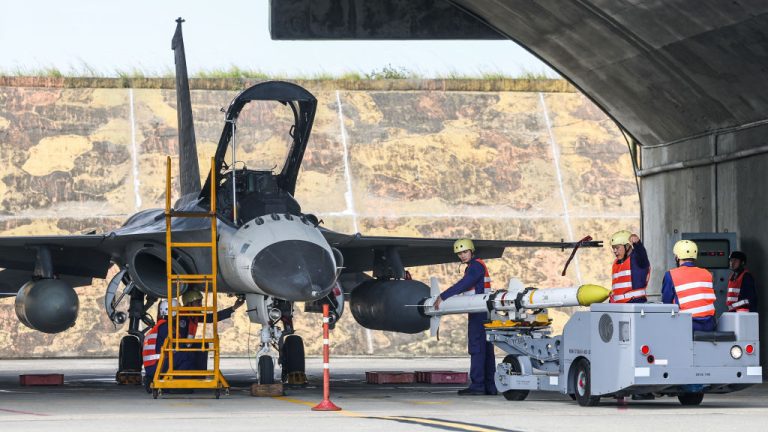
On Feb. 26, Beijing prepared a live-fire exercise area near Taiwan without any warning, threatening security risks to the island’s transportation in the sea and air.
According to Taiwan’s ministry of defence, the exercise area was set up around 40 nautical miles (75 km) off the coast of the Taiwanese port city of Kaohsiung.
The ministry decried Beijing, saying the communist government “blatantly violated international norms by unilaterally designating” the area. Taiwan’s naval, air and land forces were deployed right away to watch over the zone as soon as they learned of its existence via “temporary radio broadcast” across the area.
“This move not only poses a high risk to the navigation safety of international flights and ships at sea, but is also a blatant provocation to regional security and stability,” the ministry warned.
In the 24 hours leading up to Feb. 26, 32 Chinese aircraft were spotted around Taiwan taking part in the drills; twenty-two of which flew over the median line of the Taiwan Strait, which divides the island and the Chinese mainland.
Success
You are now signed up for our newsletter
Success
Check your email to complete sign up
Overall, Taiwan’s military detected 45 Chinese aircraft and 14 naval vessels around the island. Seven ships were seen in the exercise zone.
The day before, a Chinese tanker ship, registered in Togo, was caught by the Taiwan Coast Guard, and was suspected of severing a communications cable near Taiwan. However, no evidence was found that it was conducting Beijing’s “gray zone” tactics.
However, two senior Taiwanese officials told Reuters that there was no live-fire shooting conducted in the zone.
By the end of Feb. 26, Chinese vessels began leaving the live-fire exercise zone near Kaohsiung, Taiwan’s defense ministry told Radio Free Asia (RFA). The island government added that its military “will continue to monitor the developments in the surrounding sea and airspace, and dispatch appropriate troops to be on alert and respond.”
READ MORE:
- Japan to Allow Residents to List Their Nationality as ‘Taiwan’ on Family Register
- Shen Yun Responds to Bomb Threat at Kennedy Center as CCP Steps Up Intimidation Campaign
- US Overtakes China to Become Germany’s Biggest Trading Partner for First Time in 9 Years
China watches on
On Feb. 27, Beijing’s defence ministry said the drills were “routine”, adding that the Taiwanese government “should stop complaining,” Reuters wrote.
The ministry’s spokesman, Wu Qian, said in a news briefing that Taiwan was just looking for attention.
“The relevant Taiwan authorities’ comments on the People’s Liberation Army’s (PLA) routine exercises are hype, and we require them to stop playing tricks for more attention,” he said.
However, upon Taiwan’s expansion of its military exercises, Wu Qian warned Taiwan that “we will come and get you, sooner or later,” the Guardian reported. The threat seemed to parallel a line spoken in the Chinese animated blockbuster, Ne Zha 2.
“It is a serious miscalculation of the situation, the public opinion and the comparison of strength,” Wu said. “Overreaching itself in such a way is extremely dangerous. We warn the [Democratic Progressive Party] authorities that holding back the tide with a broom will only end up in self-destruction. We will come and get you, sooner or later.”
Taiwan’s defence ministry has named communist China the biggest “troublemaker” in the world, and has emboldened its defence against a potential invasion.
“The actions of the communist military in recent years are repeating the mistakes of the invaders and pushing China towards defeat.”
Bill Bishop, a China expert working for the Sinocism newsletter, said on Feb. 28 that China’s stance against Taiwan “appears to be getting harsher,” warning that the readout of 2025’s Taiwan affairs work conference did not include promoting “the peaceful development of cross-strait relations;” something that had been a part of the readouts of the last two years.
Volleys in international waters
The recent live-fire area’s establishment was not the first in the past week. On Feb. 24, Beijing fired live ammunition in the Gulf of Tonkin, days after the Vietnamese government established its territory in the gulf.
On Feb. 21, a flotilla of Chinese warships fired into the Tasman Sea before conducting another exercise near New Zealand the day after. The exercises forced commercial flights between Australia and New Zealand to be cancelled. Both of these drills came out of nowhere for the Australian government who called them out, though the drills were made in international waters.
China’s defence ministry called Australia’s complaints “hyped up” and “inconsistent with the facts.”
Carl Thayer, emeritus professor at Australia’s University of New South Wales, believes that China’s recent exercises were a blatant act of saber rattling — the threat of military force — as well as a test to the U.S. government.
“Given China’s continued bullying of the Philippines, Beijing is sending a message to regional states as well as the Trump Administration that Beijing will defend its sovereign rights and interests whenever they are challenged,” Thayer told RFA.