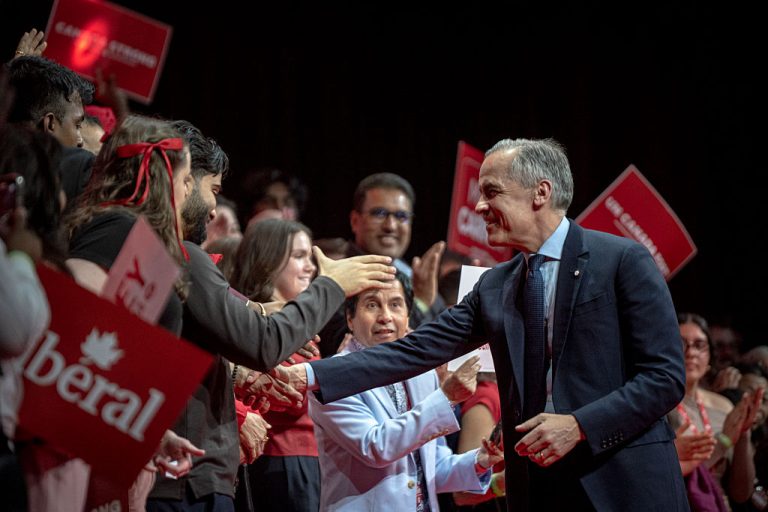
On April 28, Canadians elected a Liberal minority government, marking a fourth consecutive term for the party and a successful first campaign for its new leader, and Canada’s Prime Minister, Mark Carney. The result dealt a significant blow to the opposition, with their leader, Pierre Poilievre, losing his seat, casting uncertainty over the future of his party, the Conservative Party of Canada (CPC).
Canada’s federal elections use a First-Past-the-Post system, where voters in 343 ridings elect Members of Parliament (MPs). The party with the most seats usually forms the government. To form a majority, a party needs 172 seats. If no party wins a majority, a minority government is formed, which requires support from other parties to pass legislation. Whoever leads the party with the most seats serves as Canada’s Prime Minister.
As of April 29, Canada’s Liberal party has been elected in 155 ridings and is leading in an additional 13, giving the party 168 seats, the most of any other party. This will allow the Liberals to form a minority government, led by party leader, Mark Carney, as Prime Minister.
Conservative Party candidates were elected in 133 seats and are leading in 11 additional ridings, giving them a total of 144 seats, making them the official opposition. In a major upset, CPC leader Pierre Poilievre failed to secure his seat in a riding in Canada’s capital, Ottawa, leaving the party in a difficult position. Poilievre will not be able to sit in Parliament during the next session unless he is elected to a seat. It remains unclear whether he will continue to lead the party.
The Bloc Québécois, a federal party confined to the French speaking province of Quebec with deep separatist roots, secured a total of 23 seats, and the New Democrat Party (NDP) lost official party status after failing to secure at least 12 seats.
Success
You are now signed up for our newsletter
Success
Check your email to complete sign up
Jagmeet Singh, who has led the NDP in three consecutive elections, immediately resigned as leader of the party following his party’s defeat and significant loss of seats.
As final votes are tallied, there is a slim possibility that the Liberals could walk away with an additional four seats, allowing them to form a majority government, however this appears unlikely.
READ MORE:
- US Could Replace China’s Rare Earth Supply, But Building the Infrastructure Would Take Years
- Nations, Markets Brace as Trump Announces ‘Liberation Day’ US Global Tariffs
Trump’s impact
United States President Donald Trump’s rhetoric around Canada becoming the country’s 51st state is being largely blamed for reversing month’s long polls indicating a strong conservative majority result.
Just four months ago, Poilievre’s CPC, was poised to easily defeat the Liberals, and its then leader, Justin Trudeau, and form a majority government, but that all changed following Trump’s continuous comments about Canada becoming the 51st state and the election of a new Liberal leader, Mark Carney.
Trump’s comments galvanized Liberal voters behind Carney, who framed himself as the only choice for Canadians who want to oppose Trump’s calls to annex their country, and his tariff war.
Trump’s comments continued right up until election day, with him posting to his social media platform, Truth Social, “Elect the man who has the strength and wisdom to cut your taxes in half, increase your military power, for free, to the highest level in the World, have your Car, Steel, Aluminum, Lumber, Energy, and all other businesses, QUADRUPLE in size, with ZERO TARIFFS OR TAXES, if Canada becomes the cherished 51st State of the United States of America.”
He added, “America can no longer subsidize Canada with the Hundreds of Billions of Dollars a year that we have been spending in the past. It makes no sense unless Canada is a State!”
Poilievre immediately responded, posting to X, “The only people who will decide the future of Canada are Canadians at the ballot box. Canada will always be proud, sovereign, and independent, and we will NEVER be the 51st state. Today, Canadians can vote for change so we can strengthen our country, stand on our own two feet, and stand up to America from a position of strength.”
READ MORE:
- ‘A Beautiful Production’: Shen Yun Delivers Awe-Inspiring Performances in Pittsburgh
- US Could Replace China’s Rare Earth Supply, But Building the Infrastructure Would Take Years
- ‘Never Make a Deal With the Devil’: How the CCP’s Trade War Is Costing American Consumers
Who is Mark Carney?
Mark Carney, who attempted to portray himself as an outsider immediately following his candidacy for Canada’s Prime Minister, played a significant role in Justin Trudeau’s government.
In August 2024, Prime Minister Justin Trudeau appointed Carney as a special economic advisor to the Liberal Party. In this role, he provided strategic advice on economic policy to address Canada’s affordability crisis, including high inflation and cost-of-living challenges.
Carney’s name had been quietly floated as a potential successor to Trudeau since 2023, especially as Trudeau’s approval ratings plummeted.
He was first elected to the Prime Minister role by a majority of Liberal party members on March 9, 2025, following Trudeau’s resignation.
From 2008 to 2013 Carney served as the Governor of the Bank of Canada and from 2013 to 2020 he was the first non-Briton to hold the role of Governor of the Bank of England.
“Mark Carney is the outstanding central banker of his generation,” George Osborne, former UK Chancellor of the Exchequer, said when Carney was appointed to the Bank of England in 2012.
Matthew Lynn, from The Daily Telegraph, criticized Carney’s tenure, blaming him for the country’s high inflation.
“Over eight years at the Bank of England, Carney was at best an indifferent governor, and, at worse, a disappointing failure,” Lynn commented
In 2014, Labour MP Pat McFadden said Carney “was a man who promised much and delivered very little.”
Carney is also a prominent advocate for addressing climate change, emphasizing its economic and financial implications. He advocates for urgent action and a transition to a net-zero economy.
“The tragedy of the horizon – the catastrophic impacts of climate change – will be felt beyond the traditional horizons of most actors, imposing costs on future generations that the current generation has no direct incentive to fix,” Carney said in his speech in 2015, “Breaking the Tragedy of the Horizon” at Llyod’s of London.