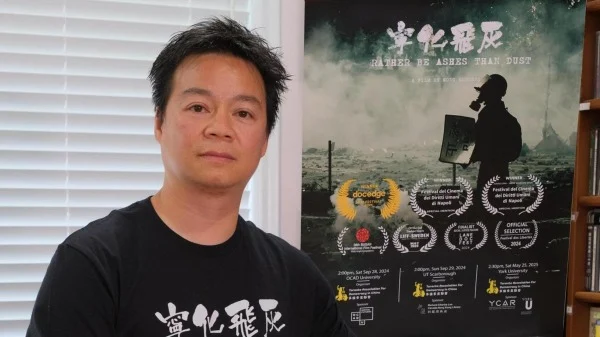
As the 36th anniversary of the Tiananmen Square massacre is commemorated across Canada, Hong Kong director Alan Lau’s documentary “Rather Be Ashes Than Dust” is drawing powerful attention to the modern-day echoes of that tragedy. On May 25, the film had its third Toronto screening, with tickets selling out quickly.
The 114-minute documentary — distilled from over 1,000 hours of footage — captures the heart-wrenching descent of Hong Kong from a city of freedom into a bastion of repression under Beijing’s tightening grip.
“I haven’t watched the film once since finishing the edit,” Lau told Vision Times in an exclusive interview. The photojournalist-turned-director carries emotional wounds as deep as the city he chronicled.
Bearing witness
Lau, who now lives in the UK, began documenting the 2019 anti-extradition protests when Hong Kong’s proposed bill sparked widespread unrest. “When the extradition bill was proposed, many were dissatisfied and started protesting. As a filmmaker, I asked myself what I could do,” he said.
Initially hired by a German media outlet to document the street protests, Lau found himself filming for three years, eventually accumulating over 1,000 hours of frontline footage. He captured harrowing scenes of violence and state crackdown that, once edited into a feature-length documentary, would become a living archive of the city’s transformation.
Success
You are now signed up for our newsletter
Success
Check your email to complete sign up
“I poured my experiences and emotions into this film,” Lau explained. “A free city was destroyed by a dictatorship in just six months to a year.” Once a haven of free speech where “you could post anything on Facebook,” Hong Kong rapidly became a place where dissent was criminalized. Through his work, Lau hopes to preserve the memory of what Hong Kong was — and what it lost. “Freedom isn’t guaranteed. As someone who’s lived through this, I know how precious it is.”
Behind the lens
The film’s title comes from a quote by American writer Jack London, once referenced by the last British Governor of Hong Kong, Chris Patten: “The function of man is to live, not to exist.” For Lau, the phrase reflects both the protesters’ spirit and his own purpose.
“This captures the protesters’ spirit and my hopes for Hong Kong’s future. We’re scattered across the world, and this film tells future generations what happened in Hong Kong and why we fled,” he said. “We must use our freedom and time to do what matters, not waste life.”
Lau didn’t just document the protests; he lived them. For three years, he dodged rubber bullets, tear gas, and chemically-laced water cannons. “The water wasn’t normal — it was blue or clear, full of chemicals that caused redness and itching,” he recalled. But it was the psychological trauma that cut deepest.
RELATED: Convictions of Tiananmen Vigil Group Dropped by Hong Kong Court
“Every day, I saw people detained, shouting their names and ID numbers into my camera, hoping lawyers could find them,” Lau said. “If I recorded but couldn’t help, I felt immense pressure. That was the deepest trauma.”
One particularly haunting moment was when he live-streamed a couple being arrested. “I couldn’t warn them to run because I was broadcasting. I felt so guilty and cried for a long time.” Another involved a teenage boy shot in the chest. “Just 3 millimeters from his heart, nearly fatal,” Lau said. “In the West, police don’t shoot live rounds at protesters. But Hong Kong became that kind of city.”
At one point, Lau even wrote a will. “I was scared of being shot, of not surviving,” he admitted. “But I saw elderly people with canes and school kids on the streets. I’m in my 30s with a camera—why should I be afraid?”
Drawing from experience
In 2021, Lau left Hong Kong with his footage and began editing in the UK. But revisiting those scenes triggered severe post-traumatic stress. “I could only watch a few minutes a day. My heart raced, my emotions were unstable,” he said. “Sometimes I’d just sit somewhere, staring into space for a whole day.” It took two years to complete the edit.
Even now, Lau avoids viewing the finished product. “During screenings, I stay outside, drinking coffee or chatting, only entering for Q&A sessions,” he said. And yet, the film’s impact is undeniable. “A Toronto viewer said watching it made him feel he wasn’t alone in his PTSD. The film creates a spiritual connection—that’s the power of cinema.”
Lau tried therapy but found it difficult to explain his trauma to Western doctors. A return visit to Hong Kong for counseling only reopened old wounds. “As soon as I stepped out of the subway, images from 2019 — gunshots here, arrests there — flooded back,” he said. “I didn’t even talk. I just cried for 30 minutes of the 35-minute session.”
Remembering Tiananmen — and Hong Kong
“Rather Be Ashes Than Dust” has been screened in South Korea, Australia, Germany, the U.K., and Canada, with more showings planned for Taiwan and Japan. “This film is part of the 36th Tiananmen anniversary events. Hong Kong’s history is inseparable from Tiananmen,” Lau said. He used to attend the annual Tiananmen vigil in Victoria Park — a tradition now banned in Hong Kong. “In free spaces overseas, we must stand up and remember history.”
To Lau, the Chinese Communist Party’s tactics haven’t changed since 1989. “Whether it’s Tiananmen or the Hong Kong protests, the CCP uses the same methods to suppress dissent, only more ruthlessly,” he said. “They don’t want different voices. But if a regime is so fragile, it should reflect on why.”
A message for the next generation
Lau knows that many young people in Hong Kong today live in fear. “People are afraid to speak in group chats. The government creates fear with anonymous tip lines,” he noted. But his message is clear: “Live well, don’t forget our original intent, and stay resolute in our beliefs.”
“This film is my way of refusing to self-censor,” he said. “We must tell future generations what happened and why we left.” With “Rather Be Ashes Than Dust,” Alan Lau ensures that the struggle for Hong Kong’s freedom is not forgotten—but remembered, felt, and passed on.